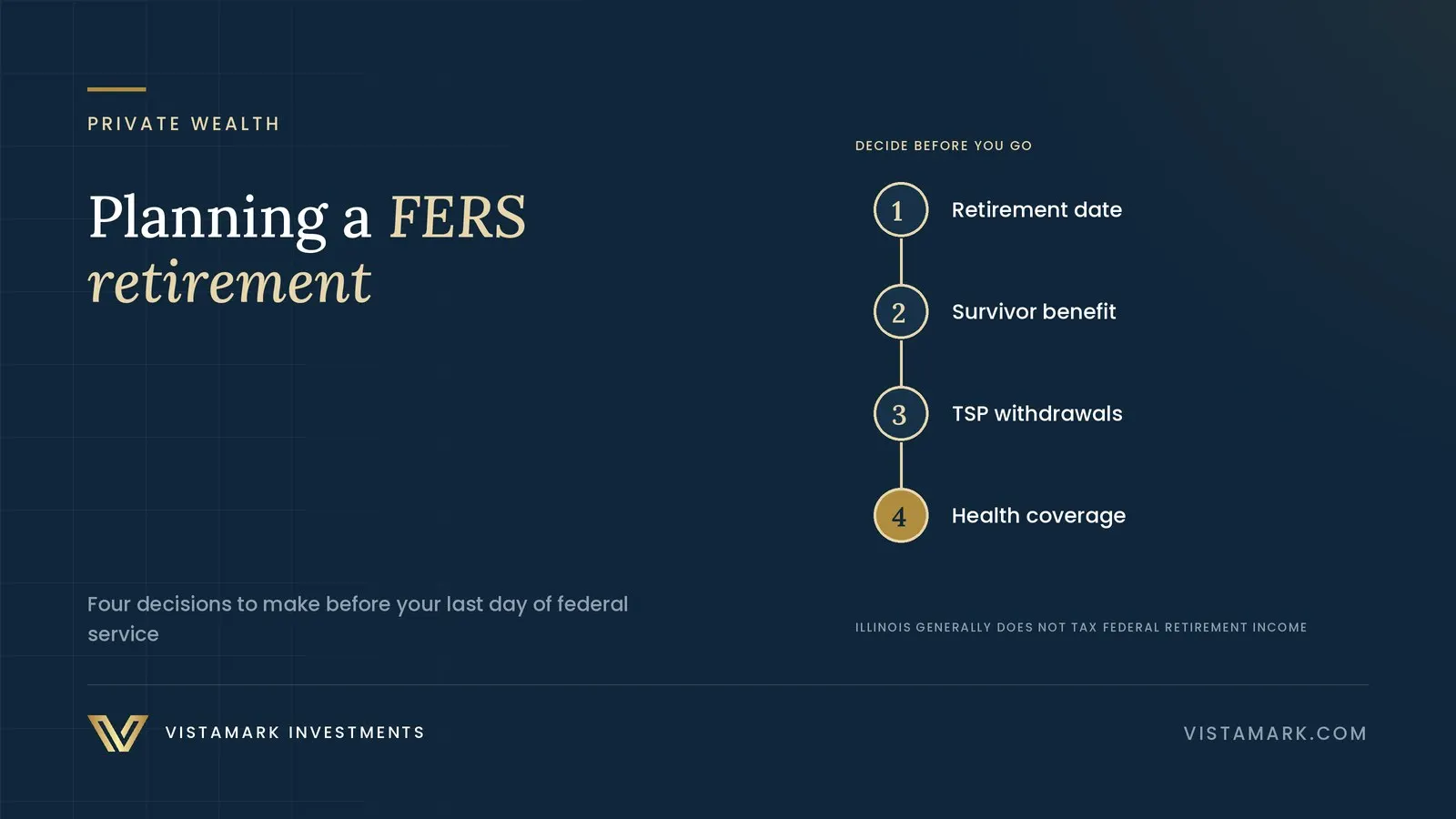
The short answer. A FERS retirement rests on four decisions you make before your last day of service: when to retire, which survivor benefit to elect, how to draw on the Thrift Savings Plan and how to keep your health coverage. The date you choose can change your pension by thousands of dollars a year for life. And because Illinois generally does not tax federal retirement income, a Chicago-area retiree who stays in Illinois keeps more of each payment than many expect.
How is the FERS pension calculated?
The FERS basic annuity is 1% of your high-3 salary for each year of service. If you retire at 62 or older with at least 20 years, the rate rises to 1.1%. Your high-3 is the highest average basic pay you earned during any three consecutive years, not counting overtime or bonuses (OPM).
The difference is easy to underestimate. With a high-3 of $150,000 and 30 years of service, retiring at 62 pays about $49,500 a year (1.1% × 30 × $150,000). Retiring at 60 with the same service pays about $45,000 (1% × 30 × $150,000), though the earlier retiree also collects two more years of payments and the FERS supplement until 62.
Retiring at your minimum retirement age with 10 to 29 years of service (the MRA+10 option) reduces the annuity by 5% for each year you are under 62, unless you have 20 years and start the annuity at 60. Postponing the start date can reduce or remove that cut (OPM).
What is the FERS supplement, and who gets it?
The FERS supplement, also called the special retirement supplement, approximates the Social Security benefit you earned during federal service and is paid until 62, the earliest age you can claim Social Security. A rough estimate: your projected Social Security benefit at 62, divided by 40, times your years of FERS service. It is not paid to MRA+10 retirees or to anyone retiring at 62 or later, and it is subject to an earnings test, so income from a second career can reduce it to zero. The basic annuity is not affected by that test (FEDweek).
How should you use the Thrift Savings Plan before and after you retire?
For 2026, you can defer up to $24,500 into the TSP, plus an $8,000 catch-up from age 50. Participants aged 60 to 63 can make a larger $11,250 catch-up instead. Under a new rule, employees whose prior-year wages exceeded $150,000 must make catch-up contributions as Roth contributions (Kiplinger).
In retirement, the TSP becomes the flexible part of your income. Decide how much to draw each year, and in what order relative to the pension and Social Security, before you separate. The TSP’s low costs are a reason to keep money there; the need for more investment choice, consolidated reporting or coordination with a spouse’s accounts can be reasons to move some of it. Compare the costs and the planning before you roll anything over.
How do you keep health insurance in retirement?
To carry FEHB coverage into retirement, you generally must have been continuously enrolled for the five years of service immediately before your annuity starts, or for all of your service since your first chance to enroll if that is shorter (OPM). Check this well before your retirement date; it cannot be fixed afterward. This year’s Federal Benefits Open Season runs from November 9 through December 14, 2026, for 2027 coverage (OPM). At 65, decide with your plan’s rules in hand whether to enroll in Medicare Part B alongside your federal coverage.
Which survivor benefit should you elect?
If you are married, your pension is reduced to provide a survivor annuity unless your spouse consents to less. A survivor benefit of 50% of your annuity reduces your own annuity by 10%; a survivor benefit of 25% reduces it by 5% (OPM). For many couples the full survivor benefit is worth its cost, in part because a surviving spouse generally needs a survivor annuity to keep FEHB coverage. Compare it with life insurance only after checking that consequence with your benefits office.
Does Illinois tax FERS pensions and TSP withdrawals?
Generally, no. Illinois lets residents subtract federally taxed income from government retirement plans, qualified employer plans and IRAs, as well as Social Security, from their Illinois income (Illinois Department of Revenue). Federal income tax still applies. That makes Illinois friendlier to federal retirees than its 4.95% income tax suggests, and it is worth weighing before moving to another state for tax reasons; our article Should You Change Your State of Residence to Cut Taxes? covers the questions to ask.
What should you do in the year before you retire?
- Get an annuity estimate from your agency and check your service history for gaps, including military or temporary service that may need a deposit to count.
- Compare two or three retirement dates: the effect on the 1% or 1.1% rate, the MRA+10 reduction and the supplement.
- Confirm five years of continuous FEHB enrollment, and your FEGLI choices.
- Decide the survivor election with your spouse.
- Write a withdrawal plan for the TSP that fits around the pension, the supplement and Social Security.
- Coordinate federal tax withholding on the pension and TSP so the first year in retirement brings no surprises.
Where does Vistamark fit?
The VistaWealth Office is Vistamark’s private wealth practice. For federal employees and retirees, it builds one plan around the pension, the TSP, Social Security and any other savings, coordinated with your tax advisor. Vistamark is independent and 100% employee- and partner-owned, has no minimum, and charges one advisory fee, asset-based or flat, described on Our fees. Agency benefits offices and OPM make the official determinations on your annuity and benefits.
Sources
- U.S. Office of Personnel Management — FERS Computation
- U.S. Office of Personnel Management — FEHB Reference: Annuitants
- U.S. Office of Personnel Management — 2026 Federal Benefits Open Season announcement
- FEDweek — Special Retirement Supplement
- Kiplinger — Thrift Savings Plan Contribution Limits for 2026
- Illinois Department of Revenue — Social Security Benefits and Certain Retirement Plans
Market Compass · weekly
Get the Compass by email
One concise recap of the week’s market-moving events and what to watch next, written by our CIO at the end of each market week.

Managing Partner and Founder; advises families, business owners and family offices through the VistaWealth Office™ and leads Vistamark’s private markets research. More about Sean →
This article is for informational and educational purposes only and does not constitute investment, legal, tax or accounting advice, or an offer or solicitation to buy or sell any security. Views are those of the author as of the publication date and are subject to change. Vistamark Investments is an SEC-registered investment adviser; see our disclosures.