
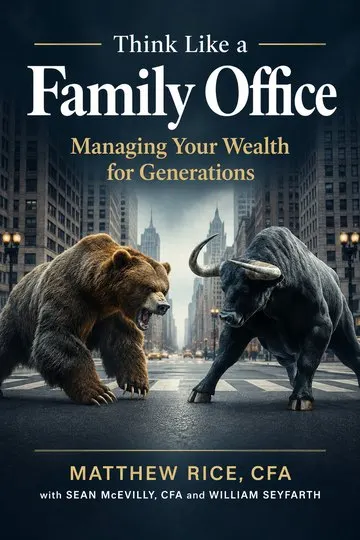
Free self-assessment · PDF · from the book
Does your family think like a family office?
Fifty yes-or-no questions — Appendix B of Think Like a Family Office — covering investment policy, spending, the tax lens, managers and private markets, concentrated positions, governance, the rising generation and continuity. Score it at the family meeting and let every “no” nominate itself as next year’s project.
- Binary on purposeA policy that exists in someone’s head, a review that happens most years, a document the custodian probably has — these are noes. The test measures what is written, signed, scheduled and rehearsed.
- Keyed to the bookEvery question names the chapter that earns the yes, so the gaps come with a reading list.
- Scored in the only terms that matterForty or more: the family thinks like a family office, whatever its size. Below twenty-five: welcome — every family in the book once scored exactly there.
Companion reading: About the book · The five families — case studies from the book · The VistaWealth Office™ · Private wealth & family office insights
Also free
Other guides and templates
PDF · 2 pages
Ten Questions to Ask an OCIO
A committee’s guide to evaluating outsourced CIO and investment consulting proposals — what to ask, why it matters, what a good answer…
Word · editable
OCIO & Investment Consultant RFP Template
An editable request for proposal for foundations, endowments, nonprofits, retirement plan committees, RIAs and bank trust departments…
A preview: three of the fifty questions
Every question is answered yes or no and names the chapter of the book that earns the yes. Three of them:
- Is there a signed, dated investment policy statement a competent outsider could run the portfolio from for a year?Part I, The Foundations · Chapter 1
- Is there a written spending policy with a stated all-in rate, a corridor, and a bear-market cut sequence?Part I, The Foundations · Chapter 3
- Is the callback rule — verify every wire at a known number, dual approval above a threshold — absolute, with no urgency exception?Part V, Running the Enterprise · Chapter 19
The full self-assessment has fifty questions in seven parts and a scoring guide. Get the self-assessment →