Integrated CIO (iCIO™) · noun
Vistamark Investments’ proprietary outsourced chief investment officer platform and philosophy.
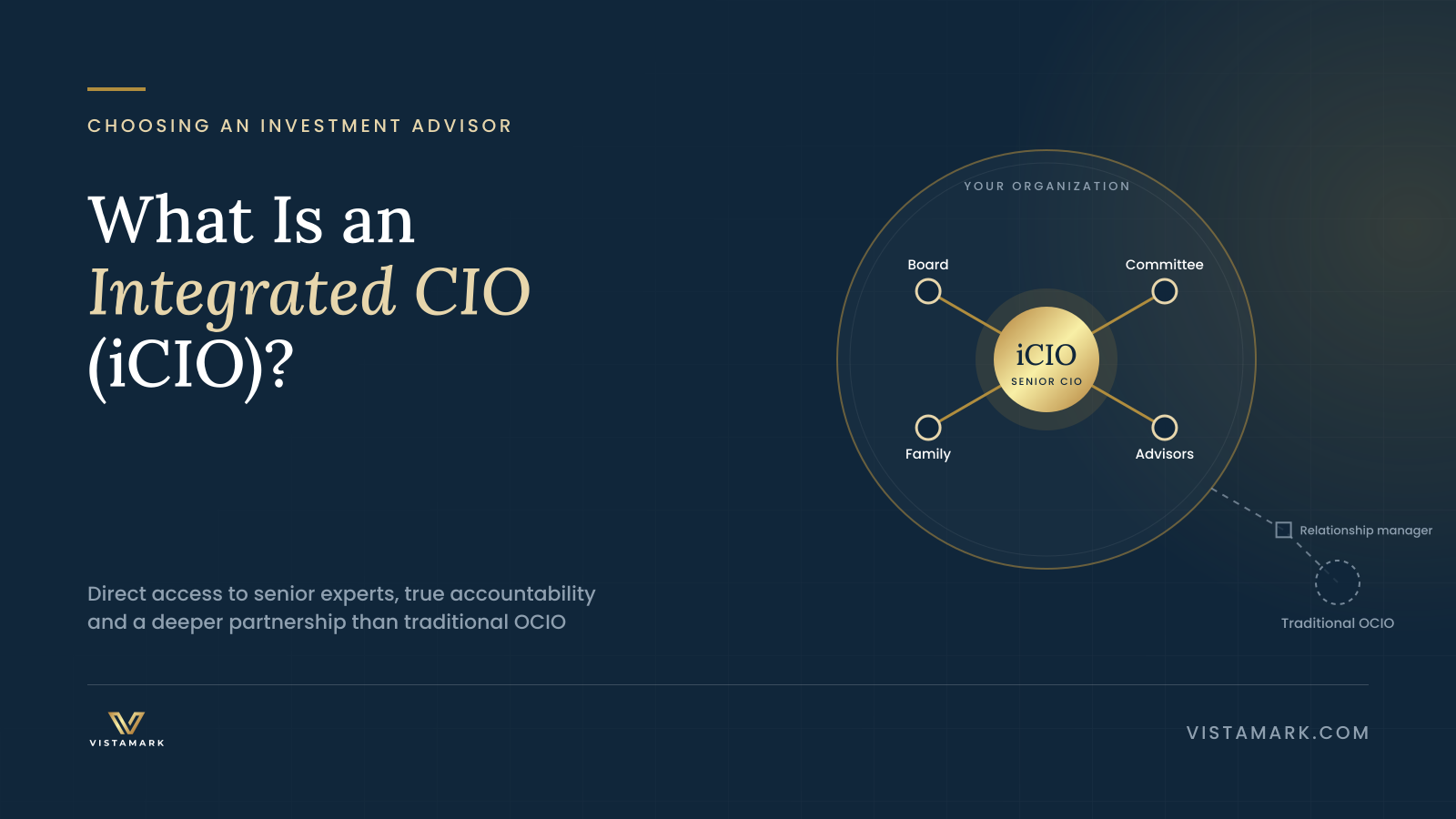
Integrated CIO (iCIO) is Vistamark’s high-touch, fully integrated approach to outsourced investment management. It delivers the strategic oversight, discipline, and expertise of an institutional chief investment office, embedded directly within a client’s own governance, decision-making, and long-term objectives. Unlike traditional OCIO arrangements that separate the client from the people managing their capital, iCIO is built on direct access to senior investment professionals, clear accountability for outcomes, and a partnership that functions as a true extension of the client’s own team.
Integrated CIO and iCIO are trademarks of Vistamark Investments, which provides the service to registered investment advisers, multi-family offices, bank and trust-company wealth divisions, family offices, foundations and endowments. This page explains what the model is, how it differs from the alternatives, and how to decide whether it fits.
The CIO you have, not the one you’re assigned
The traditional OCIO model was built for scale. Too often, clients get a relationship manager instead of a decision-maker, a quarterly report instead of a conversation, and a process designed around the provider rather than the portfolio.
Integrated CIO is Vistamark’s answer: a fully integrated outsourced chief investment officer platform defined by three commitments.
- Direct access to the experts. You work with the senior professionals who build and manage your portfolio, not intermediaries relaying their views. When markets move or your needs change, the people making the decisions are the people you talk to.
- True accountability. Ownership is clear. Every recommendation, allocation, and outcome traces back to identifiable decision-makers who stand behind their work and answer for results.
- A deeper partnership. iCIO integrates with your board, investment committee, family, or leadership team, aligning to your governance, mission, and time horizon. We function as an extension of your organization, not a vendor serving it.
The result is institutional-caliber investment management with the responsiveness, transparency, and personal commitment that the conventional OCIO world rarely delivers.
How is an Integrated CIO different from a traditional OCIO?
Both give an organization access to an investment office it does not have to build. The difference is where the investment officer sits and how many relationships that person carries.
| Model | Where the work happens | Who sits with your committee | What you are buying |
|---|---|---|---|
| Integrated CIO | Inside your organization: your committee, your advisor meetings, your client conversations, on site where that helps | A named senior CIO who serves a limited number of clients | An investment office that behaves like your own, under your brand if you choose |
| Traditional OCIO | Mostly at the provider, delivered through reports, calls and periodic meetings | A relationship manager, often supported by a central team covering many clients | Outsourced portfolio management, usually discretionary |
| TAMP or model marketplace | On a platform | Usually no one | Administration and a shelf of model portfolios |
| In-house CIO | Inside your organization | Your own employee | Full control, with the full cost of salaries, research, data and continuity |
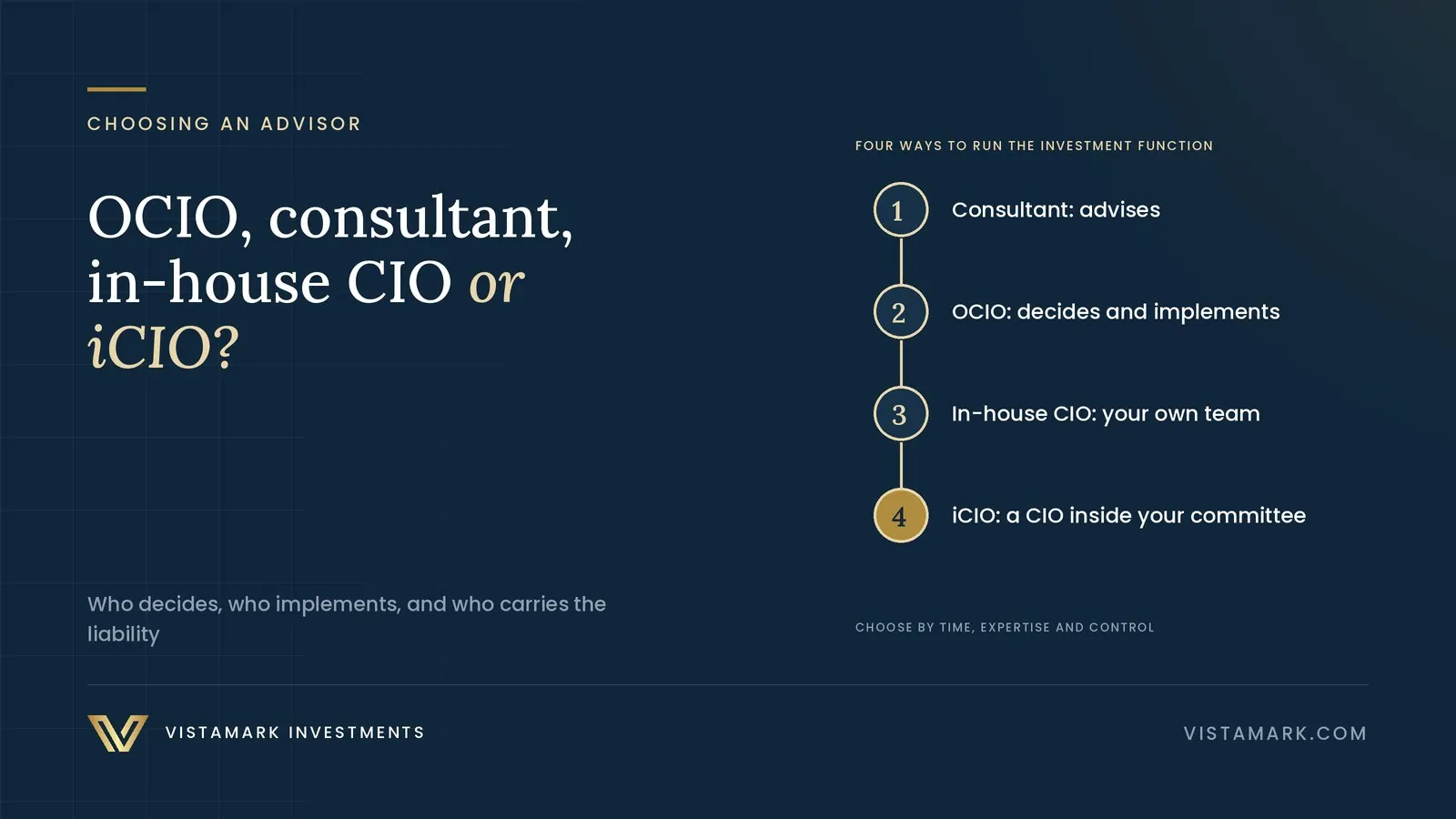
Put simply, a traditional OCIO manages the portfolio for you, a TAMP gives you tools, and an Integrated CIO becomes part of the team that makes the decisions with you.
What does an Integrated CIO actually do?
The scope is written down at the start and sized to what the client needs. A full engagement typically covers:
- Investment philosophy and process: a documented, defensible process that a compliance file, examiners, boards and clients can follow.
- Capital market assumptions and asset allocation: annual assumptions, strategic and tactical views, and model portfolios across risk profiles and tax status.
- Manager research and due diligence: written diligence on funds, ETFs, separately managed accounts and alternatives, with ongoing monitoring.
- Private markets: access, diligence and structuring for private equity, private credit and real assets where they suit the portfolio.
- Investment committee leadership: chairing or staffing the committee, preparing materials and documenting decisions.
- Advisor and client communication: market commentary, quarterly letters and direct help on complex situations.
- Rebalancing and trading support: rule-based rebalancing and coordination with the custodian and model-management platform. Several institutions white label Vistamark’s asset allocation and rebalancing models under their own brand.
Who uses an Integrated CIO?
The model fits organizations whose investment function is a real operation with a real cost, but not large enough to justify a full internal investment department:
- Independent RIAs, typically from about $100 million to $5 billion in advised assets
- Bank and trust-company wealth management divisions
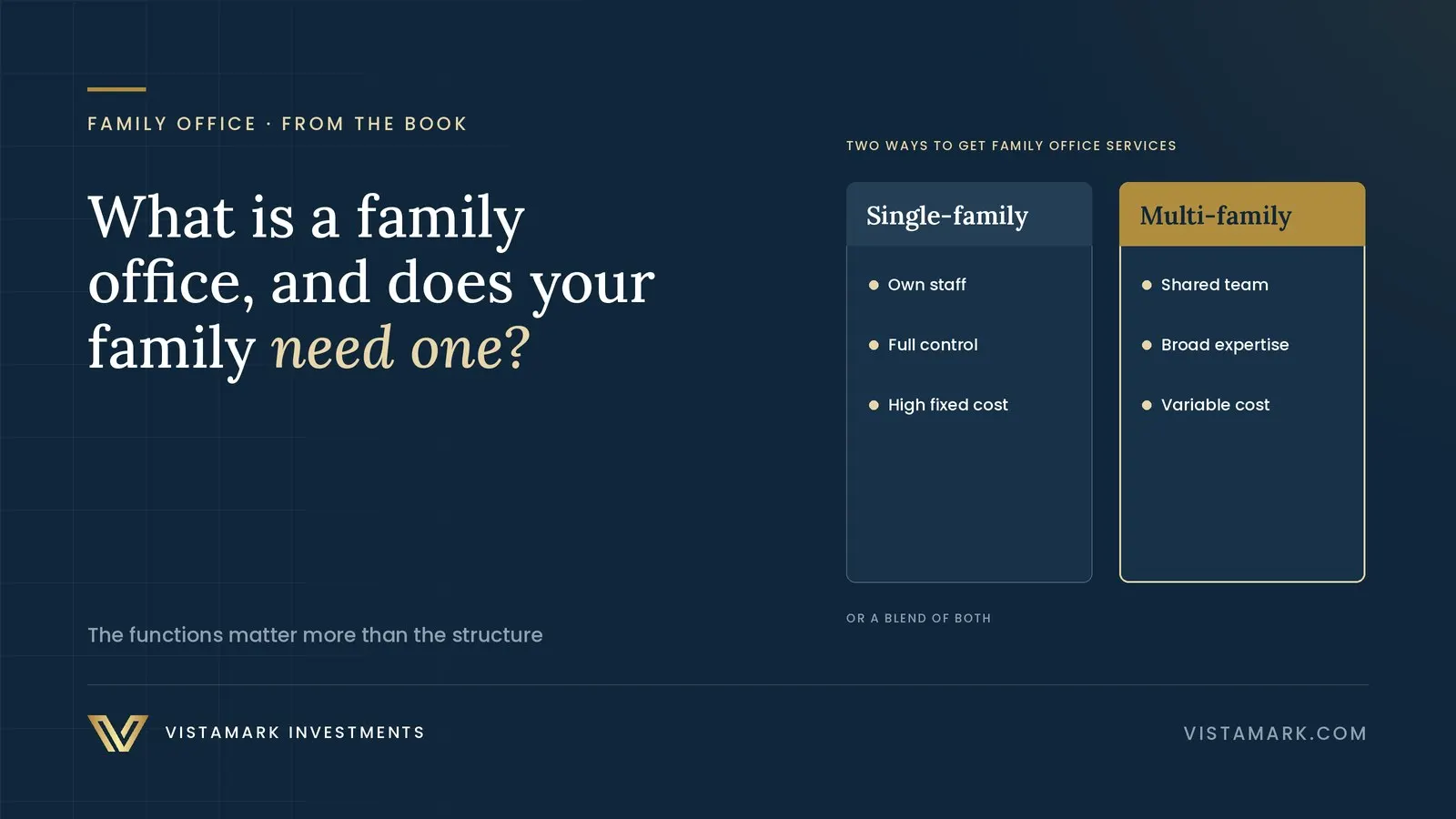
- Single- and multi-family offices, typically $100 million or more
- Foundations and endowments that want senior investment leadership inside their own committee
- Firms in transition: a departing CIO, a merger, or a move to independence
When does it make more sense than building or buying?
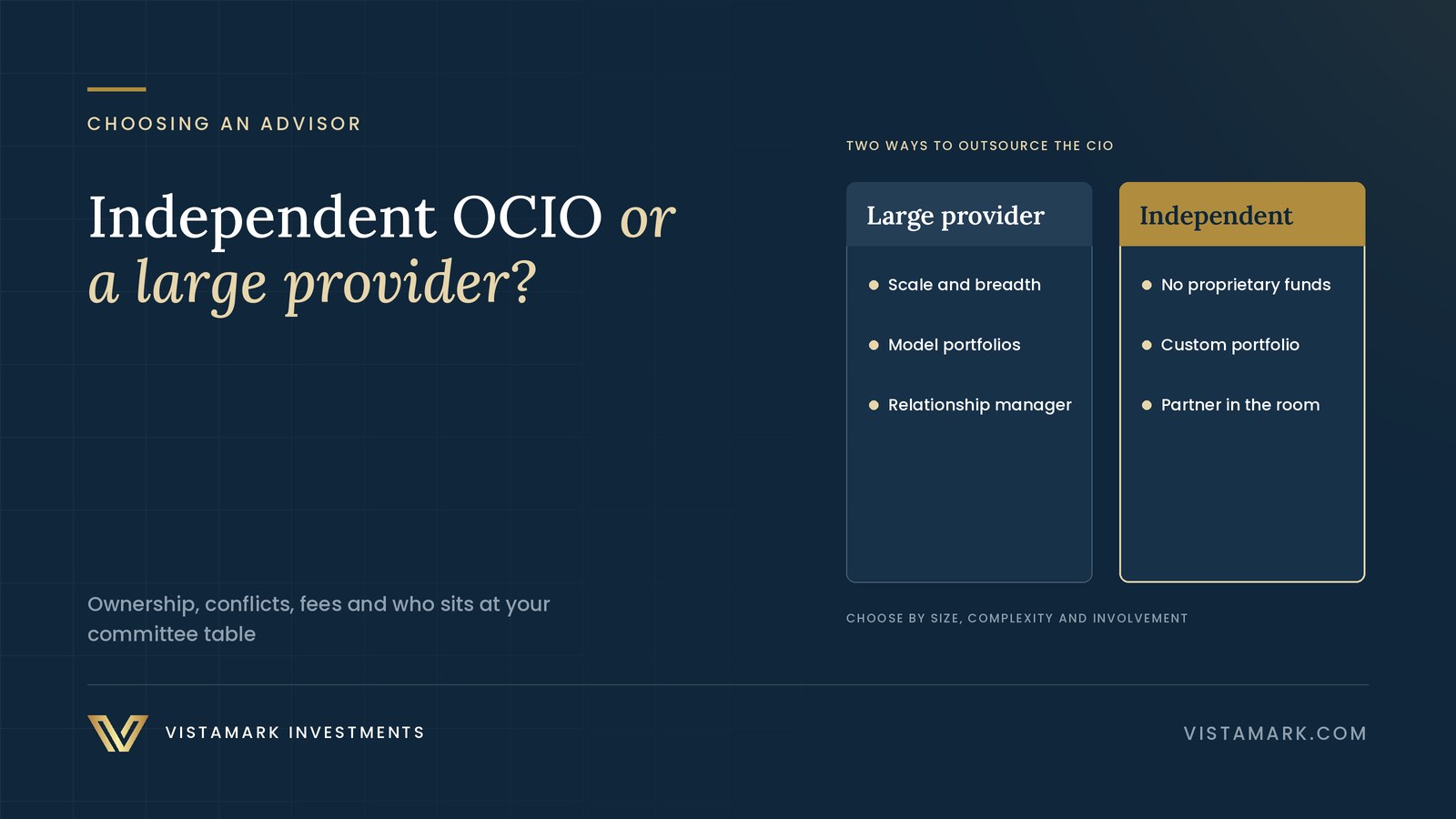
Most organizations weigh three options: build an internal investment department, buy a product or platform, or retain an outside investment office. Building gives the most control and carries the highest fixed cost and key-person risk. Buying a platform is inexpensive but leaves no one accountable when a situation does not fit the model. An Integrated CIO sits between the two: the client keeps final authority, and gains a senior investment officer and a research process without hiring a department. Our analysis of the real cost of an internal investment department walks through the numbers.
Banks and trust companies should also expect their vendor-risk process to apply: an outside investment officer is a third-party relationship, and federal banking guidance expects it to be reviewed before it begins and monitored afterward.
What should you ask before hiring one?
- Who, specifically, will do the work? Ask for the named senior person, how much of that person’s time you will have, and how many clients that person serves.
- How do you make money, in full? Advisory fees only, or also revenue from products, funds or managers on the recommended list?
- What is in scope, and in writing? Research and recommendations, model management, committee leadership, or the full investment function.
- Who has discretion, and how are decisions documented? The answer should match your governance, compliance program and client agreements.
- Who owns the provider, and what happens if it is sold? Ownership changes can change pricing, people and service.
- What happens if we part ways? Ask who owns the models, research and documentation, and what a transition looks like.
Our free guide, Ten Questions to Ask an OCIO, expands on these with a scoring sheet, and How OCIO Pricing Actually Works explains the fee structures you will see.
How does Vistamark deliver it?
Vistamark Investments is an independent, 100% employee- and partner-owned, SEC-registered investment adviser and a fiduciary to every client, with completely transparent fees. Its Integrated CIO engagements are led by Matthew Rice, CFA, CAIA, Vistamark’s founder and Chief Investment Officer. As Chief Investment Officer of Fiducient Advisors, he oversaw investment strategy for more than $260 billion in client assets for endowments, foundations, family offices and retirement plans. Financial institutions with billions in client assets have retained Vistamark as their Integrated Chief Investment Officer.
An engagement starts with a confidential diagnostic of the current investment function, followed by a written scope, integration with the client’s branding, calendar and technology, and a standing committee cadence. Details are on our Integrated CIO for financial institutions page, and The Value of Integrated Chief Investment Officer Services describes how the model works day to day.
The one-sentence version
Integrated CIO (iCIO) is Vistamark’s high-touch outsourced CIO platform, offering direct access to senior experts, true accountability, and a deeper partnership than traditional OCIO.
Sources and further reading
- U.S. Securities and Exchange Commission — Commission Interpretation Regarding Standard of Conduct for Investment Advisers, Release IA-5248 (2019)
- Federal Reserve, FDIC and OCC — Interagency Guidance on Third-Party Relationships: Risk Management (SR 23-4, June 2023)
- U.S. Securities and Exchange Commission — Form ADV Part 2 instructions (Item 5, Fees and Compensation)
This article is part of our Foundation & Endowment Investment Guide, which collects our writing on the topic with answers to common questions.
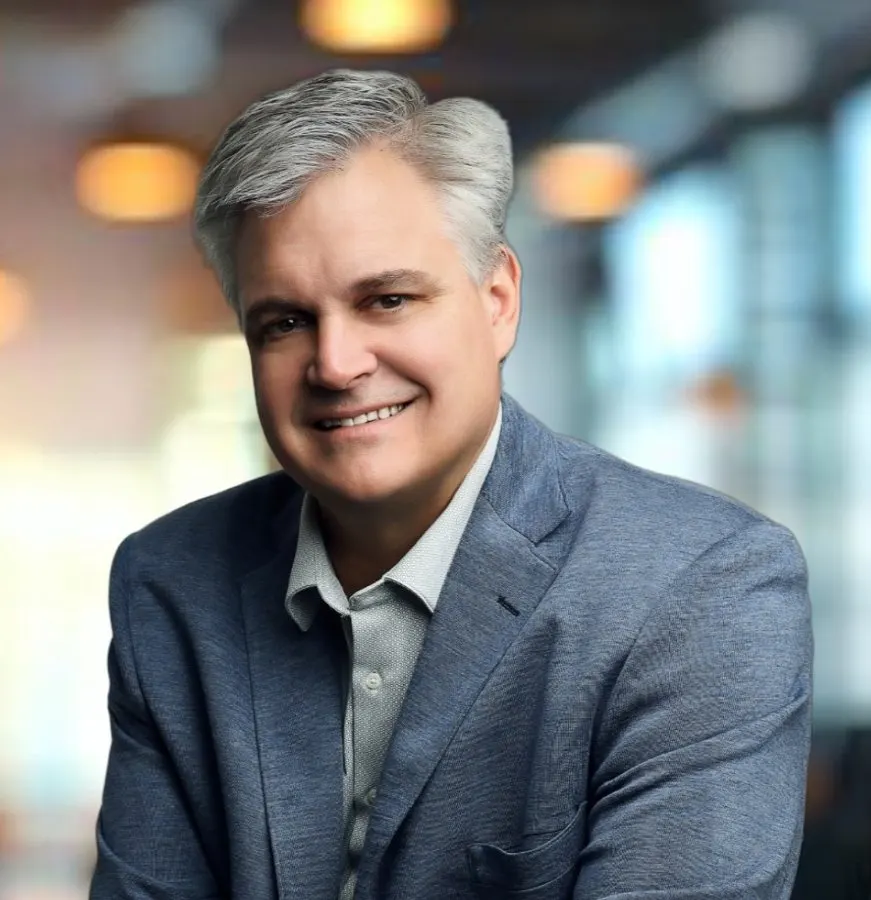
Founder and CIO of Vistamark; as CIO of Fiducient Advisors, oversaw investment strategy for more than $260 billion in client assets. More about Matthew →
This article is for informational and educational purposes only and does not constitute investment, legal, tax or accounting advice, or an offer or solicitation to buy or sell any security. Views are those of the author as of the publication date and are subject to change. Vistamark Investments is an SEC-registered investment adviser; see our disclosures.