The short answer. A charitable remainder trust (CRT) is an irrevocable trust that pays you, or people you name, an income stream for life or for a term of up to 20 years, and then gives what is left to charity. If you fund it with an appreciated asset, such as concentrated stock or an interest in a business you plan to sell, the trust can sell the asset without paying capital gains tax at the time of sale and reinvest the full proceeds. You receive a partial income tax deduction when you fund the trust. The gain is not forgiven: it is taxed gradually as you receive payments. For a business sale, the trust must own the shares before a sale is legally committed.
How does a charitable remainder trust work?
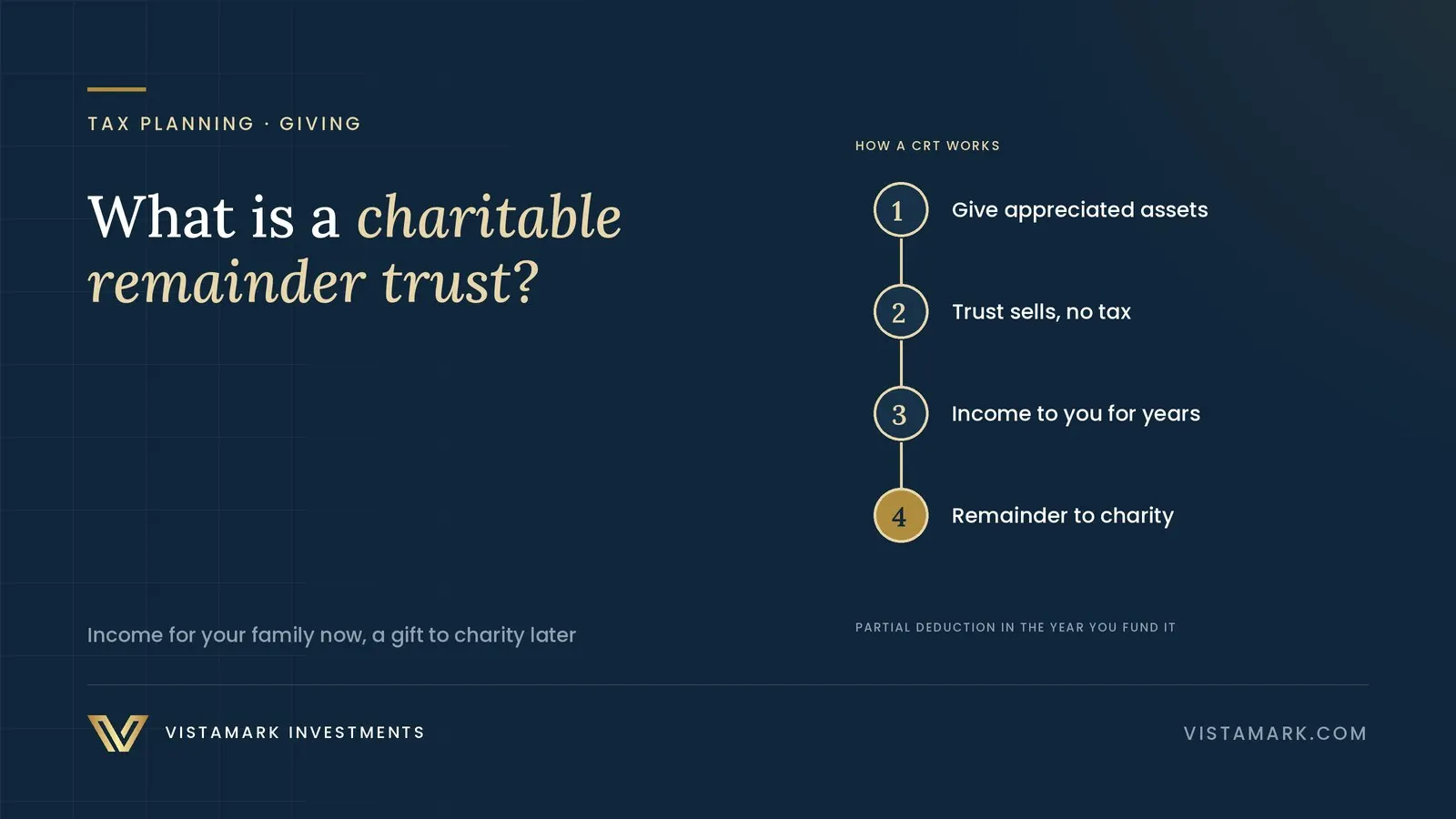
A donor transfers appreciated assets to an irrevocable trust, the trust sells them without paying capital gains tax at the time of sale, the trust pays the donor or other beneficiaries income for life or up to 20 years, and the remainder then goes to charity.
- You transfer assets to the trust, often appreciated stock, real estate or a business interest.
- The trust sells the assets. Because a qualifying CRT is exempt from income tax, it pays no capital gains tax when it sells and can invest the full proceeds in a diversified portfolio (IRS).
- The trust pays you, or other beneficiaries you name, an income stream at least once a year for life or for a term of up to 20 years.
- When the term ends, the remainder goes to charity, which can be a public charity, a donor-advised fund or your family foundation.
Your income tax deduction in the year you fund the trust equals the present value of the amount expected to pass to charity, based on the payout rate, the term or your age, and an IRS interest rate published each month.
What is the difference between a CRAT and a CRUT?
A charitable remainder annuity trust (CRAT) pays a fixed dollar amount every year, while a charitable remainder unitrust (CRUT) pays a fixed percentage of the trust’s value, recalculated each year, and can accept additional contributions.
| Charitable remainder annuity trust (CRAT) | Charitable remainder unitrust (CRUT) | |
|---|---|---|
| Payment | A fixed dollar amount every year | A fixed percentage of the trust’s value, recalculated each year |
| Additional contributions | Not allowed | Allowed |
| Hard-to-sell assets | Poor fit; payments are due regardless | Better fit; a net-income version can pay only what the trust earns until the asset sells |
| Best for | Those who want predictable income | Those who want income that can grow with the portfolio |
For both, the payout must be at least 5% and no more than 50% of the trust’s value each year, and the projected remainder to charity must be at least 10% of the initial value (26 U.S.C. § 664).
What does a CRT look like in numbers?
Suppose a Chicago executive owns $5 million of company stock with a $1 million cost basis. Selling it personally would trigger tax on a $4 million gain. Instead, she funds a unitrust with a 5% payout. The trust sells the stock, pays no tax on the sale and invests the full $5 million. Her first-year payment is about $250,000, and later payments rise or fall with the trust’s value. She receives a charitable deduction in the year she funds the trust, and when the trust ends, the remainder goes to her family’s donor-advised fund. The figures are illustrative; the actual deduction depends on her age, the payout rate and the IRS rate in the month of the gift.
Is the income from a CRT tax-free?
No. The payments you receive carry out the trust’s income in a set order: ordinary income first, then capital gains, then tax-exempt income, then return of principal. In effect, the capital gains tax on the sale is spread over many years rather than paid up front, while the full proceeds stay invested. The trust files Form 5227 each year, and beneficiaries receive a Schedule K-1. Illinois residents also pay Illinois income tax at 4.95% on the taxable part of each payment.
Can you use a CRT to sell a business?
Yes, but timing and structure decide whether it works. If you transfer shares after the sale is effectively committed, for example under a binding purchase agreement, the IRS can treat the sale as yours and tax the gain to you. Bring in the estate attorney, the transaction attorney and the CPA before a letter of intent is signed, and make sure the trustee, not you, controls the sale. S corporation stock cannot be held by a CRT without ending the S election, and partnership or LLC interests with debt can create taxable income inside the trust, so many owners contribute C corporation stock, or restructure first. Our article How Should a Chicago Business Owner Choose an M&A Advisor? covers preparing for a sale.
When does a CRT make sense?
A charitable remainder trust makes the most sense for a charitably inclined family that owns a highly appreciated asset it wants to sell and diversify, wants long-term income from it, and can fund the trust before any sale is agreed.
- You own a highly appreciated asset you want to sell and diversify, such as a concentrated stock position.
- You want lifetime or long-term income from that asset.
- You intend to leave a meaningful amount to charity.
- You are planning a liquidity event and can fund the trust before a sale is agreed.
How did the 2025 tax law affect CRTs?
The structure of CRTs did not change. The upfront charitable deduction is now subject to the new rules for itemizers: gifts are deductible only above 0.5% of adjusted gross income, and for top-bracket taxpayers deductions reduce tax at no more than 35%. The deduction is somewhat less valuable at the margin, but the core benefits, a tax-free sale inside the trust, diversified income and a gift to charity, remain.
What are the drawbacks?
The main drawbacks of a charitable remainder trust are that it is irrevocable and its remainder must go to charity, that it adds setup and annual administration costs, and that illiquid assets need careful planning to fund the required payments.
- The trust is irrevocable, and the remainder must go to charity, so heirs receive less unless you replace the value, often with life insurance held in a trust.
- Setup and annual administration, including a separate trust tax return, add cost.
- Illiquid assets such as real estate need careful planning so the trust can make its required payments.
- Annuity trusts funded for a person’s lifetime must also pass an IRS test showing a low chance that the trust runs out of money, which can rule out a CRAT for younger donors.
How should a family get started?
Start by modeling a charitable remainder trust against selling the asset outright or giving part of it directly to charity, using the asset’s value, cost basis and sale timeline, and bring in the estate attorney and CPA early.
- Gather the asset’s value, cost basis and any sale timeline.
- Model three outcomes: selling outright, funding a CRT, and giving part of the asset directly to charity or a donor-advised fund.
- Choose the charity or family foundation that will receive the remainder, and the trustee.
- Have the estate attorney draft the trust and the CPA confirm the deduction and the tax on future payments.
- Set an investment policy for the trust that supports the payout without taking excessive risk.
Where does Vistamark fit?
The VistaWealth Office is the private wealth practice of Vistamark, an independent, employee- and partner-owned firm based in Chicago and Hinsdale. It models CRT outcomes against the family’s full balance sheet, coordinates the design with the family’s estate attorney and CPA, and manages trust portfolios to meet their payout requirements and the family’s goals. This article is general information, not legal or tax advice.
Sources
This article is part of our Tax Planning Guide, which collects our writing on the topic with answers to common questions.
Market Compass · weekly
Get the Compass by email
One concise recap of the week’s market-moving events and what to watch next, written by our CIO at the end of each market week.

Managing Partner, VistaWealth Office™ — integrated wealth planning for executives, business owners, family offices and charities. More about William →
This article is for informational and educational purposes only and does not constitute investment, legal, tax or accounting advice, or an offer or solicitation to buy or sell any security. Views are those of the author as of the publication date and are subject to change. Vistamark Investments is an SEC-registered investment adviser; see our disclosures.