
Available now · First edition 2026
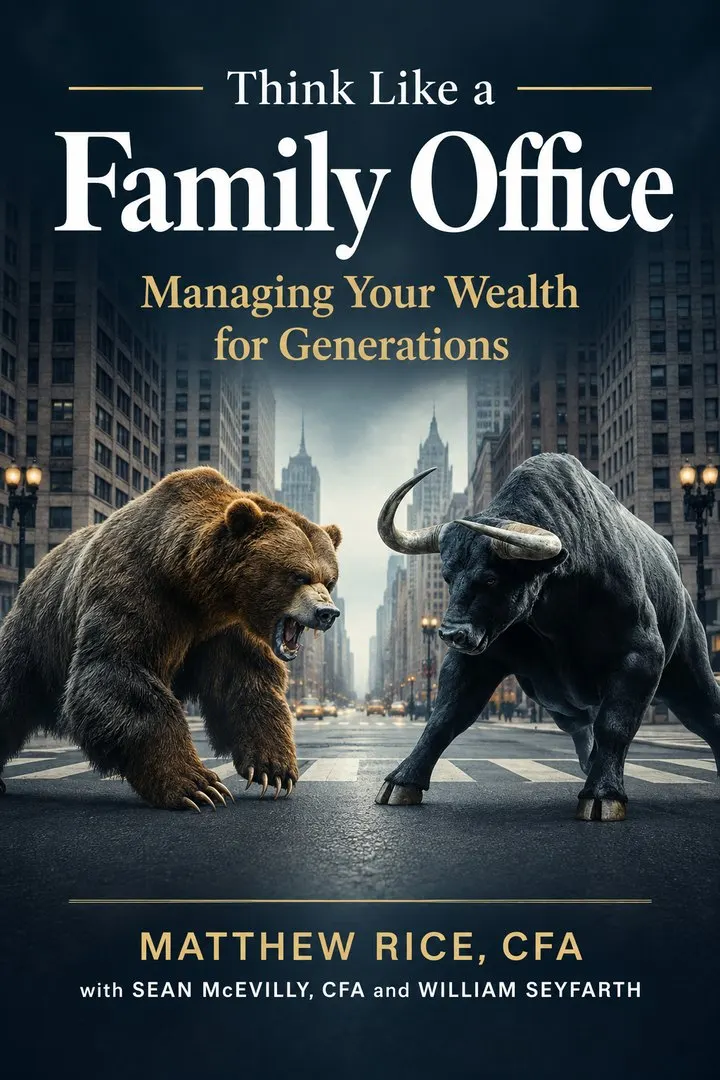
Think Like a Family Office: Managing Wealth, Purpose and Legacy Across Generations
The institutional playbook — investment policy, asset allocation, spending, manager selection, governance — rewritten for families, where taxes compound, liquidity answers to life events, and the committee is the Thanksgiving table.
By Matthew Rice, CFA · with contributions from Sean McEvilly, CFA and William Seyfarth · 2026
26 chapters · 7 parts · 2 appendices · 80+ exhibits · ISBN 9798998155406 · Vistamark Press
About the book
“The risks that created the wealth are almost never the risks that should be carried forward to preserve it.”
— from the Preface
Endowments, pensions and foundations have a mature literature on how to run money for the long term. Families do not — and families carry burdens institutions never face. Taxes are not a footnote but a structural drag that compounds across generations. Liquidity answers to estate events, divorces and capital calls on the operating business, not just to a spending policy. Concentration is rarely an allocation parameter; it is usually the legacy holding the family is unwilling to sell. And governance is not a committee of strangers but relatives across three or four generations.
Think Like a Family Office translates the institutional toolkit for that reality. It opens with the Four Flows framework and a one-page investment policy statement, builds an after-tax asset allocation for multi-generational capital, sets spending against arithmetic rather than habit, and then works through the building blocks — tax-managed equity and loss harvesting at scale, manager selection, hedge funds, private equity and venture, direct deals, real assets — before turning to concentrated positions, the sale of a business, after-tax performance measurement, family governance, the build-buy-blend decision on an outsourced CIO, philanthropy, estate architecture, cross-border families, asset protection and continuity.
Four composite families — the Whitman Family Office, the Ashford Group, the Dawsons and the Reyes Family Trust — carry the argument from chapter to chapter, with a fifth, the cautionary Calloways, as the counterexample whenever the alternative needs a face. The book closes with a month-by-month plan for the first year after a liquidity event, a worked after-tax capital market assumption, and a fifty-question self-assessment. Every quantitative, legal and empirical claim carries a numbered note.
Which version of this book applies to you
The disciplines scale down further than the structures do
A family at $8 million and a family at $800 million should both write an investment policy and set a spending rate against arithmetic. They should not both build an investment committee. Find your row.
| If the balance sheet is | The work that actually pays | Start with |
|---|---|---|
| $3–15 million often with an operating business | Investment policy, liquidity, tax-aware asset location, insurance, current estate documents, one coordinated set of advisors. No committee, no alternatives, no entity architecture. | Chapters 1–5, 13, 19, 21, 25, 26 |
| $15–75 million | Entity architecture and the basis-versus-transfer question, concentrated-position management, selective alternatives where access is real, a written governance rhythm rather than a formal board. | Add 6, 7, 12, 14, 22, 24 |
| $75–250 million | Institutional-grade reporting across entities, a formal investment committee, private-markets pacing and the build-buy-blend decision. This is where an office starts to earn its overhead. | Add 8–11, 15, 16, 18, 20 |
| $250 million and above | The full operating stack, direct investing where a real edge exists, dedicated governance, and continuity engineering for an institution that must outlive its founder. | The whole book; 17 and 23 become live |
The rows are about complexity, not worth. A $20 million family with a business in three states, a child abroad and a second marriage has more architecture to manage than a $60 million family holding index funds in one trust.
Inside
Twenty-six chapters in seven parts
Plus a worked after-tax capital market assumption (Appendix A), the fifty-question self-assessment (Appendix B), notes, glossary and sources.
Part I — The Foundations
- The Four Flows and the Investment Policy
- Integrated Asset Allocation for Taxable, Multi-Generational Wealth
- Spending Policy: How Much a Family Can Take
- The Other Side of the Balance Sheet: Liquidity, Leverage, and Borrowing
Part II — The Tax Lens
- Traditional Asset Classes Through a Taxable Lens
- Harvesting Losses at Scale: Direct Indexing and Long-Short Tax-Managed Equity
Part III — The Building Blocks
- Manager Selection and Active versus Passive
- Hedge Funds for Families
- Private Equity and Venture Capital
- Direct Investing: The Family’s Own Deals
- Real Assets for Inflation and Legacy
Part IV — Positions and Measurement
- Concentrated and Legacy Positions
- The Exit: Selling a Business, Founder Stock, and Equity Compensation
- Performance Measurement: After-Tax, After-Fee, Multi-Entity
Part V — Running the Enterprise
- Family Governance and the Investment Committee
- Outsourced CIO and the Build/Buy/Blend Decision
- Values-Aligned and Mission Investing
- Family Philanthropy: Foundations and Donor-Advised Funds
- Custodians, Administrators, and the Operating Stack
Part VI — The Human Side
- Behavioral Finance in Families
- Raising Stewards: Children, Grandchildren, and the Inheritance That Matters
Part VII — Architecture and Continuity
- Estate Planning, Trusts, and the Transfer of Wealth
- Cross-Border Families: When the Wealth Outgrows the Passport
- Asset Protection: Keeping Wealth Safe from Creditors and Claims
- Continuity: Incapacity, Death, and the Single Point of Failure
- The First Year: A Liquidity Event, Month by Month
Free download · Appendix B
The fifty-question self-assessment
Does your family think like a family office? Fifty yes-or-no questions keyed to the chapters. Score it at the family meeting.
The five families
Case studies from the book
The Whitmans, Ashford, the Reyeses, the Dawsons — and the Calloways. Illustrative composites from $4 million to $1.8 billion.
Who it’s for
Written for the people who sit across the table from advisors
Families and founders
Who have built or inherited meaningful wealth and want an operating model rather than another product — from $3 million with a business to $250 million with an office.
Family offices and their advisors
Single- and multi-family offices, trustees, CPAs and attorneys who want one shared vocabulary for allocation, spending, governance and the build-buy-blend decision.
Independent advisors
RIAs and bank trust teams who want to deliver a family-office standard of care to clients who will never build one.
Authors
From the Vistamark partners
Matthew Rice is also the author of Nonprofit Asset Management: Effective Investment Strategies and Oversight (Wiley, 2012).
 Matthew Rice, CFA, CAIA
 Sean McEvilly, CFA
 William Seyfarth
Read alongside
Related insights
 Private Wealth & Family Office
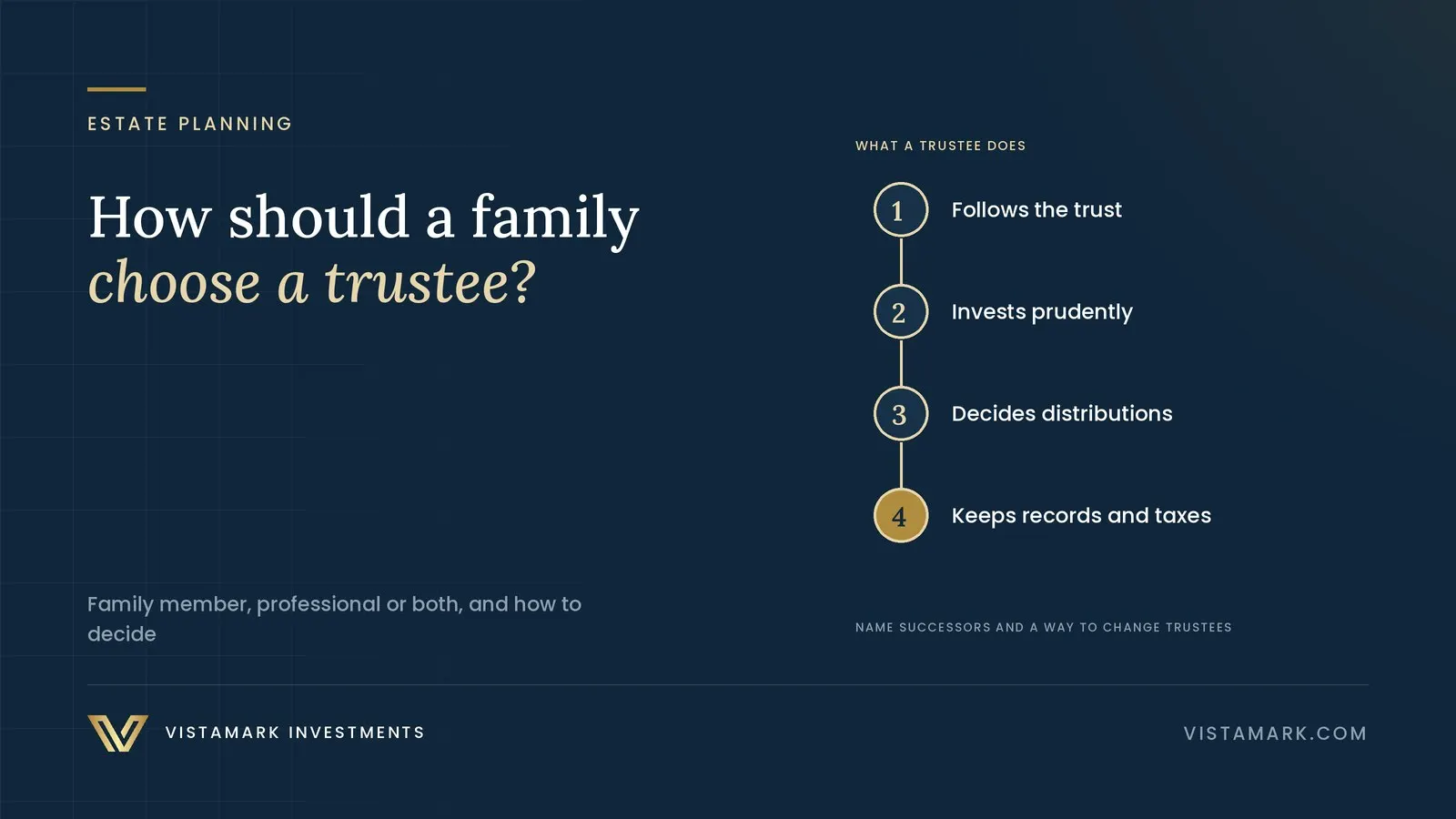
How Should a Family Choose a Trustee?
How to choose a trustee: family member vs. professional, co-trustees and trust protectors, the qualities that matter…
 Private Wealth & Family Office
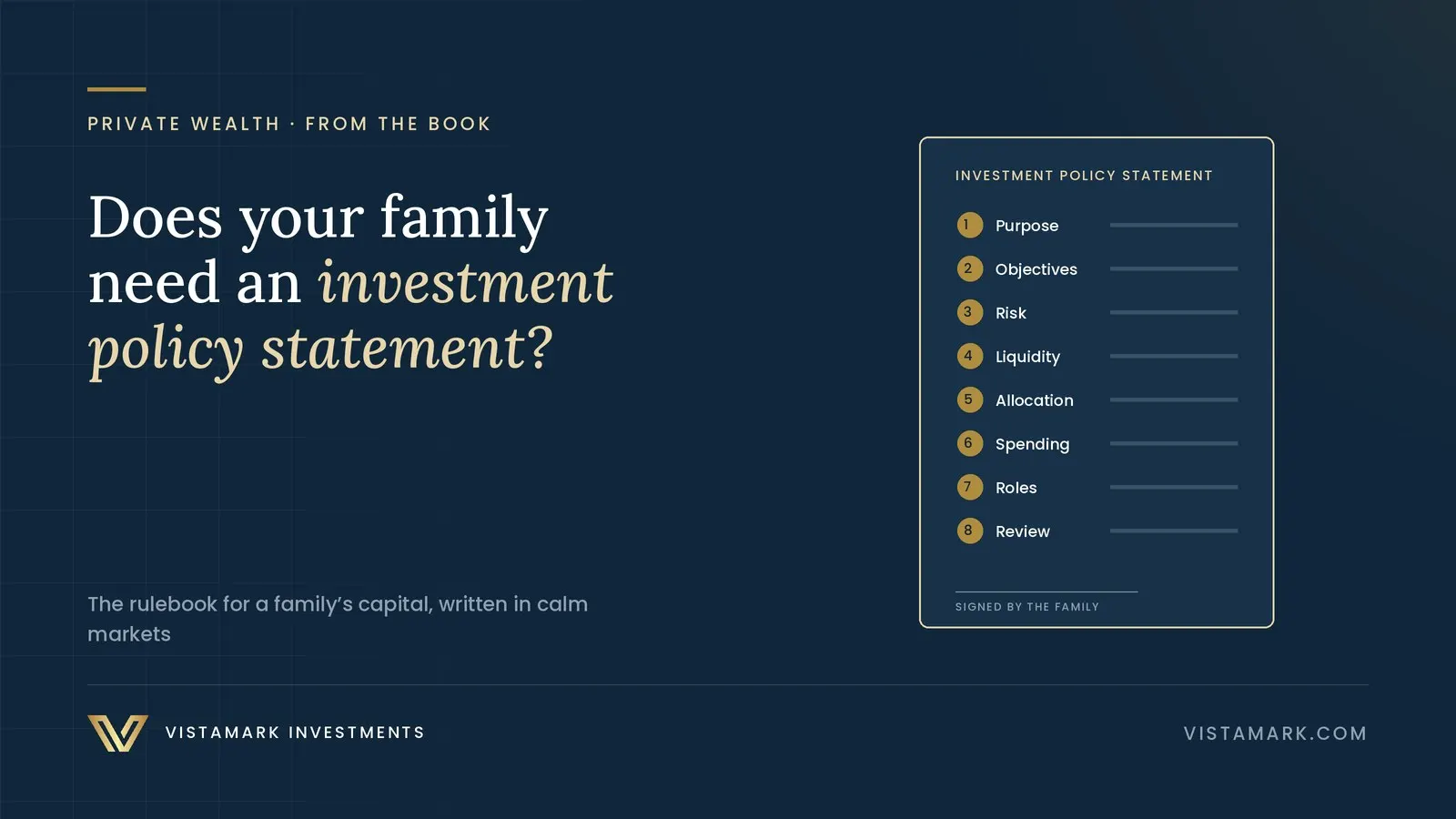
Does Your Family Need an Investment Policy Statement?
Why every wealthy family needs a written investment policy statement, the eight sections it should cover, and how to…
 Private Wealth & Family Office
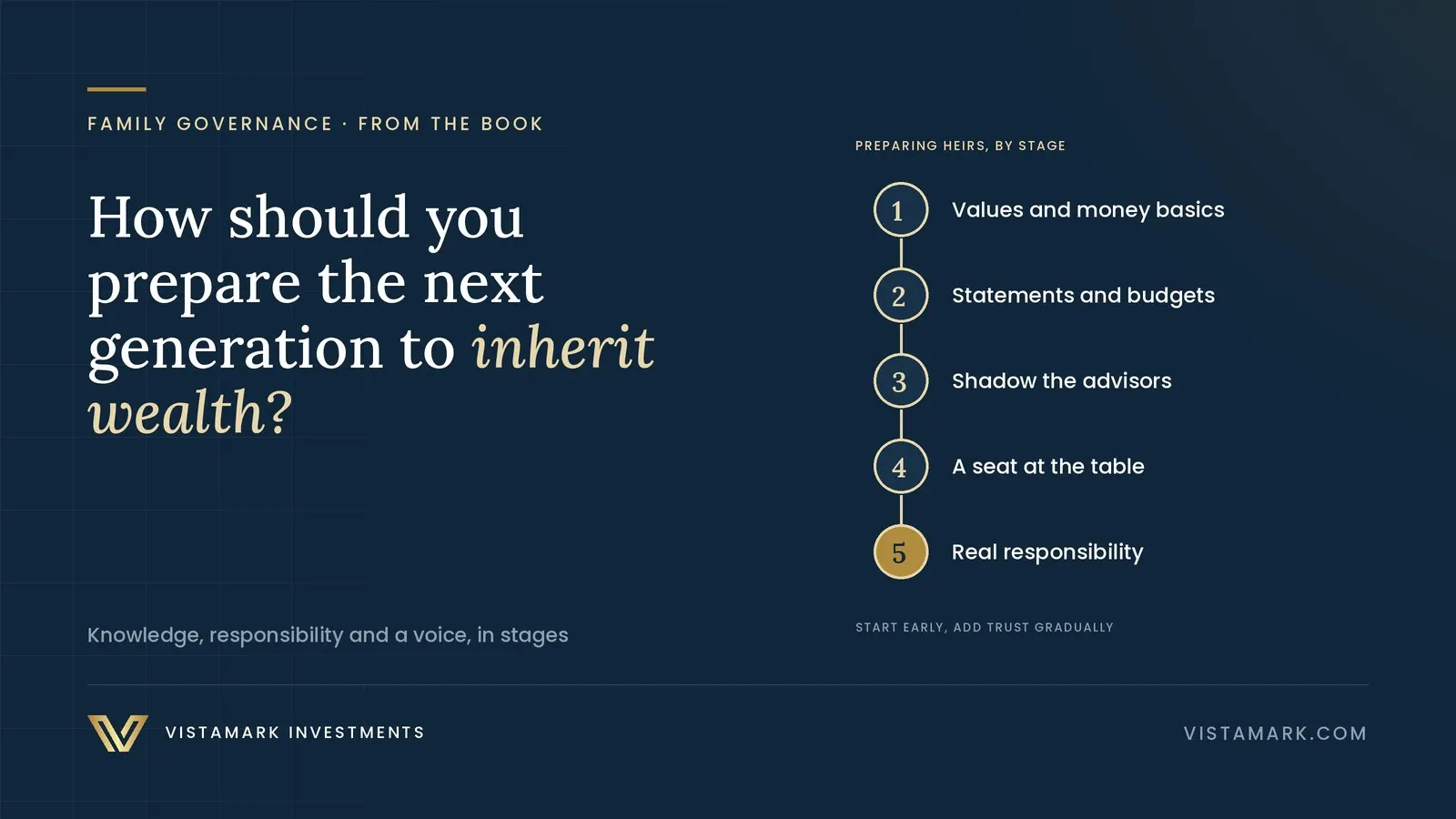
How Should You Prepare the Next Generation to Inherit Wealth?
How to prepare heirs to inherit wealth: what to teach at each age, how to give real responsibility, and how trusts and…
Bring the family office model to your own balance sheet.
The VistaWealth Office™ is the practice the book describes. Two of its contributing authors work with families there.