
Wiley Nonprofit Authority · John Wiley & Sons
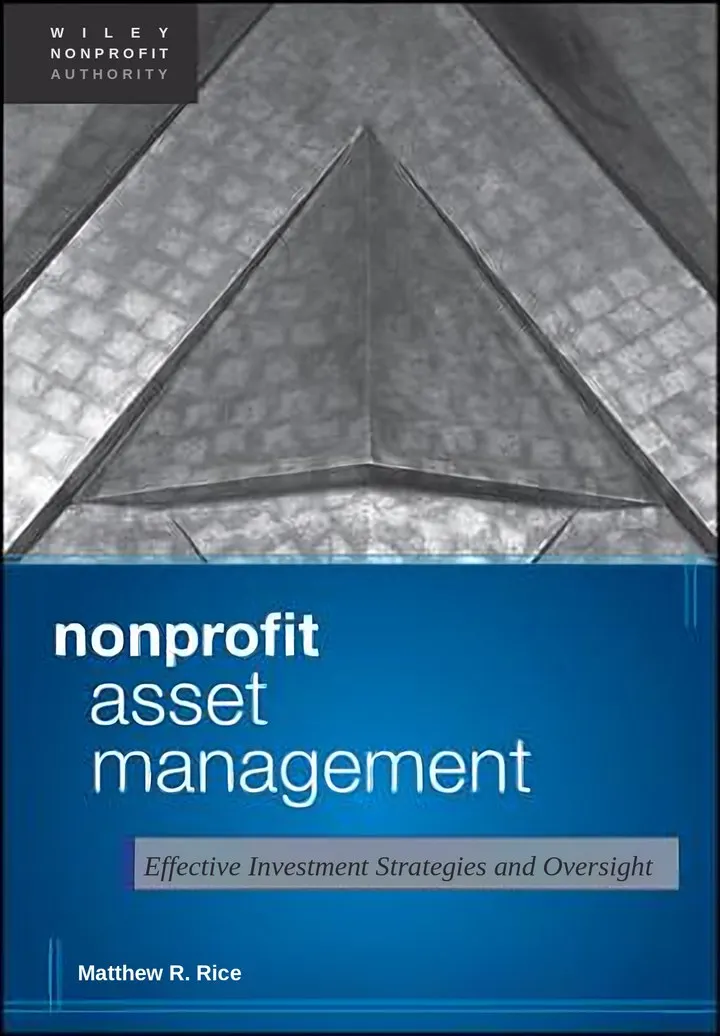
Nonprofit Asset Management: Effective Investment Strategies and Oversight
An authoritative guide to the investment management and oversight of endowments, foundations and other nonprofit investors — an elegant, simple framework for the prudent stewardship of mission capital.
By Matthew Rice, CFA, CAIA · 2012
John Wiley & Sons · Wiley Nonprofit Authority series · ISBN 9781118004523
About the book
A simple framework for the prudent oversight of nonprofit assets
A practical guide for fiduciaries of endowment, foundation and other nonprofit funds.
Nonprofit Asset Management is a timely guide for managing endowment, foundation and other nonprofit assets. It takes the reader through each phase of the process to build an elegant and simple framework for the prudent oversight of a nonprofit’s investments.
The book covers setting investment objectives, writing investment policy, asset allocation strategy, investment manager selection and the alternative asset classes — and then shows how to establish an effective oversight system that keeps the program on track year after year, through changes in markets, staff and board membership.
Written as a practical guide for the fiduciaries of nonprofit funds — board members, investment committee members and internal business managers — it offers much-needed, step-by-step guidance on the effective investment management of nonprofit assets.
Inside
Each phase of the process, step by step
From the first conversation about what the money is for to the oversight system that keeps the program on track.
Investment objectives
What the money is for: the return the mission requires, the risk the organization can bear, and the time horizon that follows from perpetuity.
Investment policy
A written policy statement that sets roles, targets, ranges and rebalancing — the document that lets a committee govern rather than react.
Asset allocation
The decision that drives most of the outcome: building a strategic mix that balances growth, income, liquidity and downside protection.
Manager selection
How to search for, evaluate and hire investment managers — and when passive implementation is the better answer.
Alternative asset classes
Hedge funds, private equity, real assets and other alternatives: what they add, what they cost, and when they belong in a nonprofit portfolio.
Oversight
An effective monitoring system — performance review, manager watch lists and committee process — that keeps the program on track.
Who it’s for
Written for the fiduciaries of nonprofit funds
Board and committee members
Volunteer fiduciaries who oversee an endowment or foundation and need a clear, defensible process rather than a stack of manager pitches.
Internal business managers
CFOs, treasurers and executive directors who run the investment program day to day and report to the board.
Advisors to nonprofits
Consultants, OCIOs, attorneys and auditors who want one shared vocabulary for objectives, policy, allocation and oversight.
Author
From Vistamark’s Chief Investment Officer
Matthew Rice is also the author of Think Like a Family Office (2026), which carries the same institutional discipline to families.
 Matthew Rice, CFA, CAIA
Read alongside
Related insights
 Choosing an Investment Advisor
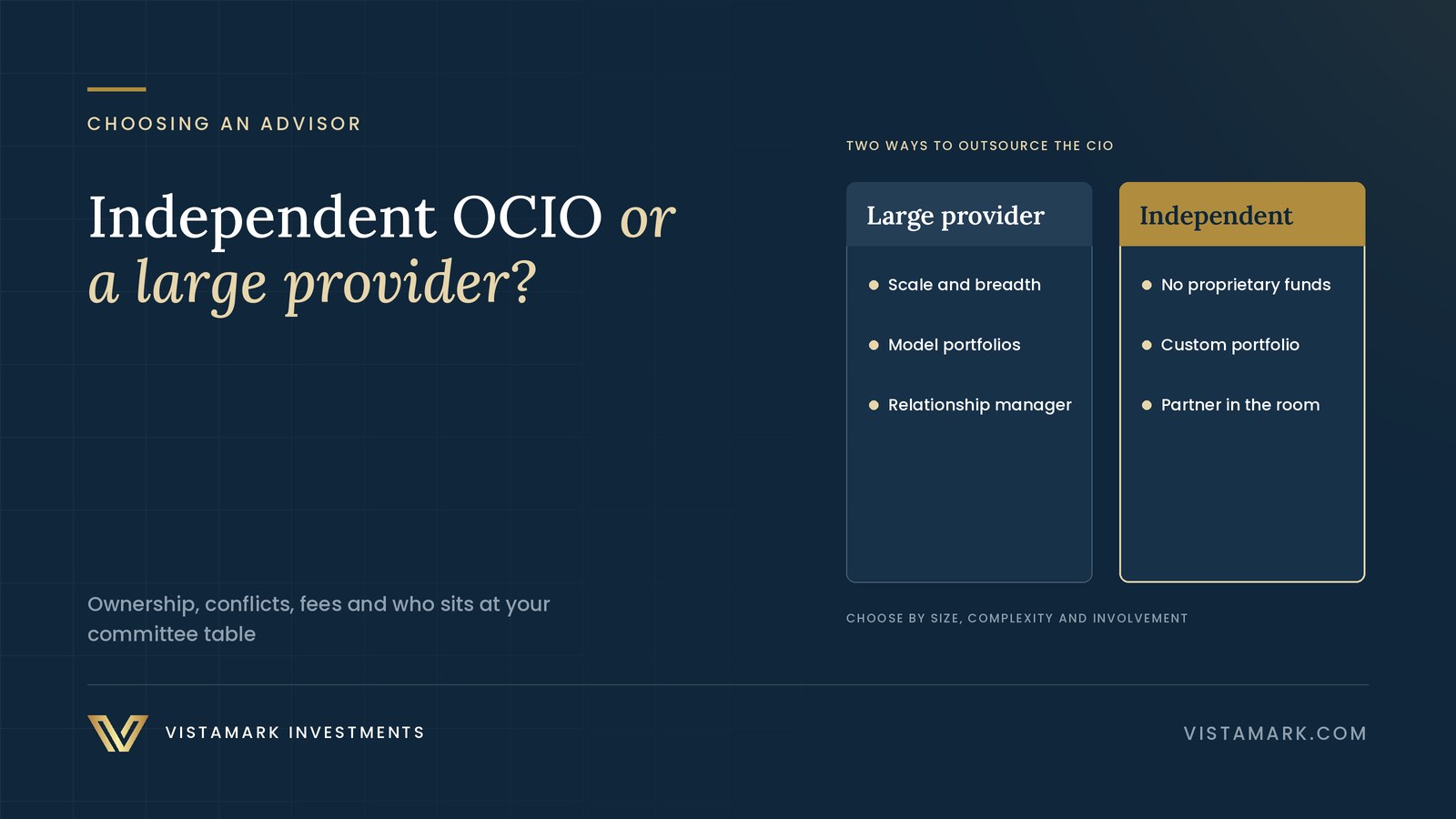
Independent vs. Large OCIO Providers
Independent vs. large OCIO providers: how they differ on ownership, conflicts, fees and who attends your meetings, and…
 Choosing an Investment Advisor
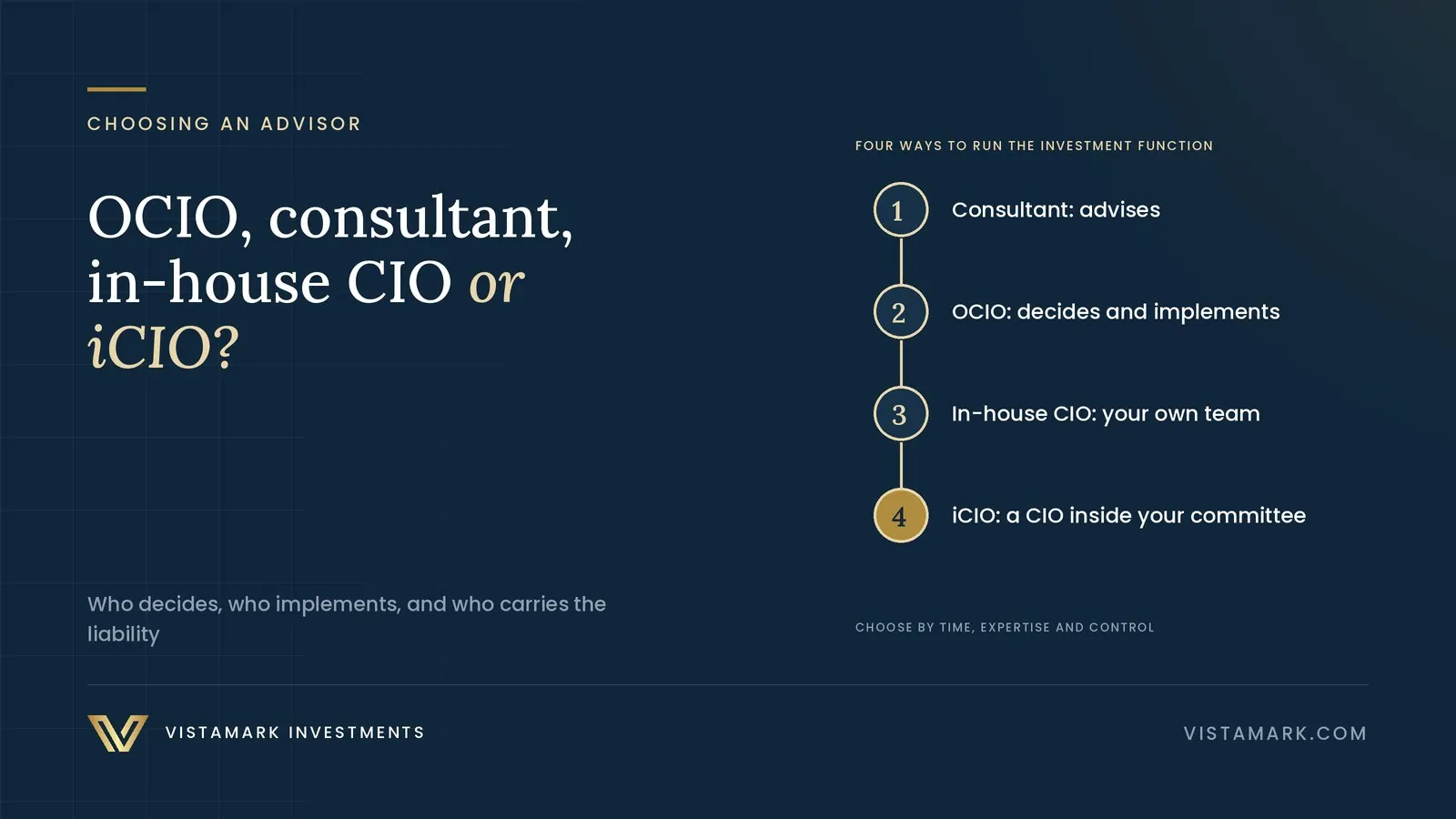
OCIO vs. Investment Consultant vs. In-House CIO
OCIO vs. investment consultant vs. in-house CIO: who decides, who carries the liability, what each costs, and where an…
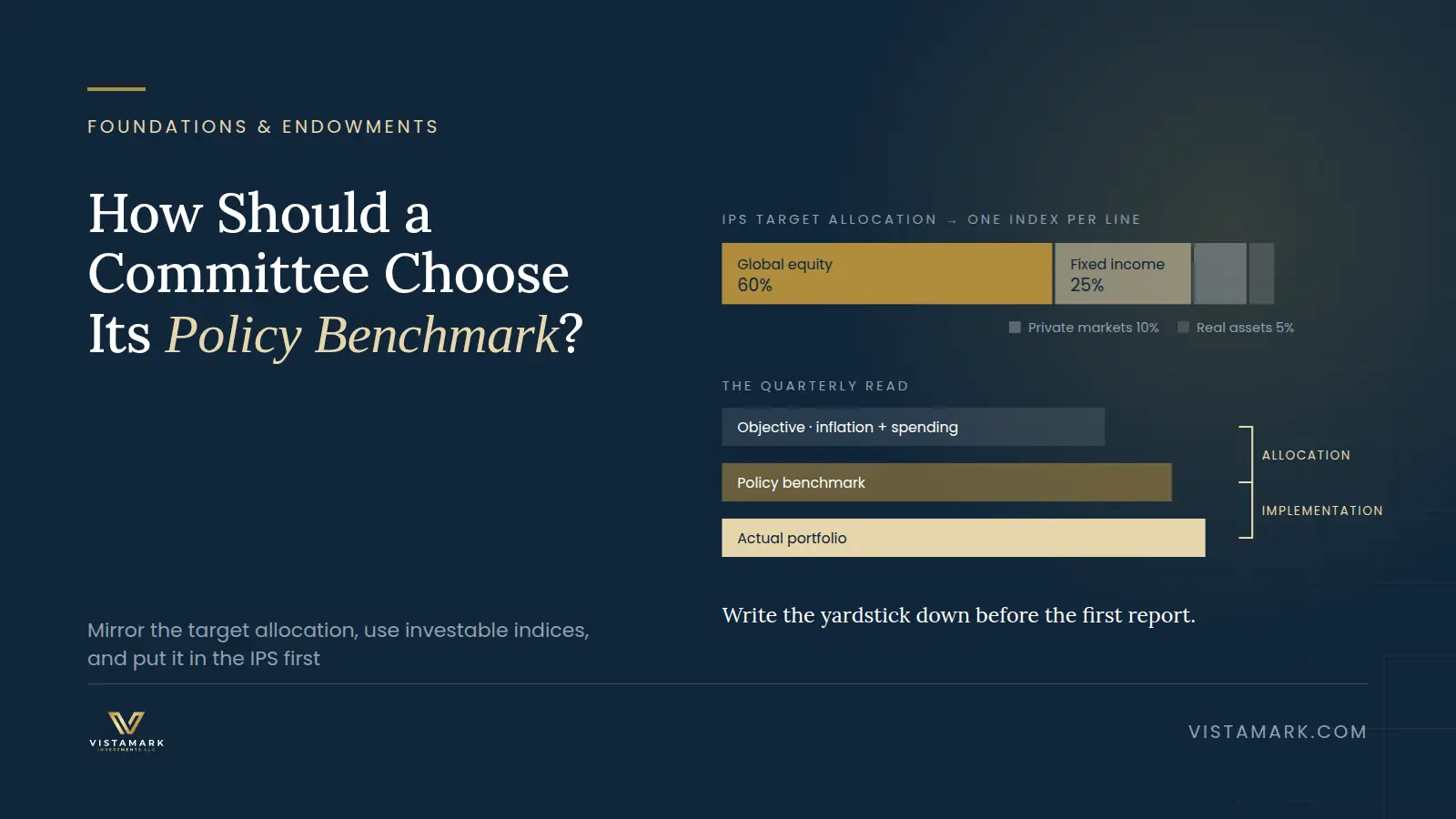 Foundations & Endowments
How Should a Foundation Investment Committee Choose Its Policy Benchmark?
A foundation policy benchmark should mirror the target asset allocation, use investable published indices, and be…
Put the framework to work for your organization.
Vistamark serves foundations, endowments and other nonprofits as an outsourced CIO and investment advisor — the practice this book describes.