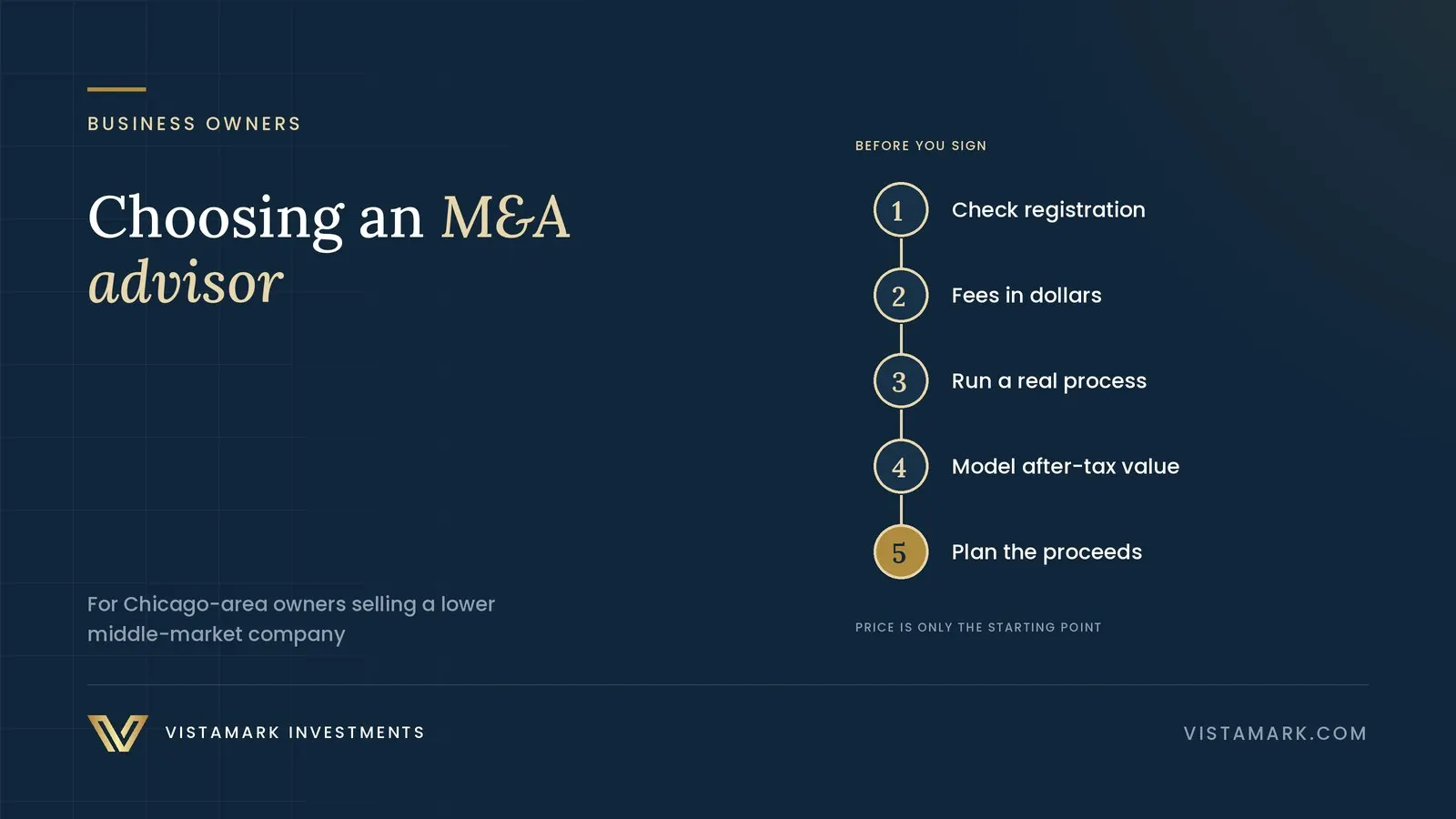
The short answer. Choose an advisor who has recently sold companies your size, will run a competitive process with more than one buyer at the table, states every fee in dollars, and is properly registered for the deal you are doing. Then plan the taxes and the proceeds before you sign a letter of intent. For a Chicago-area owner, federal and Illinois taxes, the deal structure and what happens to the money afterward decide how much of the price you actually keep.
What does an M&A advisor do in a business sale?
A sell-side advisor runs the sale so the owner can keep running the business. The work usually covers preparing the financial story and a confidential information memorandum, a view of value, building a buyer list, managing outreach under nondisclosure agreements, collecting and comparing indications of interest, negotiating the letter of intent, and steering diligence through closing. A sale of a lower middle-market company commonly takes six to twelve months from preparation to close, and most of the value is won or lost before the letter of intent is signed, while several buyers are still competing.
Business broker, M&A advisor or investment bank: which do you need?
The right choice depends mainly on the size of the company. Business brokers usually sell small, owner-operated businesses to individual buyers; M&A advisors run targeted sales of lower middle-market companies to strategic buyers, private equity firms and family offices; and investment banks handle larger companies and complex transactions.
| Type of firm | Typical client | How it sells | What to check |
|---|---|---|---|
| Business broker | Small, owner-operated businesses | Listings and individual buyers, often asset sales | State licensing where required; how many buyers it actually reaches |
| M&A advisor | Lower middle-market companies | A targeted process to strategic buyers, private equity and family offices | Registration status or the federal M&A broker exemption; recent deals of your size |
| Investment bank | Larger companies and complex capital structures | Broad auctions, financing and securities transactions | FINRA registration (check BrokerCheck); minimum fee; who on the team works on your deal |
Registration matters because selling a company through a sale of stock is a securities transaction. Since March 2023, a federal exemption has let M&A brokers handle the sale of a privately held company without registering as broker-dealers, if the company has EBITDA under $25 million or revenue under $250 million, the buyer will control and actively run the business, and the broker never holds the parties’ funds or securities. The exemption is federal only and does not override state rules (Foley Hoag). Ask any advisor how it is registered, or which exemption it relies on, before you sign an engagement letter.
What are buyers paying for lower middle-market companies?
Private equity buyers paid about 6.8 times EBITDA on average for companies sold for $10 million to $50 million in 2026, and about 7.6 times for $50 million to $250 million, according to GF Data figures cited by Mercer Capital. Averages hide a wide range: growth, customer concentration, management depth beyond the owner and the quality of the financial records move a multiple more than the industry does. A good advisor will tell you which of those to fix before you go to market, and how long fixing them will take.
How do taxes change what you keep in Illinois?
Price is only the starting point: an Illinois owner who sells a business can owe federal capital gains tax of up to 20%, the 3.8% net investment income tax and Illinois income tax at 4.95%, and the deal structure decides how much of each applies. The main layers are:
- Federal capital gains tax of up to 20% on long-term gains, with higher rates on some kinds of gain (IRS).
- The 3.8% net investment income tax on investment income above $250,000 for joint filers, depending on how active the owner was in the business (IRS).
- Illinois income tax at a flat 4.95% for individuals, plus Illinois’s personal property replacement tax on entity income: 1.5% for partnerships and S corporations and 2.5% for C corporations (Illinois Department of Revenue).
Whether the deal is a sale of assets or a sale of stock changes which of these apply and how much. Buyers usually prefer assets; sellers usually prefer stock. Owners of C corporation stock should also ask whether any of the gain qualifies for the qualified small business stock exclusion, which the 2025 tax law expanded; our article What Is QSBS, and How Did the 2025 Tax Law Change It? explains the rules. Your CPA and transaction attorney should model the after-tax result of each offer, not just its headline price.
Which deal terms matter beyond price?
Two offers at the same price can be worth very different amounts. Compare every offer on the terms that move value and risk:
- Cash at close versus an earn-out, which pays only if the business hits targets after you no longer control it.
- Rollover equity, which keeps you invested alongside a private equity buyer, with a second sale and its own risks later.
- Seller notes, which make you a lender to the buyer.
- Working capital targets, escrows and indemnities, which decide how much of the price can come back out after closing.
- Your role after the sale: employment terms, non-compete scope and how long you are expected to stay.
What should you ask before you hire an M&A advisor?
Ask each advisor for proof of relevant deal experience, how it is registered, the full cost in dollars at several sale prices, who will run the process and which buyers it would approach. Compare written answers from at least two or three advisors before signing an engagement letter.
- Which companies of our size and industry have you sold in the last three years, and can we speak with those owners?
- How are you registered for this transaction, or which exemption do you rely on?
- What will we pay, in dollars, at a range of sale prices: retainer, success fee, expenses and any fee after the engagement ends?
- Who will run our process day to day, and how many other sales are they running?
- Which buyers would you approach, and how many do you expect to reach the letter of intent stage?
- Do you receive anything from buyers, lenders or other parties to the deal?
Why plan the proceeds before you sell?
A sale often turns a business that took decades to build into the largest pool of cash a family has ever held, in a single day. Decisions made before the letter of intent, such as gifting shares to trusts, funding a donor-advised fund or setting up the entity that will receive the proceeds, can save far more than decisions made after closing. Our articles Selling Your Small Business: A Roadmap to a Successful Exit and From Business Owner to Investor walk through both stages, and our Dawson family case study follows one owner’s sale from preparation to the first year after.
Where does Vistamark fit?
Vistamark’s advisory practice works with owners of lower middle-market companies around the Chicago area, typically with enterprise values from about $5 million to $100 million. M&A advisory is provided through Vistamark Consulting, an affiliate of Vistamark Investments; Vistamark is not a broker-dealer, and where a transaction requires a registered intermediary, we coordinate with appropriately registered partners. The practice draws on the partners’ private equity, alternative credit and family office relationships. Because the VistaWealth Office sits in the same firm, the plan for the proceeds can be built alongside the deal. A first conversation is confidential and carries no obligation.
Sources
- Foley Hoag — The M&A Broker Exemption (July 30, 2026)
- Mercer Capital — Middle Market Transaction Update, Fall 2026 (citing GF Data)
- Internal Revenue Service — Topic No. 409, Capital Gains and Losses
- Internal Revenue Service — Net Investment Income Tax
- Illinois Department of Revenue — Income Tax Rates

Managing Partner and Founder; advises families, business owners and family offices through the VistaWealth Office™ and leads Vistamark’s private markets research. More about Sean →
This article is for informational and educational purposes only and does not constitute investment, legal, tax or accounting advice, or an offer or solicitation to buy or sell any security. Views are those of the author as of the publication date and are subject to change. Vistamark Investments is an SEC-registered investment adviser; see our disclosures.