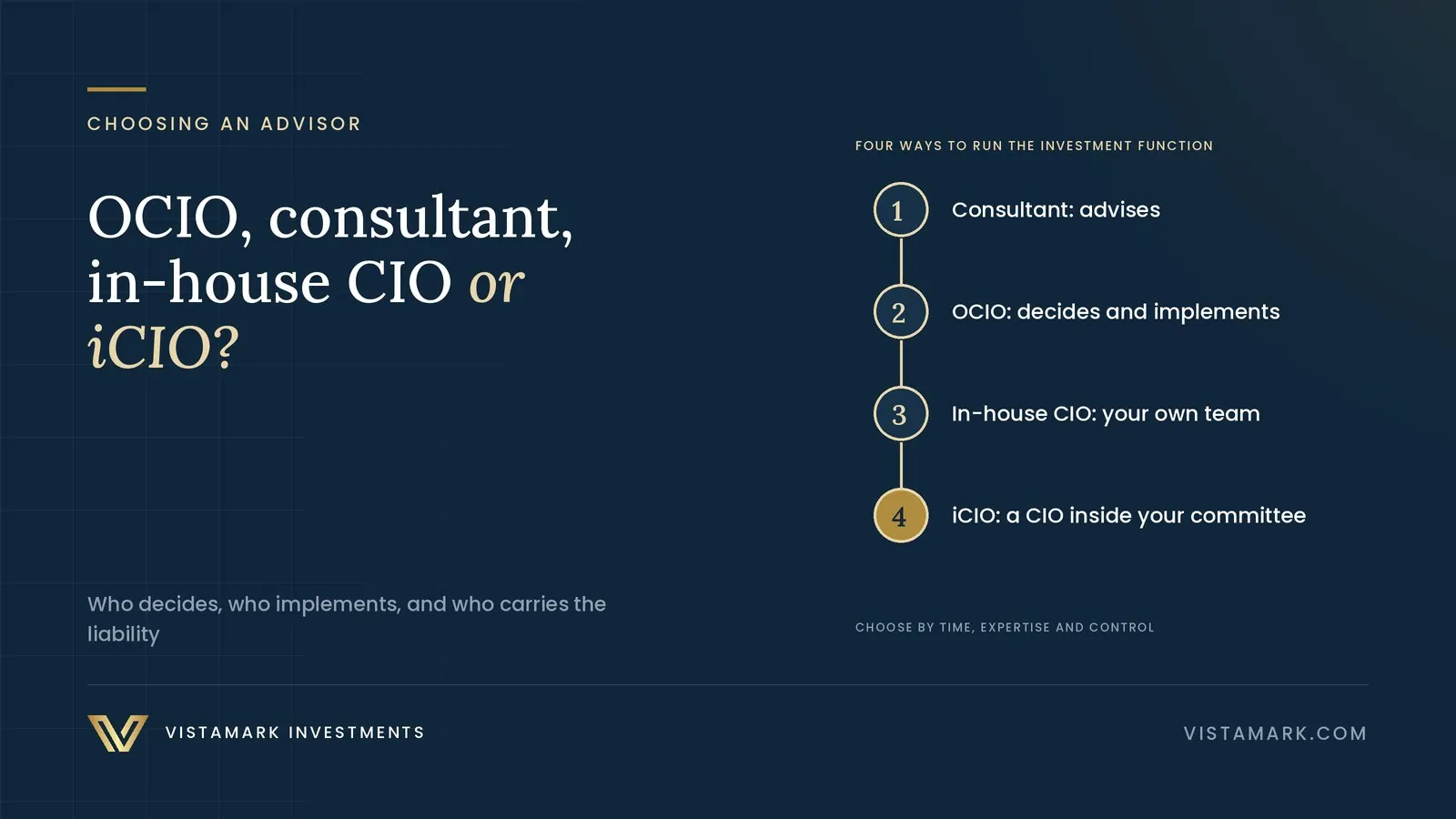
An investment consultant advises and the committee decides; an outsourced chief investment officer (OCIO) decides and implements within limits the committee sets; and an in-house CIO is the organization’s own employee doing both. The right model depends on three things: how much day-to-day decision-making your committee wants to keep, how much time its members can give, and whether the portfolio is large and complex enough to support its own investment staff. None of the three removes the committee’s fiduciary duty. Each one changes what that duty requires.
The three models at a glance
| Investment consultant | OCIO | In-house CIO | |
|---|---|---|---|
| Who makes investment decisions | The committee, on the consultant’s advice | The OCIO, within an investment policy the committee approves | Staff, within an investment policy the committee approves |
| Who hires and fires managers | The committee votes on each change | The OCIO | The CIO and staff |
| Who executes trades and rebalancing | The committee or its staff, through the custodian | The OCIO | Staff |
| Committee time required | Highest | Lowest | Moderate: overseeing staff instead of portfolios |
| Speed of decisions | Paced by the meeting calendar | Days, not quarters | Days, not quarters |
| Typical cost structure | Retainer or basis points for advice | Basis points or retainer covering advice and implementation | Salaries, data, systems and overhead, largely fixed |
| Main risk to manage | Decisions that lag markets; diffuse accountability | Conflicts in the OCIO’s own products; less committee visibility | Key-person risk; cost that does not shrink with assets |
| Most common among | Committees with investment expertise and time | Endowments up to about $500 million, where more than half use one | The largest endowments, particularly above $5 billion |
What does each model actually do?
An investment consultant is a non-discretionary advisor. It drafts the investment policy statement, recommends an asset allocation, researches and recommends managers, measures performance and prepares the committee’s meeting materials. Every decision goes to the committee for a vote, and the committee (or its staff) instructs the custodian and managers to carry it out.
An outsourced chief investment officer does the same research and adds discretion. Once the committee approves an investment policy, with a target allocation, ranges and risk limits, the OCIO hires and replaces managers, rebalances and moves money within those limits without waiting for the next meeting. The committee’s job shifts from making each decision to setting policy and holding the OCIO accountable for following it.
An in-house CIO is an employee, usually supported by analysts, who runs the portfolio inside the organization. Large endowments and pension plans use this model because their portfolios are big and complex enough to justify a dedicated team, and because they want investment judgment to sit with people whose only job is that one portfolio.
Who keeps the decisions, and who keeps the liability?
The legal difference between the models is discretion, and it matters most for retirement plans and charities.
Under ERISA, an advisor who gives investment advice for a fee is a fiduciary under section 3(21), but the plan’s committee still makes, and owns, each decision. An investment manager appointed under section 3(38), a registered adviser, bank or insurer with power to manage plan assets that has acknowledged its fiduciary status in writing, takes on those decisions; the law then relieves trustees of liability for that manager’s individual acts. The committee remains responsible for prudently selecting and monitoring the manager. In practice, an investment consultant usually works as a 3(21) advisor and a discretionary OCIO as a 3(38) manager.
Charitable endowments follow a similar logic under the Uniform Prudent Management of Institutional Funds Act (UPMIFA), adopted in Illinois and nearly every other state. An institution may delegate management and investment of its funds to an outside agent, provided it acts prudently in selecting the agent, in setting the scope and terms of the delegation, and in periodically reviewing the agent’s performance. An institution that meets those duties is not liable for the agent’s individual decisions. Our guide UPMIFA in Plain English covers the statute in more detail.
The practical point for committees: delegating to an OCIO can narrow your exposure for individual investment decisions, but it does not delegate the duty to choose well, document the scope and monitor. A committee that hires an OCIO and stops paying attention has not reduced its risk.
Which model do organizations your size use?
Size is the strongest predictor. In the 2025 NACUBO-Commonfund Study of Endowments, which covered 657 institutions with $944 billion in endowment assets in fiscal 2025, 46.2% of institutions used an OCIO. Use was highest among endowments of $101 million to $250 million (61.3%) and stayed above half for every size band up to $500 million. It fell to 35.6% for endowments of $501 million to $1 billion and 23.3% for $1 billion to $5 billion, and no institution above $5 billion used one. The largest endowments run their own investment offices instead.
Outsourcing is also growing. Cerulli Associates estimated OCIO assets at more than $3.3 trillion at the end of 2024 and projected about $1.3 trillion of new assets from first-time adopters through 2029, led by defined contribution and corporate pension plans, with endowments and foundations among the client types most likely to consider the model.
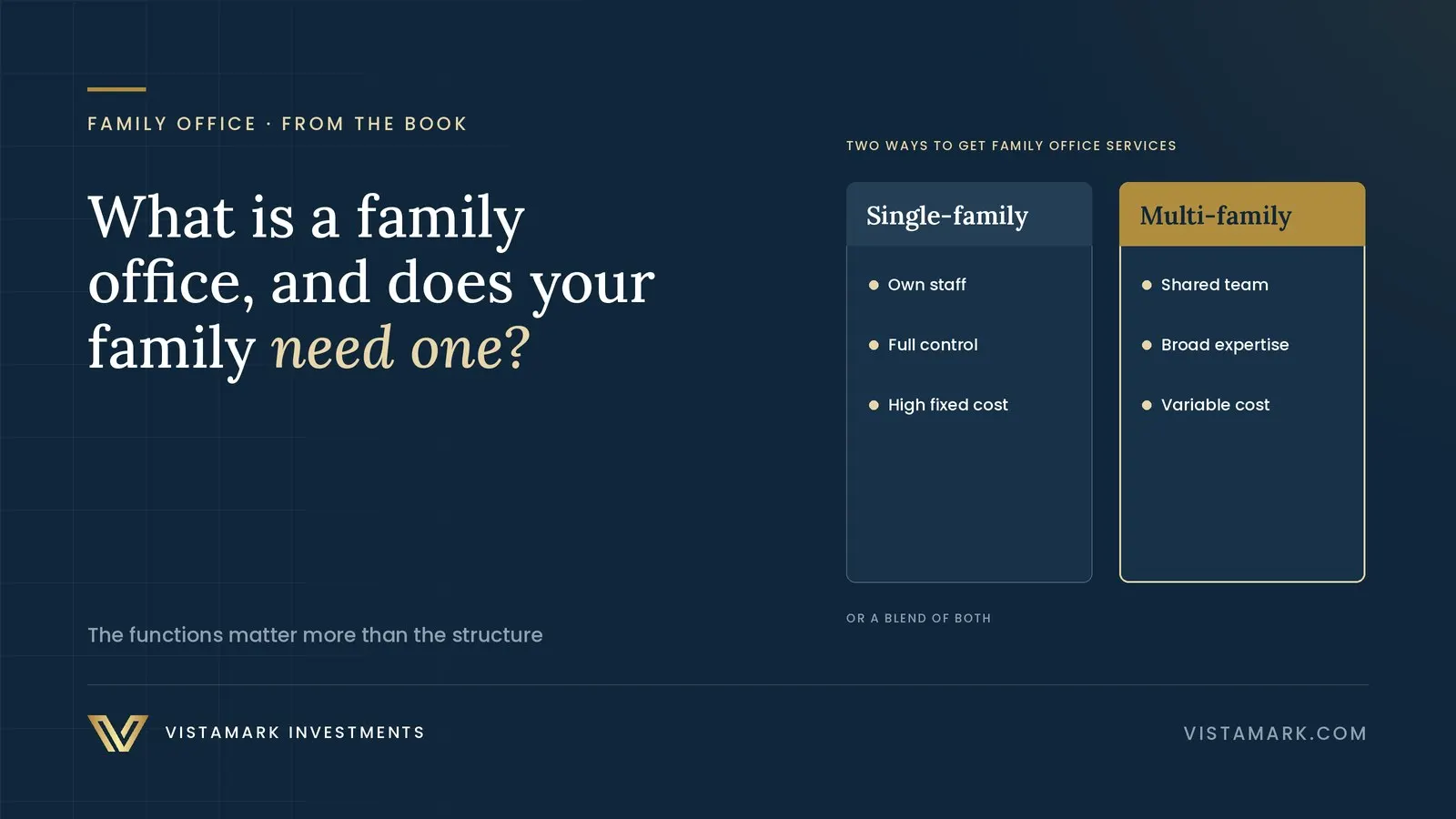
Those patterns reflect economics more than preference. Below roughly $1 billion, a full internal team is a large fixed cost relative to the portfolio; above that level, the cost is spread over enough assets that many institutions prefer the control of their own staff.
How do the costs compare?
The three models price different things, so compare total annual cost rather than headline fees.
- Consultant: a retainer or a basis-point fee for advice. Implementation, staff time and the cost of decisions that wait for a meeting are not in the fee.
- OCIO: a basis-point fee or retainer that covers advice and implementation. Ask whether the OCIO earns anything from the funds it selects, and add underlying manager fees to get the all-in figure.
- In-house CIO: salaries and benefits, research and data subscriptions, systems, audit and compliance, and the cost of replacing a key person when one leaves. Much of that cost is fixed whether the portfolio grows or shrinks.
Our guides on how OCIO pricing works and what an endowment or foundation should pay an advisor or OCIO walk through the fee structures, and Build vs Buy lays out the full cost of an internal investment department.
When is an investment consultant the right choice?
A consultant fits a committee that wants to make every decision itself and has the expertise and time to do it well: members who understand asset allocation and manager selection, a chair who can run a disciplined meeting, and a calendar that allows decisions to wait for the next quarterly session. It also suits organizations whose portfolios are simple, mostly index funds with few managers, where there is little to implement between meetings. The trade-off is speed and accountability: when a manager needs replacing or markets move sharply, the portfolio waits for a vote, and when results disappoint, responsibility is shared between the adviser who recommended and the committee that decided.
When is an OCIO the right choice?
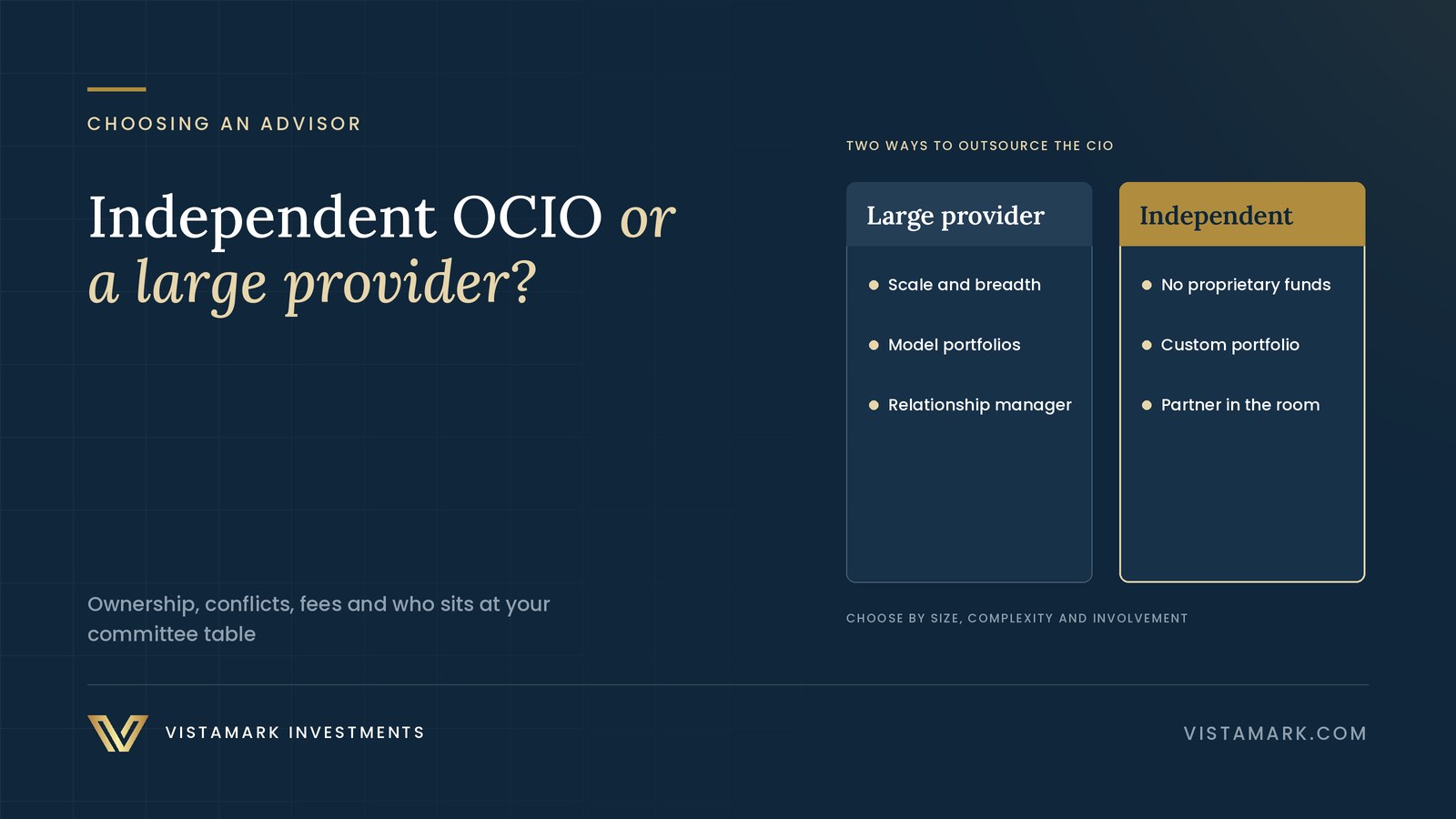
An OCIO fits a committee that would rather set policy and oversee than make each investment decision. Common signs: volunteer members with limited time or rotating terms, a portfolio with private markets or many managers that needs frequent attention, a history of decisions delayed by the meeting calendar, or a small staff with no investment specialist. The trade-offs are visibility and conflicts. The committee sees results and reports rather than each decision as it is made, so it must insist on clear reporting against the policy. And some OCIOs place clients in their own proprietary funds, which creates a conflict worth asking about directly.
When does an in-house CIO make sense?
An internal team makes sense when the portfolio is large enough that its cost is a small fraction of assets, complex enough to need full-time attention (direct private investments, co-investments, a large manager roster), and when the organization can recruit, pay and retain investment talent. The risks are concentration in a few people and a cost base that does not fall when markets do. For most foundations, endowments and plans below about $1 billion, the arithmetic rarely supports a full team.
Is there a middle ground?
Yes, and many organizations end up there. Common hybrids include a consultant with limited discretion over rebalancing, an OCIO for one part of the portfolio such as private markets, and an internal investment lead who works alongside an outside firm. Vistamark offers OCIO, consulting and project engagements for foundations, endowments and plan sponsors, as well as the Integrated CIO model described below. The right answer is the one that matches your committee’s time, expertise and appetite for control, not the provider’s preferred model.
Where does an Integrated CIO (iCIO™) fit?
An Integrated Chief Investment Officer™ (iCIO™) is a hybrid built for committees that want the resources of an OCIO without handing their portfolio to a distant team. Vistamark’s iCIO model pairs the institutional research, manager due diligence and portfolio management of an outsourced CIO with a named senior investment officer who works inside the client’s own investment committee and meetings, rather than off-site. The committee keeps policy and oversight, as it would with an OCIO, and gains the direct access and continuity that usually come only with an in-house CIO, without the fixed cost of building a team.
- Compared with a consultant: the iCIO is responsible for putting the policy to work, not only for recommending, so decisions do not have to wait for the next meeting.
- Compared with a traditional OCIO: a named senior CIO sits in your committee’s meetings and knows your organization, rather than a relationship manager relaying decisions made elsewhere.
- Compared with an in-house CIO: similar access and accountability, backed by a full research team, with a cost tied to the engagement rather than a fixed payroll and without key-person risk inside your organization.
The model suits foundations, endowments and family offices that value hands-on engagement, and RIAs, multi-family offices and bank trust departments that want an institutional investment function of their own without hiring one. As with any delegation, the committee still selects, scopes and monitors the relationship. Our article What Is an Integrated Chief Investment Officer? explains how the model works, and the Integrated CIO™ page describes the service.
What should a committee do before changing models?
- Write down what the committee wants to keep. Asset allocation? Manager hiring? Only policy and oversight? The answer narrows the choice more than any fee comparison.
- Count the time honestly. How many hours a year can members give, and how often do decisions wait for a meeting today?
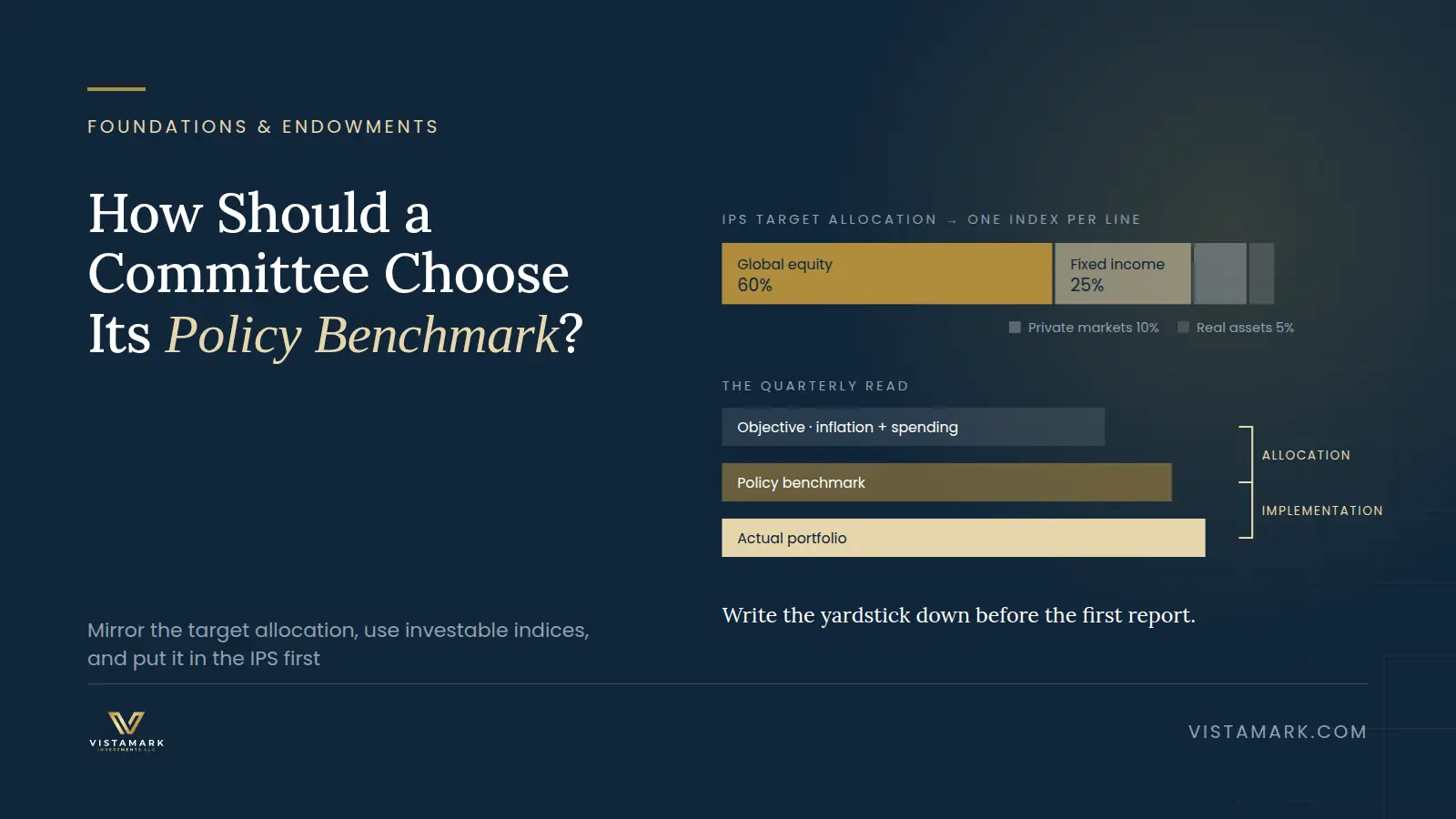
- Update the investment policy statement first. Whatever the model, the policy defines the scope of authority, the limits and how performance will be judged.
- Run a competitive search. Ask every candidate the same questions, including how it is paid in full and whether it uses its own products. Our free OCIO and investment consultant RFP template and Ten Questions to Ask an OCIO are built for this step.
- Document the decision and the delegation. Record why the committee chose the model, what it delegated and how it will monitor the result. That record is what demonstrates prudence later.
The one-sentence version
Choose a consultant if your committee wants to make every decision and has the time and expertise to do it, an OCIO if it would rather set policy and hold an expert accountable, an in-house CIO only when the portfolio is large and complex enough to carry its own team, and an Integrated CIO if you want OCIO resources with a senior investment officer working inside your own committee.
Sources and further reading
- PNC — Key Takeaways from the 2025 NACUBO-Commonfund Study of Endowments (April 2026)
- Chief Investment Officer — OCIO to See $1.3T in Inflows by 2029, reporting Cerulli Associates’ U.S. Outsourced Chief Investment Officer Function 2025 (November 2025)
- 29 U.S.C. § 1002 — ERISA definitions, including (21) fiduciary and (38) investment manager
- 29 U.S.C. § 1105(d) — trustee liability when an investment manager is appointed
- Uniform Law Commission — Uniform Prudent Management of Institutional Funds Act (2006), Section 5: Delegation of Management and Investment Functions
This article is part of our Foundation & Endowment Investment Guide, which collects our writing on the topic with answers to common questions.
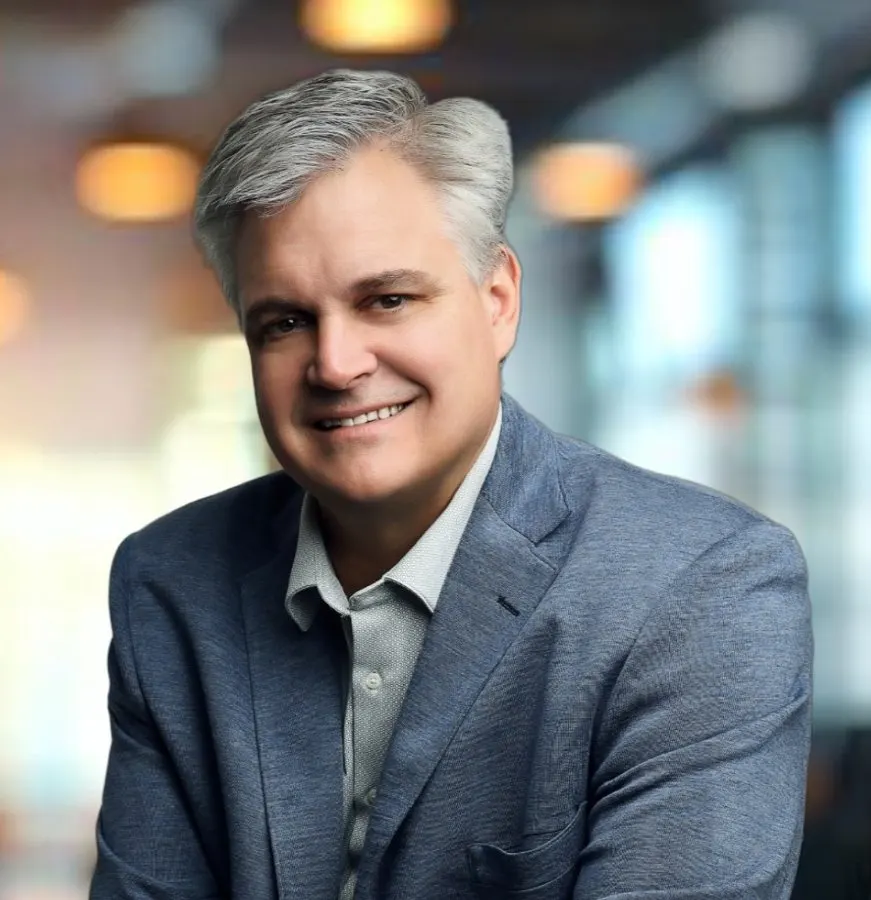
Founder and CIO of Vistamark; as CIO of Fiducient Advisors, oversaw investment strategy for more than $260 billion in client assets. More about Matthew →
This article is for informational and educational purposes only and does not constitute investment, legal, tax or accounting advice, or an offer or solicitation to buy or sell any security. Views are those of the author as of the publication date and are subject to change. Vistamark Investments is an SEC-registered investment adviser; see our disclosures.