Why does your financial advisor's succession plan matter?
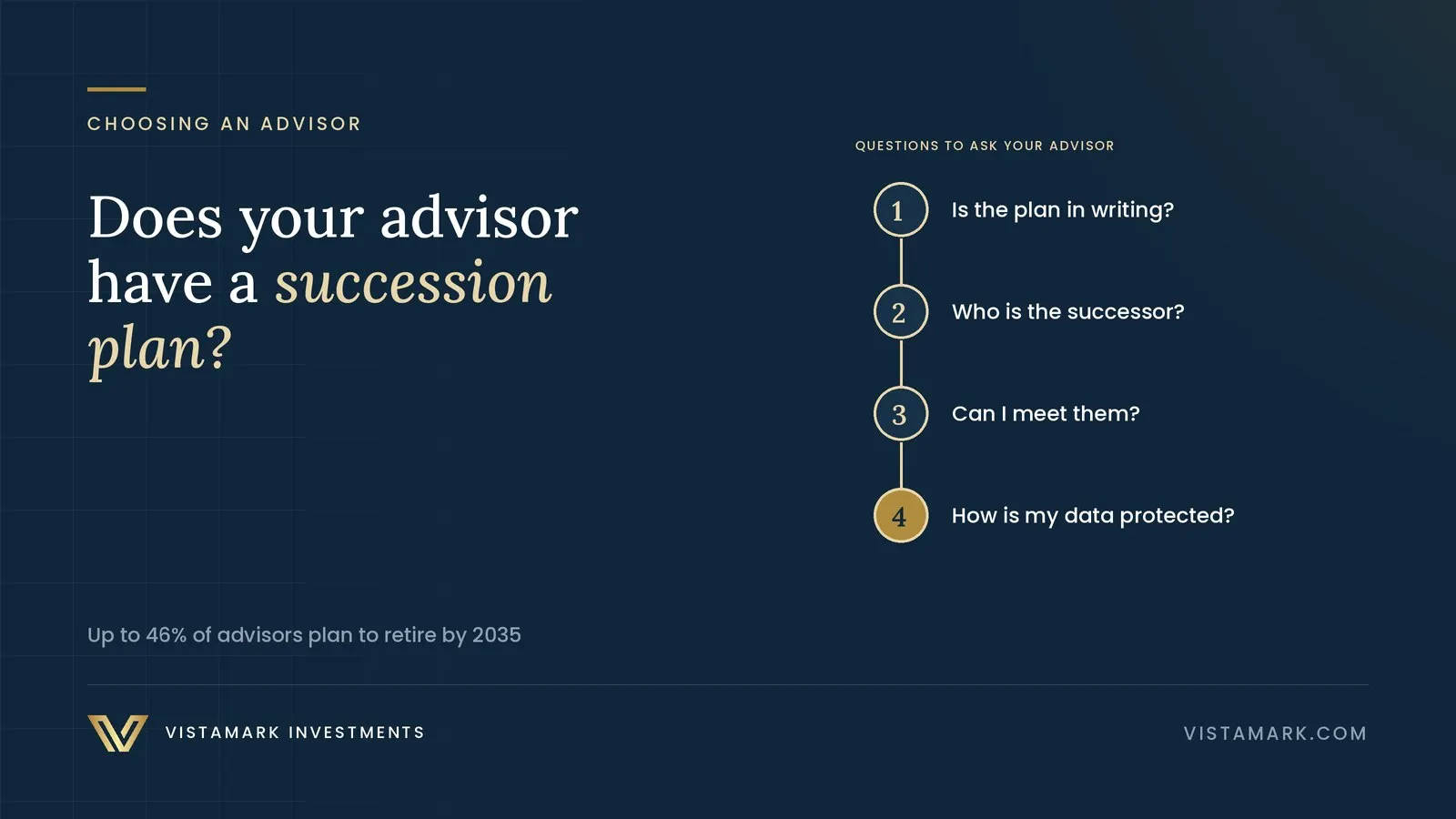
Choosing a financial advisor today is about more than investment performance—it’s about securing the future stewardship of your family’s wealth. With a wave of advisor retirements ahead, families must consider who will manage their assets tomorrow, not just today. Up to 46% of U.S. financial advisors plan to retire by 2035, putting trillions of dollars at risk if succession planning isn’t handled properly. For clients, continuity can’t be taken for granted.
How common is it for financial advisors to lack a succession plan?
The average advisor age exceeds 55, and too many lack a clear succession plan. If your advisor retires or is suddenly unavailable, your investments and data can be transferred to strangers with little notice. For you, this can mean disruption, confusion, and even risk during key financial moments.
Why Succession Planning Matters to You
A robust succession plan ensures your relationship, strategy, and sensitive information stay secure—even if your trusted advisor steps away. Without this plan, transitions may be abrupt and stressful, with service shifts and lost priorities. If you have a multi-generational family or long-term goals, demand succession readiness before it’s too late.
The Smart Investor’s Succession Checklist
Bring these questions to your next advisor review, especially if they’re approaching retirement:
-
Do you have a written succession plan?
A written plan names who takes over each client relationship, how the transition works and how quickly clients are introduced to the successor. Ask to see it, or at least a summary, and how often it is tested.
-
Who is your successor, and can I meet them?
Your successor should be a named person or team who already knows your situation and attends some of your meetings now. Meeting them before any transition is the best test of whether the plan is real.
-
How will my data be protected?
Ask where your personal and account information is stored, who can access it, and what happens to it if your advisor leaves or the firm is sold, including whether your consent is needed before it is transferred.
-
Will fees or services change if you leave?
Ask whether your fees, service level and investment approach would stay the same under the successor, and get the answer in writing. Many families learn about changes only after an advisor has retired or sold the practice.
-
How often is your plan updated?
A succession plan should be reviewed at least once a year and whenever the team changes. An outdated plan that names people who have since left gives clients little protection.
-
Are younger advisors being trained at your firm?
Firms that hire and develop younger advisors, and pair them with senior advisors on client work, are better placed to keep relationships stable for decades and across generations of a family.
A quality advisor will answer clearly and treat this as a non-negotiable part of their commitment to your family.
The Case for Multi‑Generational Advisory Teams
Teams that blend experienced advisors with younger talent give clients the best of both worlds—technology fluency, regulatory agility, and relationship continuity. For families facing generational wealth transfer, stability is strongest when senior and junior advisors collaborate.
An Industry Shrinking in Supply
Advisor retirements are accelerating, but too few new professionals are stepping in. Choose a succession-ready team now, before competition increases and expertise becomes scarce.
Don’t Wait: Make Continuity Part of Your Investment Strategy
With over $125 trillion changing hands in the coming wealth transfer, continuity of advice is vital—whether your goal is preservation, growth, or philanthropy. Ask your advisor about their succession strategy, and look for teams that can promise stability for years to come.
Related Reading
-
How to Evaluate Fiduciary Standards at Your Advisory Firm
-
The Great Wealth Transfer: What Every Family Should Expect
-
Five Signs Your Advisor Is Planning for the Next Generation
About Vistamark Investments
Vistamark Investments helps families and institutions build resilient portfolios through private credit, fixed income, and multi-strategy solutions. Our team-based model is committed to clarity and continuity with every transition.
For more information and personalized guidance, please feel free to reach out to Vistamark Investments. You can contact us at 312-895-3001, visit our website at vistamark.com, or send us an email to info@vistamark.com.
Market Compass · weekly
Get the Compass by email
One concise recap of the week’s market-moving events and what to watch next, written by our CIO at the end of each market week.
The VistaWealth Office™ is the private wealth practice of Vistamark, an independent, employee- and partner-owned firm headquartered in Hinsdale, Illinois, in the Chicago area: investment management, family office services and planning for families, business owners and executives, coordinated with each family’s tax and estate advisors.

Managing Partner and Founder; advises families, business owners and family offices through the VistaWealth Office™ and leads Vistamark’s private markets research. More about Sean →
This article is for informational and educational purposes only and does not constitute investment, legal, tax or accounting advice, or an offer or solicitation to buy or sell any security. Views are those of the author as of the publication date and are subject to change. Vistamark Investments is an SEC-registered investment adviser; see our disclosures.