The short answer. Probably more than you think. Ten companies now make up close to 40% of the S&P 500, and a 401(k) that holds an S&P 500 index fund, a large-cap growth fund and a target-date fund owns those same companies three times over. The fix is not to sell stocks. Add up what the whole account owns, then make sure part of it sits in small and midsize companies, international stocks and bonds, and rebalance to that mix once a year.
How concentrated is the S&P 500 today?
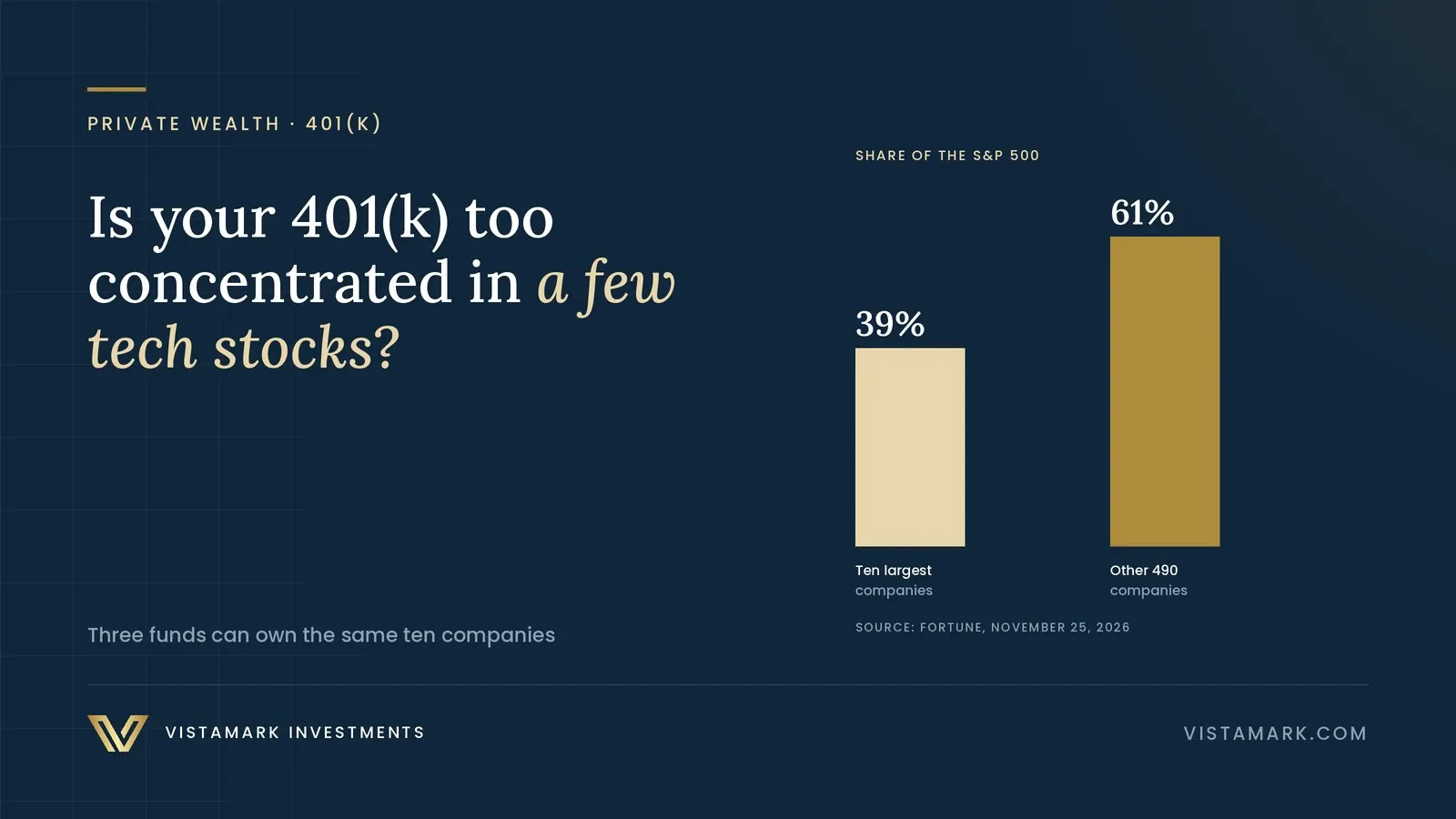
The ten largest companies in the S&P 500 make up roughly 39% of the index, according to Fortune’s November 25, 2026 reporting. Most are technology and AI-driven businesses, so one theme now sets the direction of an index of 500 companies more than at any time in decades.
That concentration is a result of success, not a flaw in the index. The S&P 500 weights each company by its market value, so the companies that grew fastest now carry the most weight. It does mean that an “S&P 500 fund” is no longer the broad, evenly spread bet many savers assume it is. When those ten stocks rise, the account rises with them, and when they fall together, as they did in this fall’s AI-led selloff, the whole account feels it.
Why does a 401(k) end up owning the same stocks several times?
Most 401(k) menus offer several funds that hold the same large companies under different names. An S&P 500 index fund, a large-cap growth fund, a total stock market fund and the U.S. stock portion of a target-date fund all own the biggest technology companies, so each looks diversified on its own while the account as a whole is not.
The overlap is easy to miss because 401(k) statements show fund names and balances, not the companies underneath. A saver who splits money across four funds to “spread it out” may hold the same ten companies in all four. The fund fact sheets on the plan website list each fund’s top ten holdings, which is the quickest way to see it.
Is a target-date fund enough diversification?
For most savers a target-date fund is a sound default, because it spreads money across U.S. and international stocks and bonds and rebalances automatically. It is enough on its own only when it is the only fund in the account. Vanguard reports that 84% of participants use target-date funds when offered and 61% hold just one.
Problems start when a saver adds a target-date fund to an S&P 500 or large-cap growth fund. The target-date fund already holds those large U.S. companies, so the extra fund pushes the account’s concentration higher and moves the mix away from the one the target-date fund was built to hold. The figures come from Vanguard’s How America Saves 2026.
What should a 401(k) saver do about concentration?
As Fortune reported, a more concentrated market “doesn’t necessarily mean investors should abandon index funds altogether.” Instead, investors should consider “taking a closer look at the makeup of their portfolio,” said Sean McEvilly, CFA, Managing Partner and Founder of Vistamark. “The practical move isn’t to bail out of stocks,” McEvilly told Fortune. “It’s to look at the whole 401(k), since target-date and large-cap funds often hold the same names, and make sure there’s real exposure to small and midsized companies, international stocks, and bonds.” The steps are to add up what the whole account owns, compare it with a target mix, and fill the gaps with funds the plan already offers.
- List every fund and its balance. Include old 401(k)s and IRAs if they are invested the same way.
- Check each fund’s top ten holdings on its fact sheet and note how much of the account sits in the same names.
- Set a target mix by age and goals, for example a set share each for large U.S., small and midsize U.S., international stocks and bonds.
- Use the menu. Most plans offer an international index fund, a small- or mid-cap fund and a bond fund.
- Rebalance once a year back to the target, or turn on the plan’s automatic rebalancing.
What does the overlap look like in a real account?
A simple tally of fund holdings usually shows the overlap. In the hypothetical account below, two stock funds that look different put about a third of a $400,000 401(k) in the same ten companies, while small companies and international stocks get almost nothing.
| Fund (hypothetical) | Balance | Share in the ten largest S&P 500 companies | Dollars in those ten companies |
|---|---|---|---|
| S&P 500 index fund | $200,000 | 39% | $78,000 |
| Large-cap growth fund | $100,000 | 55% (assumed) | $55,000 |
| Bond fund | $100,000 | 0% | $0 |
| Total | $400,000 | 33% | $133,000 |
Worked example (hypothetical). This saver has no small-company or international stock at all. Moving $60,000 from the growth fund into an international index fund and $40,000 into a small- and mid-cap fund cuts the money in those ten companies from about $133,000 to $78,000, or from 33% of the account to under 20%, without selling out of stocks. The fund weights are illustrative, not a recommendation of any fund or a forecast of returns.
Should savers sell their tech stocks after a selloff?
Selling after a drop usually locks in the loss and adds the problem of deciding when to buy back. Rebalancing on a schedule does the useful part of selling: it trims what has grown beyond its target and adds to what has lagged, on a rule rather than on a headline. For long-term savers, the mix matters more than the timing.
Inside a 401(k), rebalancing has no tax cost, which makes it the cleanest place to fix concentration. In a taxable account, families with large gains in one or a few stocks have other tools, from gradual sales to exchange funds and option strategies, covered in A Strategic Guide to Hedging Your Concentrated Stock Position.
Does international diversification still help?
International stocks respond to different economies, currencies and sectors than the large U.S. technology companies that lead the S&P 500, which is the point of holding them. They have lagged U.S. stocks for long stretches, so their job in a 401(k) is to keep any single market from deciding the outcome, not to outperform every year.
Our article International Equity Diversification: Weighing the Global Opportunities and Challenges explains how much international exposure to consider and why it often feels least useful just before it helps.
How much are 401(k) savers putting away?
Savings rates remain steady even as markets swing. Fidelity reports an average total 401(k) savings rate of 14.3% in the third quarter of 2026, combining an average employee contribution of 9.6% and an employer contribution of 4.7%.
Steady contributions are the most reliable part of a retirement plan, and they also make rebalancing easier: new money can go to the parts of the mix that are below target. The figures are from Fidelity’s Q3 2026 Retirement Analysis of 26.2 million participants.
Where does Vistamark fit?
Vistamark is an independent, employee- and partner-owned investment firm headquartered in Hinsdale, Illinois, in the Chicago area. Through the VistaWealth Office™, it reviews families’ full balance sheets, including 401(k)s, IRAs and concentrated stock, sets a target mix across every account and rebalances by rule, coordinated with each family’s tax and estate advisors. Vistamark has no minimum. This article is general information, not investment advice.
Sources
Market Compass · weekly
Get the Compass by email
One concise recap of the week’s market-moving events and what to watch next, written by our CIO at the end of each market week.

Managing Partner and Founder; advises families, business owners and family offices through the VistaWealth Office™ and leads Vistamark’s private markets research. More about Sean →
This article is for informational and educational purposes only and does not constitute investment, legal, tax or accounting advice, or an offer or solicitation to buy or sell any security. Views are those of the author as of the publication date and are subject to change. Vistamark Investments is an SEC-registered investment adviser; see our disclosures.