The short answer. A fiduciary financial advisor is legally required to put your interests ahead of its own for the whole relationship. Under the Investment Advisers Act, a registered investment adviser owes a duty of care and a duty of loyalty and must eliminate or fully disclose every conflict of interest. A broker-dealer under Regulation Best Interest, in force since June 30, 2020, owes a best-interest duty only when it makes a recommendation and has no duty to monitor your account. Most families with ongoing planning, tax and estate needs are better served by a fiduciary.
What does it mean for a financial advisor to be a fiduciary?
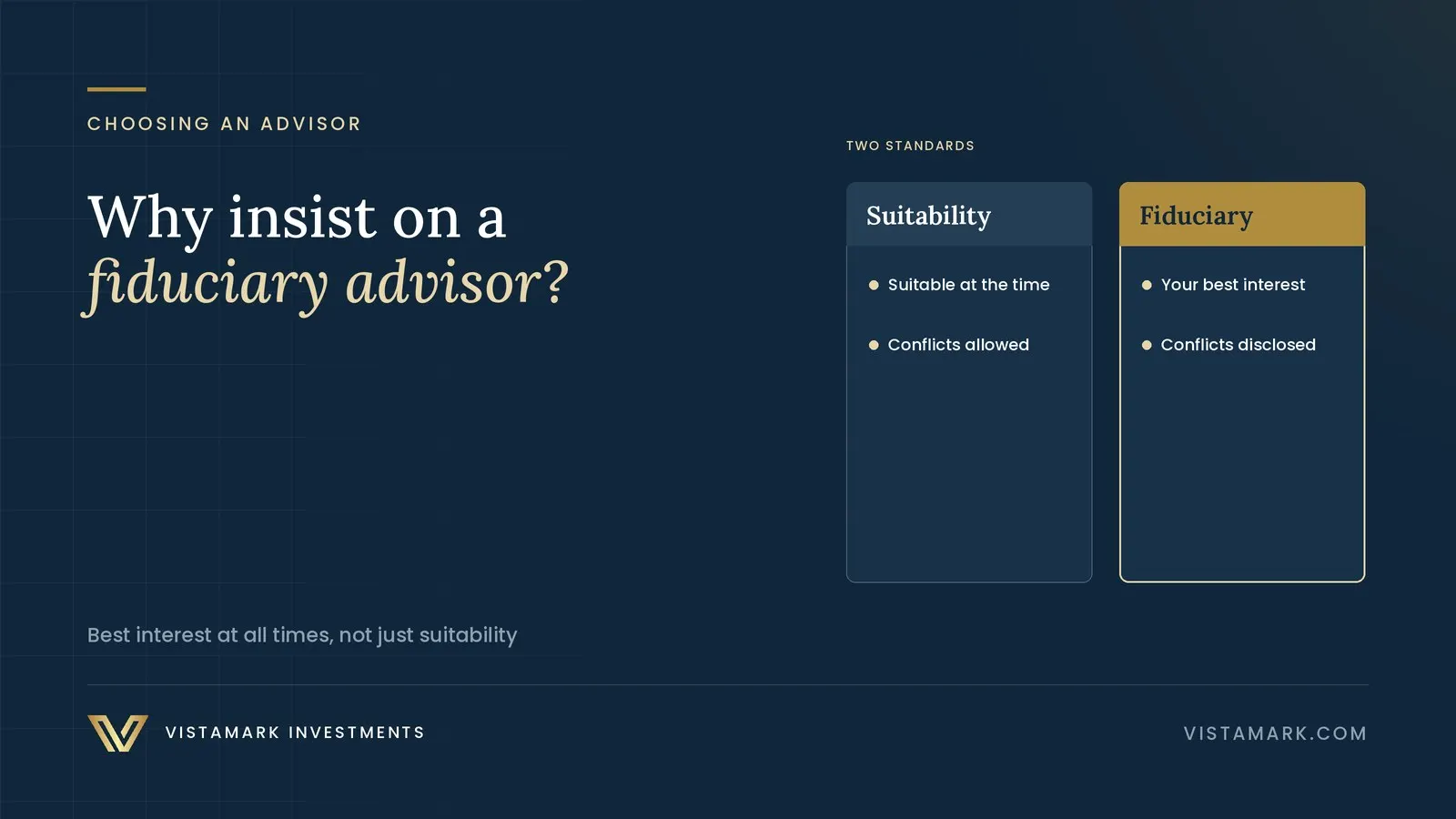
A fiduciary financial advisor must act in the client’s best interest at all times, not only when selling something. For a registered investment adviser, the SEC describes this duty as a duty of care plus a duty of loyalty that “applies to the entire adviser-client relationship” (SEC, Release IA-5248).
- Duty of care. Advice must suit your goals and situation, be based on a reasonable investigation, and include the best execution of trades and monitoring at a frequency that fits the relationship.
- Duty of loyalty. The adviser may not put its interests ahead of yours, and it “must eliminate or make full and fair disclosure of all conflicts of interest” so you can give informed consent (SEC).
- Enforcement. The duty is enforced through the antifraud provision of the Investment Advisers Act, section 206 (15 U.S.C. § 80b-6).
What is the difference between a fiduciary and a broker?
A registered investment adviser is a fiduciary for the whole relationship, while a broker-dealer under Regulation Best Interest must act in your best interest only “at the time the recommendation is made” and does not have to monitor your account afterward (SEC). The SEC adopted Regulation Best Interest on June 5, 2019.
| Registered investment adviser (fiduciary) | Broker-dealer (Regulation Best Interest) | |
|---|---|---|
| When the duty applies | Throughout the relationship | When a recommendation is made |
| Ongoing monitoring | Part of the duty of care, as agreed with the client | Not required by Regulation Best Interest |
| Conflicts of interest | Eliminate or fully and fairly disclose all of them | Disclose, and mitigate or eliminate certain ones |
| How it is usually paid | Advisory fees paid by the client | Commissions and sales charges per transaction |
| Where to check | Form ADV and Form CRS | Form CRS and BrokerCheck |
Insurance agents selling life insurance and annuities work under state insurance rules rather than either standard above, which is why large insurance purchases deserve an independent review; our article How Should Wealthy Families Use Life Insurance? explains what to check.
Are all financial advisors fiduciaries?
No. “Financial advisor” is not a legally protected title, so a person using it may be a registered investment adviser, a broker-dealer representative, an insurance agent, or someone who is all three and changes roles from one account to the next. Ask whether the firm acts as a fiduciary for every account and every recommendation, and get the answer in writing.
Two other signals help. CFP Board requires that “at all times when providing Financial Advice to a Client, a CFP® professional must act as a fiduciary” (CFP Board). And an adviser’s size decides its regulator: a firm may register with the SEC once it manages $100 million and must register at $110 million (17 CFR 275.203A-1); smaller advisers generally register with their state, in Illinois the Secretary of State.
How are fiduciary advisors paid?
Fiduciary advisors are usually paid directly by the client through an advisory fee, which may be a flat fee, an hourly or project fee, or a fee based on the assets managed. What matters most is whether anyone other than the client pays the advisor, because outside payments such as commissions or revenue sharing create conflicts that must be disclosed.
- Fee-only: paid only by clients. The fewest product conflicts.
- Fee-based: advisory fees plus commissions on some products, often through a related broker-dealer or insurance agency. Ask which accounts are covered by the fiduciary duty.
- Commission: paid by product providers when you buy. Usually a broker-dealer relationship under Regulation Best Interest.
Ask every firm to state its total annual cost for your family in dollars, including fund expenses, not only the headline fee.
What does the difference look like in dollars?
The fiduciary question matters most at large, one-time decisions such as rolling over a 401(k), investing the proceeds of a business sale, or buying an annuity or permanent life insurance, where an upfront sales charge or a higher-cost product can cost tens of thousands of dollars.
Consider a Hinsdale executive rolling a $1,000,000 401(k) into an IRA. One recommendation puts the money in funds with a 5% upfront sales charge, which costs $50,000 on day one, before any annual expenses. A comparable portfolio without a sales charge leaves the full $1,000,000 invested. Both recommendations might pass a point-of-sale test, but a fiduciary must weigh the cost and either avoid the conflict or disclose it fully, and then keep monitoring the account. The figures are illustrative; the actual costs appear in the product prospectus and the firm’s Form CRS.
How can you check whether an advisor is a fiduciary?
You can check whether an advisor is a fiduciary in a few minutes on Investor.gov, the SEC’s free investor site, by searching the firm and the individual and then reading the firm’s Form CRS relationship summary and Form ADV Part 2A brochure.
- Search the firm and the individual on Investor.gov’s Check Out Your Investment Professional tool, which shows registration and disciplinary history.
- Read the firm’s Form CRS, the two- to four-page relationship summary that describes its services, fees, conflicts of interest and standard of conduct (Investor.gov).
- Read Form ADV Part 2A for fees, conflicts, custody and any disciplinary events.
- Ask whether the firm or the individual is also registered as a broker-dealer or insurance agent.
- Ask for written confirmation that the fiduciary duty covers every account you would open.
Do Chicago families need a fiduciary advisor?
Chicago-area families with significant assets usually benefit from a fiduciary advisor, because their biggest decisions are ongoing and tax-driven rather than one-time product purchases. Illinois taxes estates above $4 million, and that exemption cannot pass to a surviving spouse, so many families face Illinois estate tax with no federal estate tax.
The federal exemption is $15 million per person in 2026 (IRS), while the Illinois threshold stays at $4 million (Illinois Attorney General). Planning for that gap, along with business sales, executive stock and charitable giving, takes years of coordinated advice with the family’s CPA and estate attorney. That is the kind of ongoing relationship the fiduciary duty is designed to cover. Business owners preparing for a sale should also read How Should a Chicago Business Owner Choose an M&A Advisor?
What should you ask a fiduciary advisor before hiring one?
Before hiring a fiduciary advisor, ask whether the firm is a fiduciary for everything it does for you, what you will pay each year in dollars, who holds your assets, who will serve your family day to day, and how the firm coordinates with your CPA and estate attorney.
Our article What Should You Ask a Chicago Wealth Manager Before Hiring One? lists twelve questions, what a strong answer sounds like and the warning signs, and shows how to check each answer against the firm’s filings.
Where does Vistamark fit?
The VistaWealth Office is the private wealth practice of Vistamark, an independent, employee- and partner-owned firm headquartered in Hinsdale, Illinois, in the Chicago area. Vistamark is a registered investment adviser and a fiduciary to every client; it is not a broker-dealer, does not sell proprietary products, and has no minimum. Its fees are described on Our fees. Client assets are held at an independent custodian; the firm prefers Charles Schwab and can work with other custodians. Our Form CRS and Form ADV are linked from our Disclosures page. This article is general information, not investment, legal or tax advice.
Sources
- SEC — Commission Interpretation Regarding Standard of Conduct for Investment Advisers (Release IA-5248)
- SEC — Regulation Best Interest: A Small Entity Compliance Guide
- Legal Information Institute — 15 U.S.C. § 80b-6, Prohibited Transactions by Investment Advisers
- Legal Information Institute — 17 CFR 275.203A-1, Eligibility for SEC Registration
- SEC, Investor.gov — Relationship Summaries (Form CRS or Form ADV Part 3): Investor Bulletin
- SEC, Investor.gov — Check Out Your Investment Professional
- CFP Board — Code of Ethics and Standards of Conduct
- Internal Revenue Service — What’s New, Estate and Gift Tax
- Illinois Attorney General — Important Notice Regarding Illinois Estate Tax and Fact Sheet
Market Compass · weekly
Get the Compass by email
One concise recap of the week’s market-moving events and what to watch next, written by our CIO at the end of each market week.

Founder and CIO of Vistamark; as CIO of Fiducient Advisors, oversaw investment strategy for more than $260 billion in client assets. More about Matthew →
This article is for informational and educational purposes only and does not constitute investment, legal, tax or accounting advice, or an offer or solicitation to buy or sell any security. Views are those of the author as of the publication date and are subject to change. Vistamark Investments is an SEC-registered investment adviser; see our disclosures.