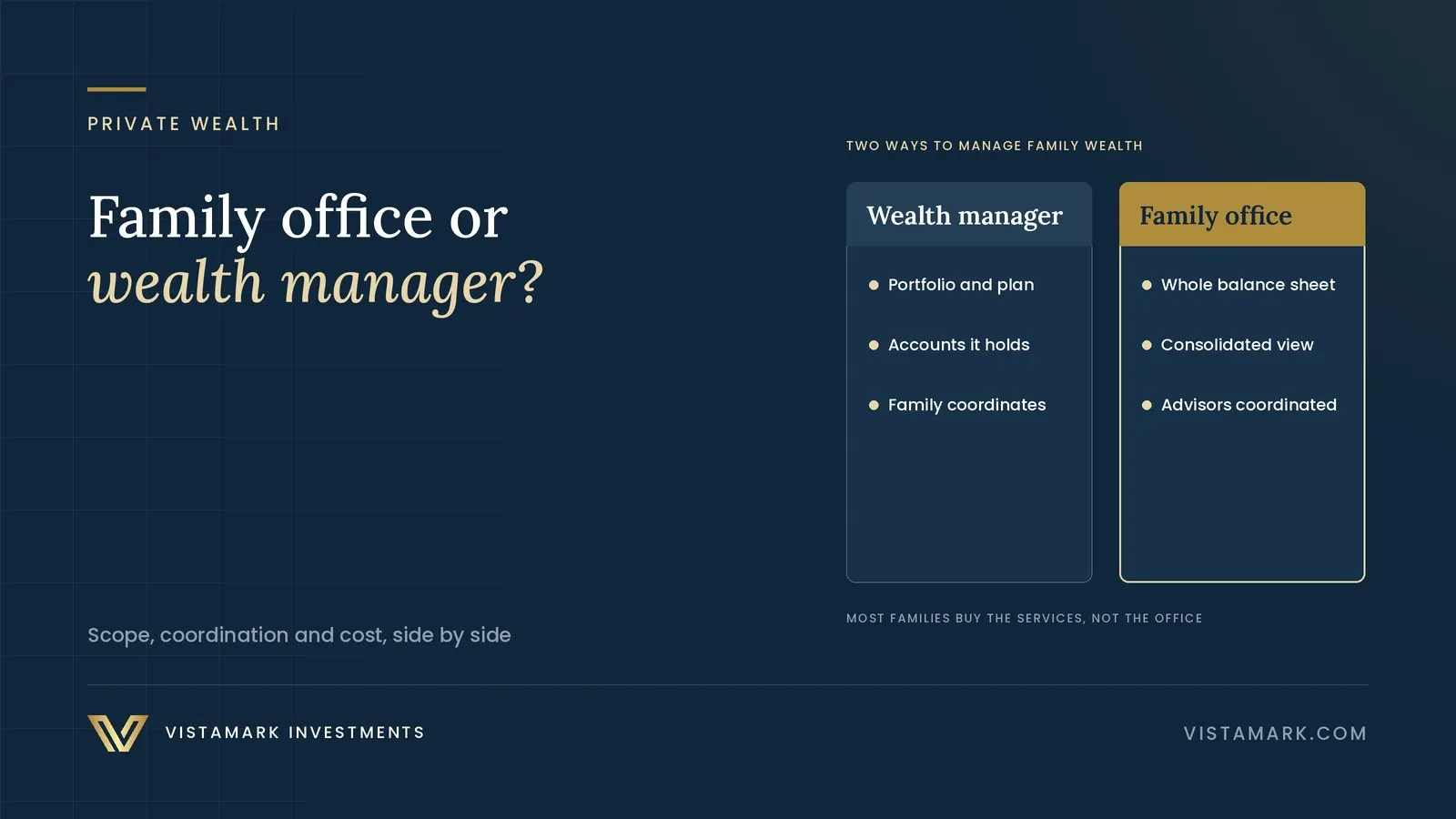
The short answer. A wealth manager invests your portfolio and builds your financial plan. A family office runs your family’s whole financial life as one enterprise: investments across every account and entity, tax and estate coordination, consolidated reporting, private investments and family governance. Only the largest families need to build a family office of their own. Most families with complex wealth are better served by a firm that delivers family office services without the overhead, and the hard part is telling which firms actually do.
What does a wealth manager do?
A wealth manager manages investments and provides financial planning, usually for individuals and couples. The work centers on a portfolio of stocks, bonds and funds, a retirement plan, and periodic reviews. Wealth managers sit inside wirehouses, banks, insurance companies and independent registered investment advisers (RIAs), and the business model shapes the advice: some are fiduciaries at all times, some are paid partly through products, and caseloads per advisor vary widely. For a household with a straightforward balance sheet, a good wealth manager is all it needs.
What does a family office do?
A family office manages a family’s wealth the way an endowment manages an institution’s: with written policy, one consolidated view of every asset, and someone accountable for coordinating every advisor. Its work covers investment policy and manager selection, private investments and direct deals, tax and estate coordination, trust and entity administration, reporting and bill pay, risk management, philanthropy and preparing the next generation. Our article What Is a Family Office, and Does Your Family Need One? covers each function.
A single-family office serves one family and is owned by it. Under the SEC’s family office rule, an office that advises only family clients, is wholly owned and controlled by the family, and does not hold itself out to the public is excluded from registering as an investment adviser (SEC Release IA-3220). A multi-family office serves many families and is generally a registered investment adviser, with the same fiduciary duty and Form ADV disclosure as any RIA.
How do a family office and a wealth manager compare?
| Question | Typical wealth manager | Family office (single- or multi-family) |
|---|---|---|
| What is managed? | The accounts the firm holds | Everything the family owns: accounts at several custodians, trusts, entities, private funds, real estate, an operating business |
| Who coordinates the CPA and estate attorney? | Usually the family | The family office, around one plan |
| Reporting | Statements for the firm’s accounts | One consolidated report across every account and entity, often after tax |
| Investment policy | A risk profile and a model portfolio | A written investment policy statement for the family and each trust |
| Private investments | Often limited to a product menu | Written diligence, pacing and capital-call planning |
| Governance | Rarely in scope | Family meetings, decision rules and next-generation education |
| Clients per advisor | Often a large book of households | One family, or a small number |
| Cost | A percentage of the assets held | A single-family office carries fixed staff and systems costs; a multi-family office charges a fee for the full scope |
How much does a family office cost?
More than most families expect. BNY Wealth notes that families with $250 million or more typically establish their own offices, and illustrates an annual budget of roughly $6.5 million: about 260 basis points of a $250 million family’s wealth, falling to about 65 basis points at $1 billion (BNY Wealth). Those costs are paid whether markets rise or fall, and recruiting and keeping senior investment talent is often harder than paying for it. That is why most families below the very top buy family office functions rather than build them, as our build, buy or blend article explains.
Is every firm that says “family office” a family office?
No. Outside the SEC’s single-family office exclusion, there is no legal test for using the words, and many wealth managers now describe themselves as family offices or as offering family office services. The label tells you little; the scope of work tells you everything. Ask any firm to show, in writing, which of these it does and which it leaves to you:
- A written investment policy statement for the family, each trust and any foundation.
- Consolidated reporting across custodians, entities and private funds, including assets it does not manage.
- Regular coordination with your CPA and estate attorney, with someone named as responsible for it.
- Written diligence on every private investment, and a pacing plan for capital calls.
- Tax-aware management across taxable, trust and retirement accounts.
- Family meeting support and education for the next generation.
Which does your family need?
Complexity, not a single dollar figure, is the better guide. A wealth manager is usually enough when most of the wealth sits in a few investment accounts, one generation makes the decisions, and the tax and estate plan is simple. Family office services usually pay for themselves when:
- Wealth is spread across several custodians, trusts or entities, and no one sees it all in one place.
- The family owns private funds, real estate, direct deals or an operating business.
- A business sale or other liquidity event has just created a large pool of capital.
- The CPA, attorney and investment advisor rarely talk to each other.
- Two or more generations are involved in decisions, or soon will be.
Our free family office self-assessment scores fifty of these practices in about twenty minutes, and How Should a Family Coordinate Its Advisors? covers the coordination problem in detail.
Where does Vistamark fit?
The VistaWealth Office is Vistamark’s private wealth practice. It applies the investment process our partners use for institutions to families, and adds family office services: investment policy, consolidated reporting, manager oversight and investment committee support, coordinated with your tax, trust and estate, insurance and philanthropy advisors. Vistamark is independent and 100% employee- and partner-owned, has no minimum, and charges one advisory fee, either asset-based or flat, described on Our fees. A partner works directly with each family.
Sources
This article is part of our Family Governance Guide, which collects our writing on the topic with answers to common questions.

Managing Partner and Founder; advises families, business owners and family offices through the VistaWealth Office™ and leads Vistamark’s private markets research. More about Sean →
This article is for informational and educational purposes only and does not constitute investment, legal, tax or accounting advice, or an offer or solicitation to buy or sell any security. Views are those of the author as of the publication date and are subject to change. Vistamark Investments is an SEC-registered investment adviser; see our disclosures.