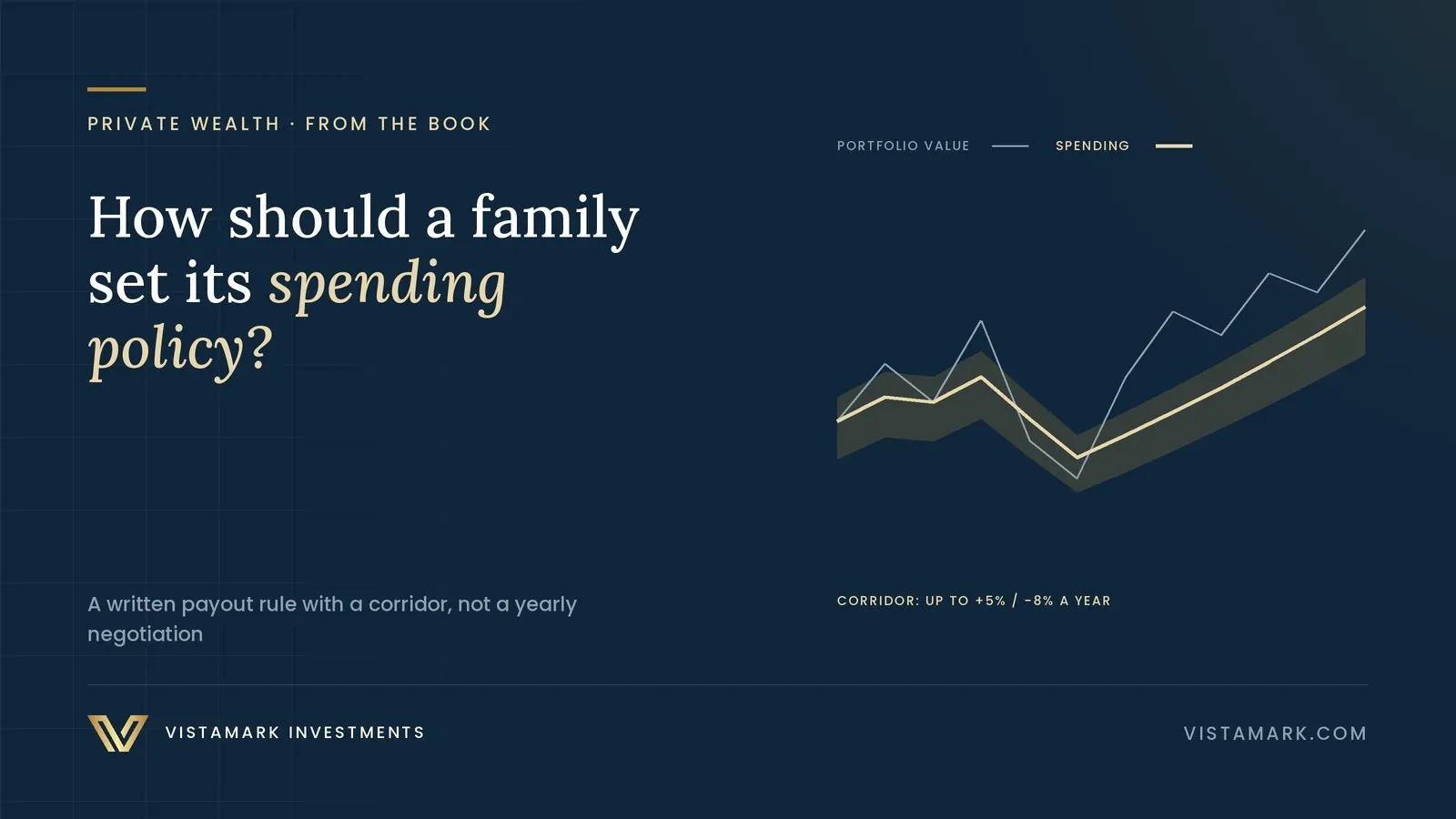
Endowments and foundations have spent decades refining one rule: how much to take out of the portfolio each year. Families rarely write that rule down, yet it is the single decision that most determines whether wealth lasts. Spend too much and the portfolio shrinks in real terms; spend too little and the family gives up the life, the gifts and the impact the money was meant to support.
What is a family spending policy?
A spending policy is a written rule that sets how much the family's investment portfolio will distribute each year for living expenses, gifts and other needs. It replaces a yearly negotiation with a formula the family agreed to in advance. The policy usually covers the core portfolio, with separate rules for one-time needs such as a home purchase or a business investment.
How much can a family safely spend each year?
For a portfolio meant to last for generations, sustainable spending is usually in the range of 3% to 4% of value a year. The arithmetic is simple: the portfolio has to earn enough after fees, taxes and inflation to replace what is spent. A diversified portfolio's long-term real return after costs is the practical ceiling, and families paying income and capital gains taxes face a lower ceiling than tax-exempt institutions. A family whose goal is to spend down over one lifetime can safely spend more than one planning for grandchildren.
Which spending formula works best for families?
Families can borrow from the formulas institutions use. Each has a trade-off between stable spending and protecting the portfolio.
| Formula | How it works | Strength | Weakness |
|---|---|---|---|
| Fixed percentage | Spend a set percentage of the current value | Never depletes the portfolio | Spending swings with the market |
| Moving average | Spend a set percentage of the average value over the past three years or twelve quarters | Smooths spending | Still falls after a long bear market |
| Inflation-adjusted | Start with a dollar amount and raise it with inflation each year | Most predictable spending | Ignores how the portfolio is doing |
| Hybrid | Blend the inflation-adjusted amount with a percentage of value | Balances stability and sustainability | Slightly harder to explain |
For most families we favor a moving average with guardrails, described below. It is simple to explain at a family meeting and responds to the market without whipsawing the household budget.
What is a spending corridor, and why does it matter?
A corridor puts a floor and a ceiling on how much spending can change from one year to the next, for example no more than 10% down and 5% up. In Think Like a Family Office, the corridor is one of the questions in our self-assessment because it does two jobs at once. In a strong market, the ceiling stops spending from ratcheting up to a level the portfolio cannot sustain. In a weak market, the floor prevents a sudden cut that would force the family to sell assets or abandon commitments. The corridor turns market volatility into gradual, planned adjustments.
How should taxes, trusts and multiple accounts be handled?
Set the policy on the family's total investable wealth, then decide which accounts fund the spending. A few principles help:
- Spend from taxable accounts in a tax-aware order. Use dividends, interest and harvested losses first, and realize gains deliberately rather than by accident.
- Respect trust terms. Distributions from a trust must follow its document and the trustee's judgment, so coordinate the family policy with each trustee rather than assuming trust money is available.
- Count required distributions. Required minimum distributions from retirement accounts are part of spending whether the family needs them or not.
- Keep philanthropy visible. If gifts to a foundation or donor-advised fund come from the same pool, include them in the policy so charitable commitments do not crowd out the family's security.
What should a family do when spending exceeds the policy?
Name it, measure it and decide on purpose. Large one-time needs are normal. The policy should say who can approve an exception, how it will be funded and whether future spending will be reduced to make up the difference. What families should avoid is drift: several years of spending a little above the rule, each justified on its own, that together permanently shrink the portfolio.
How do you put a spending policy in place?
Start with the family's actual spending over the past two or three years, including gifts and taxes paid from the portfolio. Compare it with 3% to 4% of investable assets. If spending is well above that range, the policy is the place to agree on a path back, not an overnight cut. Then write the formula, the corridor and the exception process into the family's investment policy statement and review it once a year.
The VistaWealth Office builds spending policies alongside the investment plan so the two are set together, not in isolation.
This article is part of our Family Governance Guide, which collects our writing on the topic with answers to common questions.
Market Compass · weekly
Get the Compass by email
One concise recap of the week’s market-moving events and what to watch next, written by our CIO at the end of each market week.

Managing Partner and Founder; advises families, business owners and family offices through the VistaWealth Office™ and leads Vistamark’s private markets research. More about Sean →
This article is for informational and educational purposes only and does not constitute investment, legal, tax or accounting advice, or an offer or solicitation to buy or sell any security. Views are those of the author as of the publication date and are subject to change. Vistamark Investments is an SEC-registered investment adviser; see our disclosures.