The phrase "family office" conjures images of billionaires with private staff. In practice, the idea is simpler and more useful: a family office is whatever arrangement a family uses to manage its wealth as one coordinated enterprise rather than a collection of accounts and advisors. In Think Like a Family Office, the central argument is that every family with significant wealth should think this way, whether or not it ever hires a single employee.
What does a family office do?
A family office coordinates everything that touches a family's wealth. The core functions are:
- Investment management: setting policy, allocating assets, selecting and monitoring managers, including private investments.
- Tax planning: coordinating returns, estimated payments and tax-aware investing across family members and entities.
- Estate and trust coordination: keeping documents current and making sure trusts are invested and administered as intended.
- Reporting and bill pay: a single consolidated view of the family's wealth, and administration of its day-to-day finances.
- Risk management: insurance, cybersecurity and asset protection.
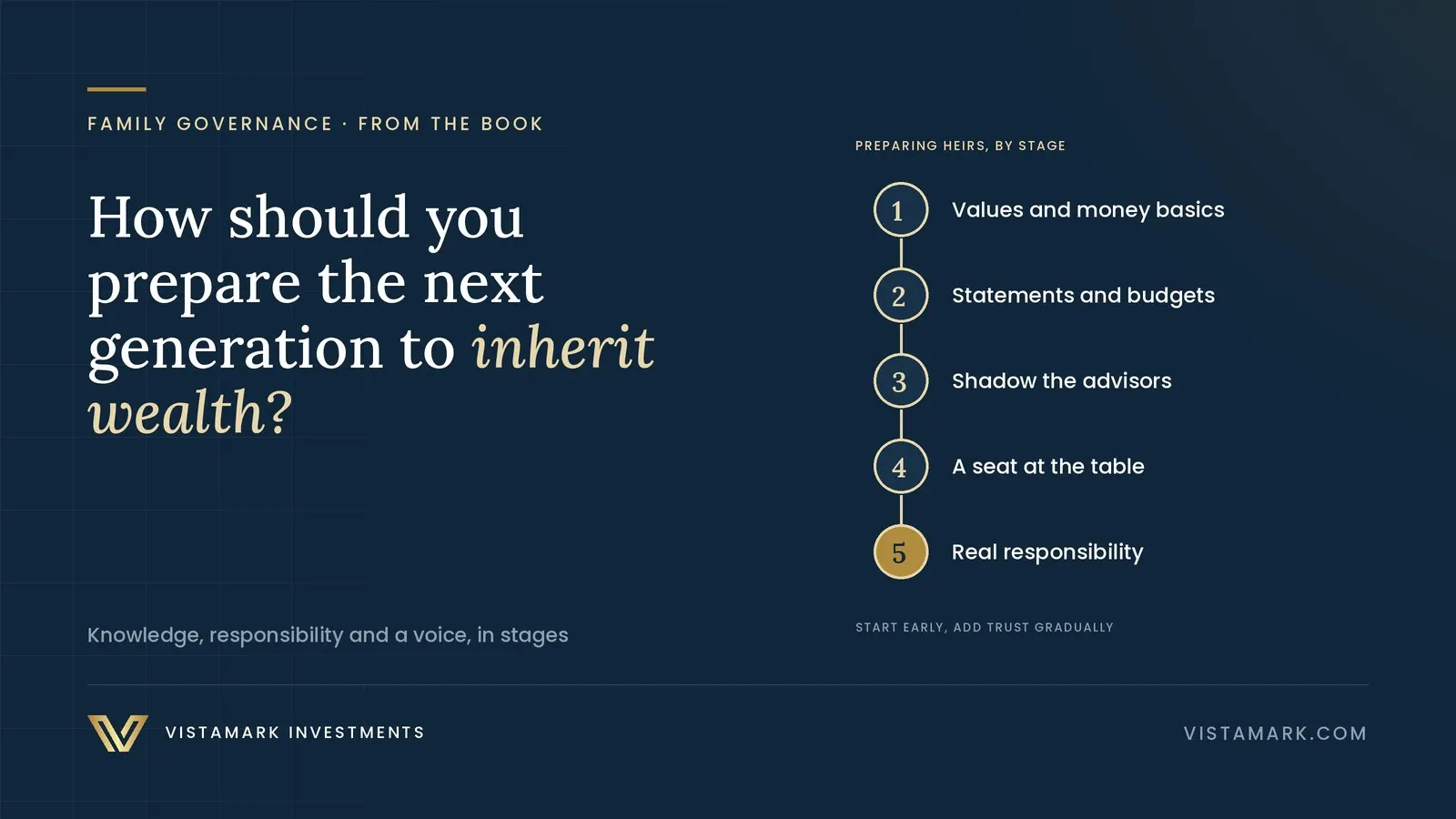
- Governance and education: family meetings, decision-making rules and preparing the next generation.
- Philanthropy: managing a foundation or donor-advised fund and the family's giving strategy.
What is the difference between a single-family and a multi-family office?
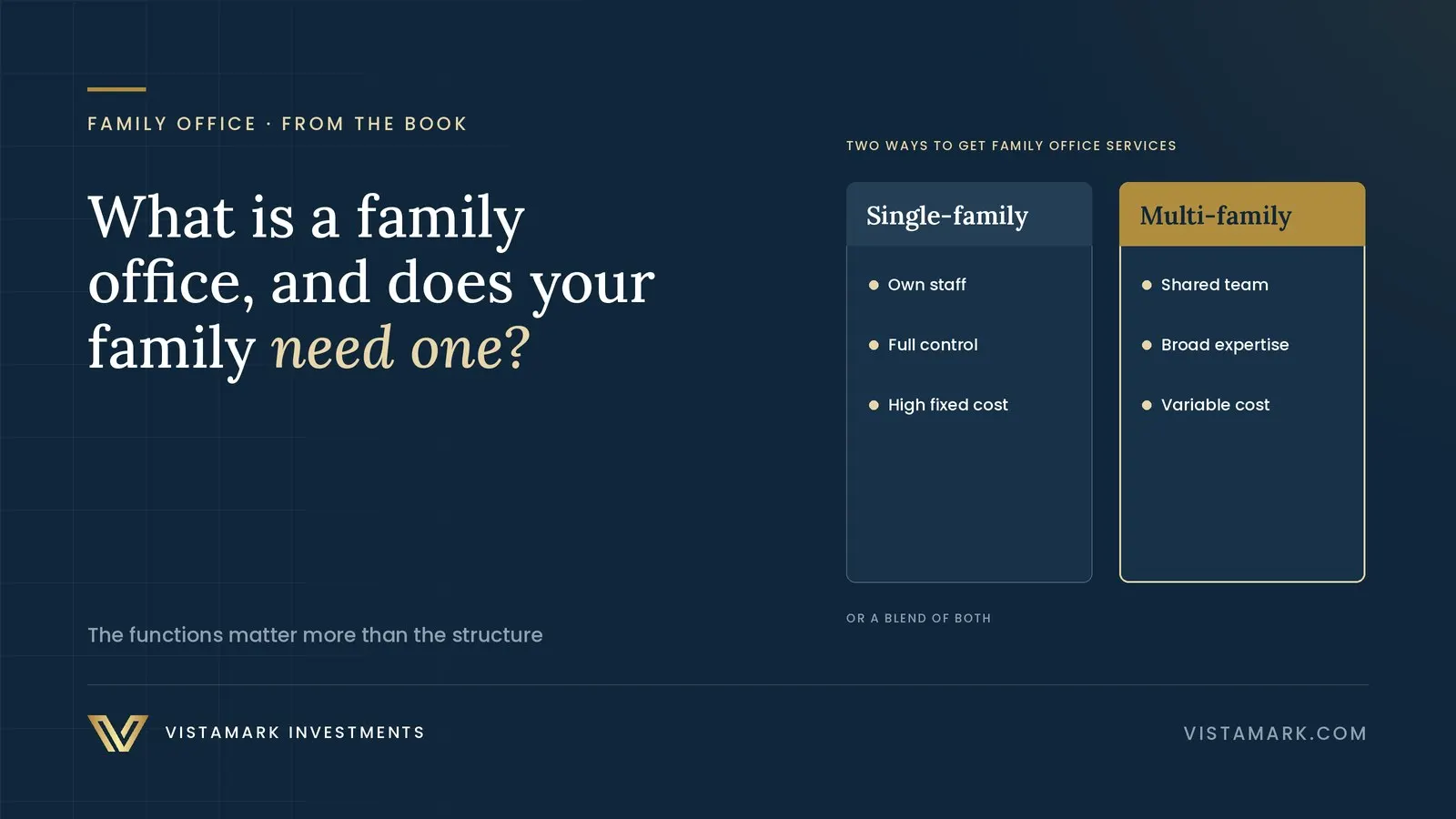
A single-family office works for one family only and is usually owned by it, with its own staff, systems and overhead. A multi-family office serves many families and spreads the cost of experienced people and infrastructure across all of them. A single-family office offers complete control and privacy; a multi-family office offers broader expertise and a lower, more variable cost. Many families blend the two, keeping a small team for administration and governance while relying on an outside firm for investment research and specialist advice.
How much wealth does a family need for its own family office?
Far more than most people assume. A single-family office has substantial fixed costs: senior investment talent, accounting, technology, compliance and security, all paid whether markets rise or fall. As a share of assets, those costs only become reasonable for very large families, and even then recruiting and keeping talented people is often harder than paying for them. Below that level, a family usually gets better expertise for less money by buying the functions rather than building them.
What are the signs a family needs family office services?
- Wealth is spread across many accounts, custodians, trusts and entities, and no one has a single view of it.
- Several advisors, such as an investment manager, CPA and estate attorney, rarely speak to each other.
- The family owns private investments, real estate or an operating business alongside its portfolio.
- A liquidity event, such as the sale of a business, has just created a large pool of capital.
- More than one generation is involved in decisions, or soon will be.
- One family member carries the whole financial picture in their head.
Two or three of these usually mean the family would benefit from family office discipline, regardless of its size.
What does it mean to "think like a family office"?
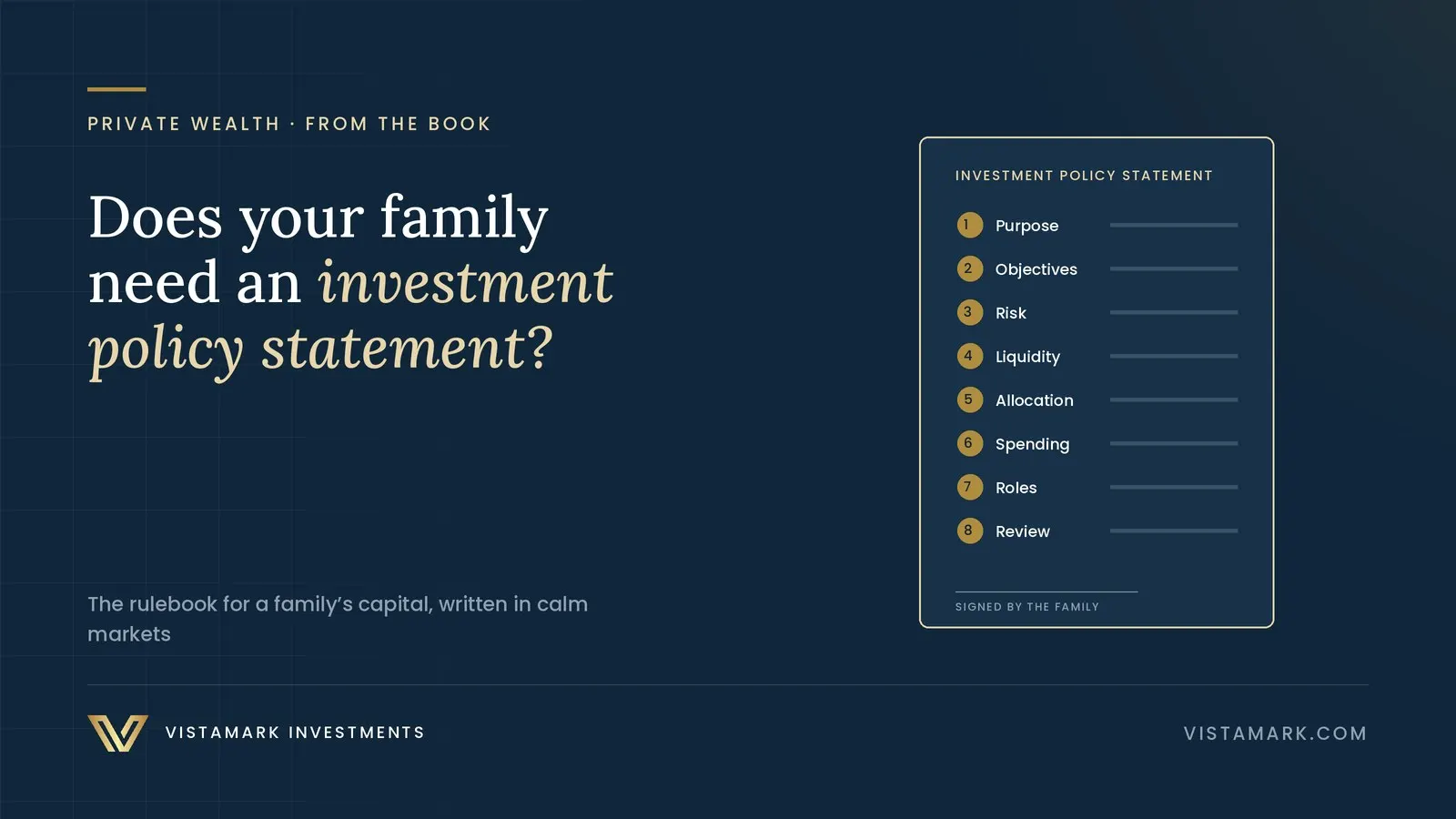
It means adopting the habits of the best institutional investors without necessarily building an institution. A family that thinks like a family office writes down its investment policy, sets a deliberate spending policy, manages its portfolio on an after-tax basis across every account, coordinates its advisors around one plan, meets regularly as a family, and plans for continuity. Those practices, not the size of the staff, are what preserve wealth across generations.
How should a family choose a family office or outsourced partner?
Look for independence and a fiduciary duty, transparent fees stated in dollars, senior people who will actually work on your account, genuine capability in private markets and tax-aware investing, and an ownership structure that is unlikely to change after you hire them. Ask how the firm coordinates with your CPA and attorney, and ask to see a sample of its consolidated reporting. Our build, buy or blend article covers this decision in more depth.
Where should a family start?
Start with an honest inventory: every account, entity, advisor and recurring decision, on one page. Most families have never seen their wealth this way, and the gaps become obvious. Our family office self-assessment, drawn from the book, scores fifty practices in about twenty minutes. The VistaWealth Office provides family office services for families who want the discipline without building an office of their own.
This article is part of our Family Governance Guide, which collects our writing on the topic with answers to common questions.

Founder and CIO of Vistamark; as CIO of Fiducient Advisors, oversaw investment strategy for more than $260 billion in client assets. More about Matthew →
This article is for informational and educational purposes only and does not constitute investment, legal, tax or accounting advice, or an offer or solicitation to buy or sell any security. Views are those of the author as of the publication date and are subject to change. Vistamark Investments is an SEC-registered investment adviser; see our disclosures.