For founders, early employees and angel investors, few provisions in the tax code are as valuable as Section 1202, the exclusion for qualified small business stock (QSBS). The One Big Beautiful Bill Act, signed on July 4, 2025, made it more generous and more flexible. This article explains how QSBS works and what changed. The rules are technical, so confirm eligibility with your CPA and attorney before relying on it.
What is qualified small business stock?
QSBS is stock in a domestic C corporation that meets several requirements when the stock is issued. If you hold it long enough and sell it, part or all of your gain can be excluded from federal income tax. The key requirements:
- The company is a domestic C corporation, not an LLC or S corporation.
- You acquired the stock at original issuance, in exchange for money, property or services, not by buying it from another shareholder.
- The company's aggregate gross assets did not exceed the limit at any time before and immediately after the stock was issued.
- The company uses at least 80% of its assets in an active qualified business. Many service businesses, such as health, law, financial services, consulting and certain others, are excluded.
- You are a noncorporate taxpayer, such as an individual or a trust.
What changed for stock issued after July 4, 2025?
Three things changed, and they apply only to stock issued after July 4, 2025. Older stock stays under the previous rules.
| Stock issued on or before July 4, 2025 | Stock issued after July 4, 2025 | |
|---|---|---|
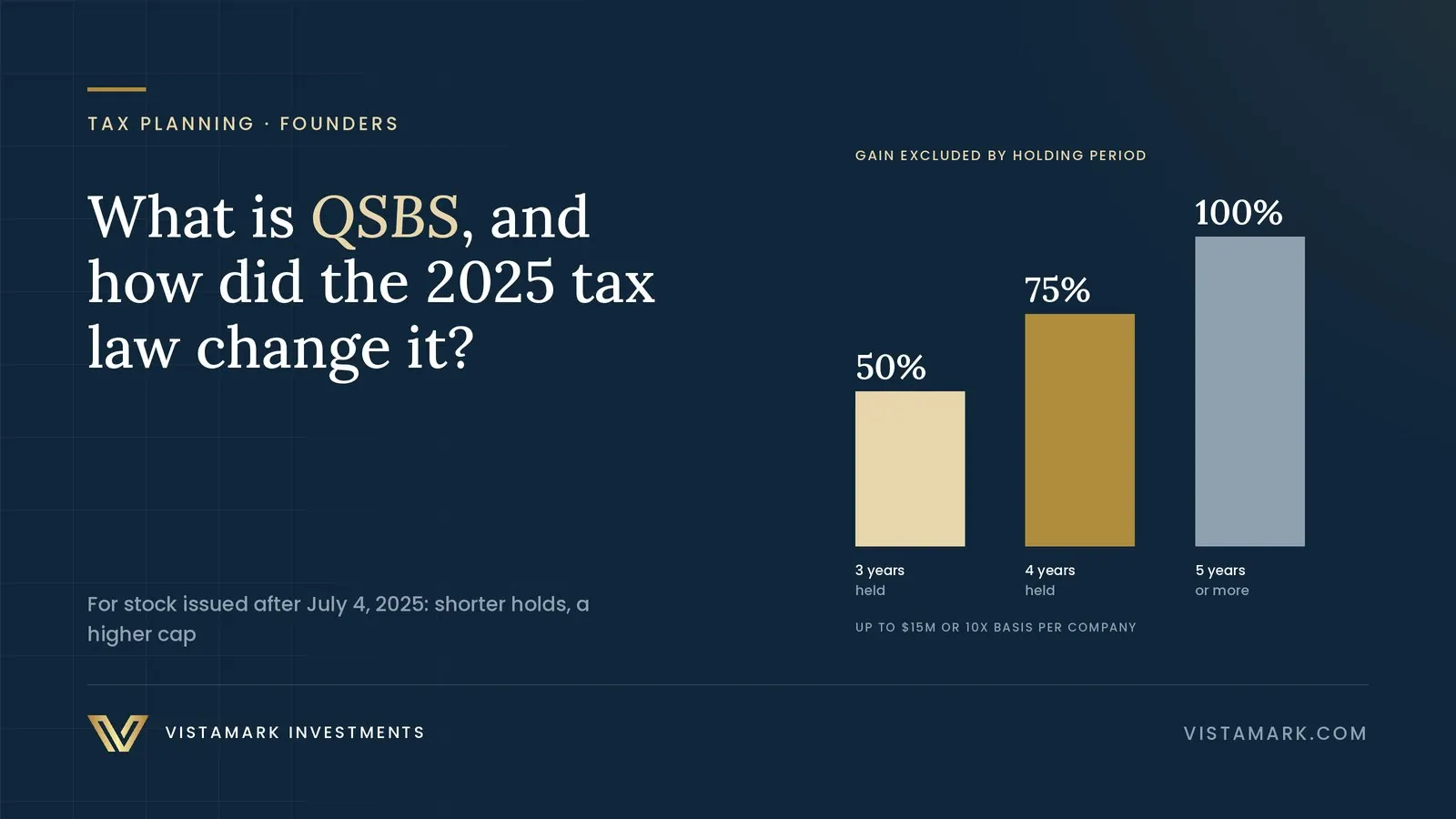
| Holding period and exclusion | 100% after more than five years; nothing before | 50% after three years, 75% after four, 100% after five |
| Per-company cap on excluded gain | Greater of $10 million or 10 times basis | Greater of $15 million or 10 times basis, indexed for inflation from 2027 |
| Company gross asset limit | $50 million | $75 million, indexed for inflation from 2027 |
Why does the tiered holding period matter?
Under the old rules, selling after four and a half years produced no exclusion at all, which made the five-year line a cliff. Many companies are acquired before five years, and founders had no control over the timing. The new tiers soften that cliff: a sale after three or four years still captures half or three-quarters of the benefit. Gain that is not excluded is generally taxed at the 28% rate that applies to the taxable portion of QSBS gains, so the partial exclusions are worth modeling carefully before agreeing to an exit timeline.
How can families multiply the QSBS benefit?
Because the cap applies per taxpayer, per company, families sometimes give QSBS to family members or to properly structured non-grantor trusts before a sale, so that each recipient has its own cap. Gifted stock generally keeps its QSBS status and holding period. This is called stacking, and it can multiply the total exclusion. It must be done carefully and well in advance of any sale, with attention to gift tax, trust design and the IRS's anti-abuse rules.
Do states follow the federal QSBS exclusion?
Not all of them. Most states follow the federal treatment, but some, most notably California, tax QSBS gains in full. Founders who live in or are moving between states should check how their state treats the gain, and when residency is measured, before a sale.
What are the most common QSBS mistakes?
- Assuming every startup qualifies without checking the business type and the gross asset test at the time of issuance.
- Buying shares from another shareholder, which does not qualify, instead of receiving them from the company.
- Converting an LLC to a C corporation without understanding how the conversion affects basis and the holding period.
- Losing documentation. Keep records showing the company's gross assets and qualified status at each issuance; you may need them years later.
What should founders and investors do now?
Confirm which of your holdings may qualify, and under which set of rules. Ask the company for a QSBS representation and supporting records. If a sale may be on the horizon, model the after-tax outcome at each holding-period tier and consider whether gifting or trust planning makes sense, well before a letter of intent is signed. Our article on what to do after a business sale covers the investment side of a liquidity event.
This article is part of our Tax Planning Guide, which collects our writing on the topic with answers to common questions.

Managing Partner and Founder; advises families, business owners and family offices through the VistaWealth Office™ and leads Vistamark’s private markets research. More about Sean →
This article is for informational and educational purposes only and does not constitute investment, legal, tax or accounting advice, or an offer or solicitation to buy or sell any security. Views are those of the author as of the publication date and are subject to change. Vistamark Investments is an SEC-registered investment adviser; see our disclosures.