For investors holding a significant portion of their wealth in a single stock, the feeling is a mix of excitement and unease. On one hand, a concentrated position can deliver life-changing returns. On the other, it exposes you to idiosyncratic risk—the unique, unpredictable dangers of a single company that can devastate your portfolio regardless of how the broader market is doing.
This guide explores strategic approaches to managing this risk, allowing you to protect your wealth while keeping your potential for upside gains.
What are the risks of a concentrated stock position?
Holding a large single-stock position exposes investors to significant idiosyncratic risk, where a stock can decline regardless of broader market performance. This concentration often creates a dangerous correlation between investment exposure and career risk, particularly for corporate executives and employees. Furthermore, the tax considerations of selling an appreciated position can make diversification psychologically and financially challenging. The core question is how to mitigate these risks without forfeiting potential upside.
How does an equity collar hedge a concentrated stock position?
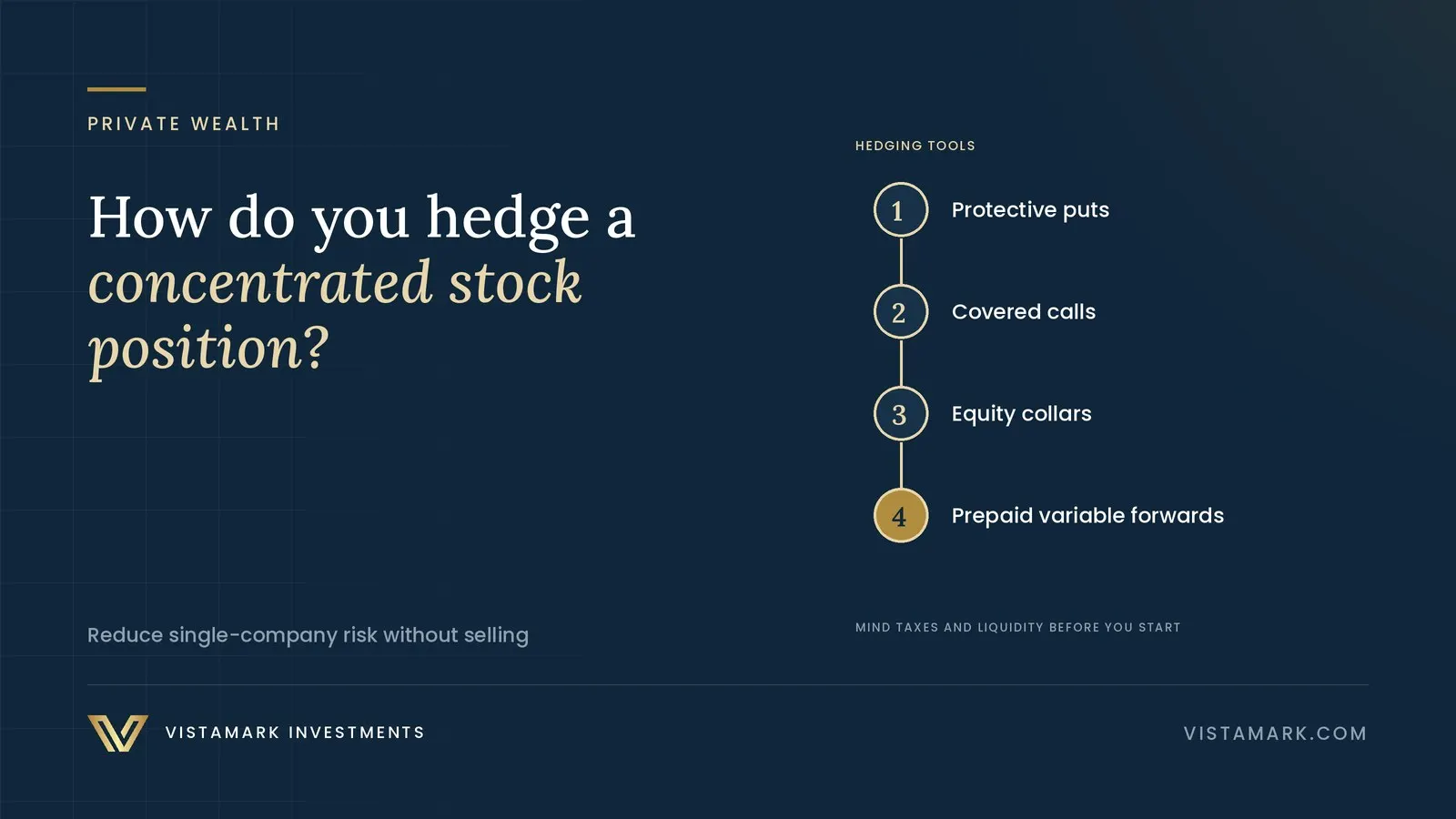
1. The Equity Collar
Think of the equity collar as a way to put a protective fence around your stock's price. This popular, cost-effective strategy involves two simple steps:
-
Buying a protective put option: This sets a "floor" or a minimum price at which you can sell your shares, protecting you from a significant drop.
-
Selling a covered call option: This sells the right to buy your shares at a set price, creating a "ceiling" on your potential gains.
The premium you receive from selling the call option helps offset the cost of buying the put, often making it a "cashless collar" with no upfront cost. The trade-off? You give up any gains above the call's strike price.
2. The Protective Put
For investors who want to keep all their upside potential, buying a protective put is the answer. This is essentially portfolio insurance. You purchase a put option that gives you the right to sell your shares at a predetermined price. If the stock falls, the value of the put option goes up, offsetting the loss in your stock's value.
This strategy offers comprehensive downside protection and doesn't cap your potential for appreciation. The main downside is the cost: the premium for the put option can be expensive, especially for volatile stocks. If the stock never drops, that premium is a direct cost to your returns.
3. Covered Call Writing
Covered call writing is a more modest hedging approach focused on generating income. You simply sell call options against your stock holdings. The premium you collect provides a small cushion against a drop in price.
This strategy is great for generating regular income and can boost returns when the market is flat or only slightly rising. However, it offers very limited protection against a major market downturn and, like a collar, caps your upside potential at the call strike price.
What hedging options exist for very large positions?
Variable Prepaid Forward Contracts (VPFs)
For sophisticated investors with very large positions (typically over $1-10 million), a Variable Prepaid Forward (VPF) offers a way to get cash upfront while deferring capital gains taxes. You receive a payment today in exchange for agreeing to deliver a variable number of shares at a future date. The exact number of shares you give up depends on the stock's performance. VPFs are complex and require professional tax and legal guidance.
Equity Swaps & Proxy Hedging
-
Equity Swaps: These are derivative contracts that allow an investor to exchange the economic return of their stock for a different payment (like a fixed rate). This is especially useful for insiders who want to reduce their economic exposure without selling their shares.
-
Proxy Hedging: When direct hedging is not possible, you can use proxy hedging. This involves hedging with a highly correlated asset, such as a put option on a related stock or a market index. It's not perfect due to correlation risk, but it's a useful tool when other options are off the table.
How do you put a hedging strategy in place?
A Systematic Framework
-
Assess Your Risk: Start by honestly evaluating your position. How much of your net worth is in this one stock? How would a 50% drop affect you emotionally and financially?
-
Choose Your Strategy: Match the strategy to your goals. Do you need income? Do you want absolute protection? Are you willing to cap your upside?
-
Manage Dynamically: Your hedging strategy isn't a "set it and forget it" solution. Re-evaluate your position and your hedges as market conditions and your personal circumstances change.
The Role of a Professional Advisor
Given the complexity of these strategies, a professional advisor is an invaluable partner. They can provide:
-
Expert Guidance: An advisor can help you navigate the intricate tax and regulatory implications of various strategies, especially for complex instruments like VPFs.
-
Customization: They can work with you to analyze your specific financial situation and risk tolerance, then design a tailored hedging program that aligns with your unique objectives.
-
Ongoing Management: Markets and your personal circumstances are constantly changing. A skilled advisor can help you monitor your hedge, rebalance your strategy, and make timely adjustments to maintain the right level of protection.
-
Emotional Discipline: The psychological challenge of managing a concentrated position is significant. An advisor can provide an objective perspective, helping you avoid emotional decisions during periods of market stress.
Ultimately, hedging a concentrated stock position isn't about eliminating all risk, but about managing it to an acceptable level. By taking a thoughtful, systematic approach and working with financial professionals, you can protect your wealth and sleep a little easier at night.
For more information and personalized guidance, please feel free to reach out to Vistamark Investments. You can contact us at 312-895-3001, visit our website at vistamark.com, or send us an email to info@vistamark.com.
This article is part of our Tax Planning Guide, which collects our writing on the topic with answers to common questions.

Managing Partner and Founder; advises families, business owners and family offices through the VistaWealth Office™ and leads Vistamark’s private markets research. More about Sean →
This article is for informational and educational purposes only and does not constitute investment, legal, tax or accounting advice, or an offer or solicitation to buy or sell any security. Views are those of the author as of the publication date and are subject to change. Vistamark Investments is an SEC-registered investment adviser; see our disclosures.