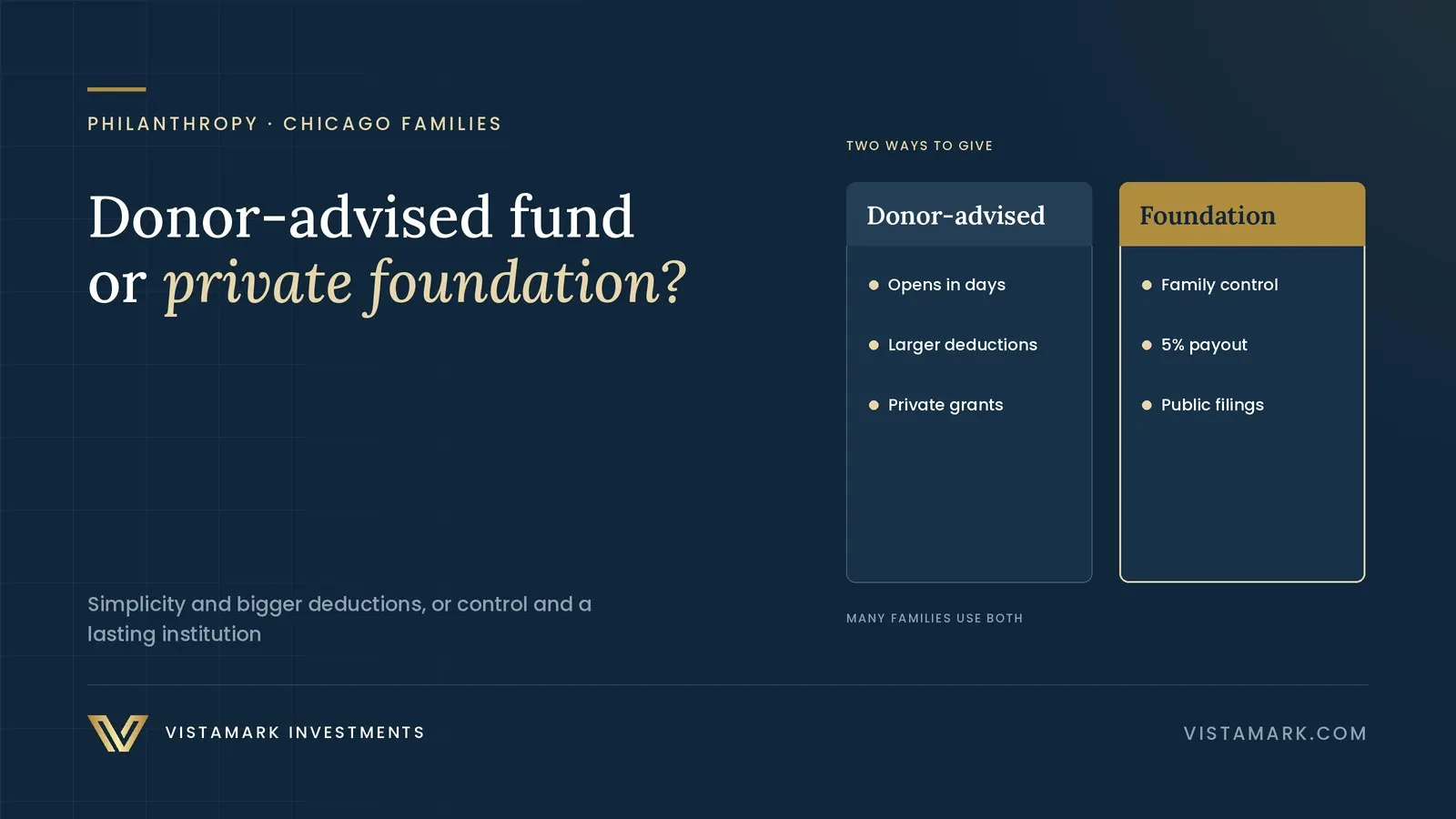
The short answer. For most Chicago-area families, a donor-advised fund is the better starting point: it is quick to open, costs little to run, gives larger income tax deductions and keeps grants private. A private foundation makes sense when the family wants full control, a lasting institution with its own name, a role for the next generation, or the ability to fund scholarships and individuals, and when it is giving enough to justify a 5% annual payout, a 1.39% tax on investment income, annual public filings and strict self-dealing rules. Many families end up using both.
What is the difference between a donor-advised fund and a private foundation?
A donor-advised fund is an account at a public charity, called the sponsoring organization. Once you contribute, the sponsor has legal control of the money and you keep advisory privileges over how it is invested and granted (IRS). A private foundation is a separate charitable corporation or trust that the family owns and governs, with its own board, investments, tax return and rules.
| Donor-advised fund | Private foundation | |
|---|---|---|
| Setup | An account, often opened in days | A new entity, IRS exemption application, legal fees |
| Deduction limit, cash | Up to 60% of AGI | Up to 30% of AGI |
| Deduction limit, appreciated stock | Up to 30% of AGI, at fair market value | Up to 20% of AGI; fair market value for publicly traded stock, generally cost basis for private stock and real estate |
| Required annual grants | None under federal law; sponsors set their own activity rules | About 5% of assets each year |
| Tax on investment income | None | 1.39% excise tax |
| Control | Advisory; the sponsor approves grants | Full; the family board decides |
| Privacy | Grants can be anonymous | Assets, grants and officer pay are public on Form 990-PF |
| Grants to individuals and paying family | Not allowed | Scholarships and individual grants with IRS-approved procedures; reasonable pay for family members who work for it |
Sources for the deduction limits: IRS Publication 526; excise tax: IRS.
How did the 2025 tax law change charitable deductions for 2026?
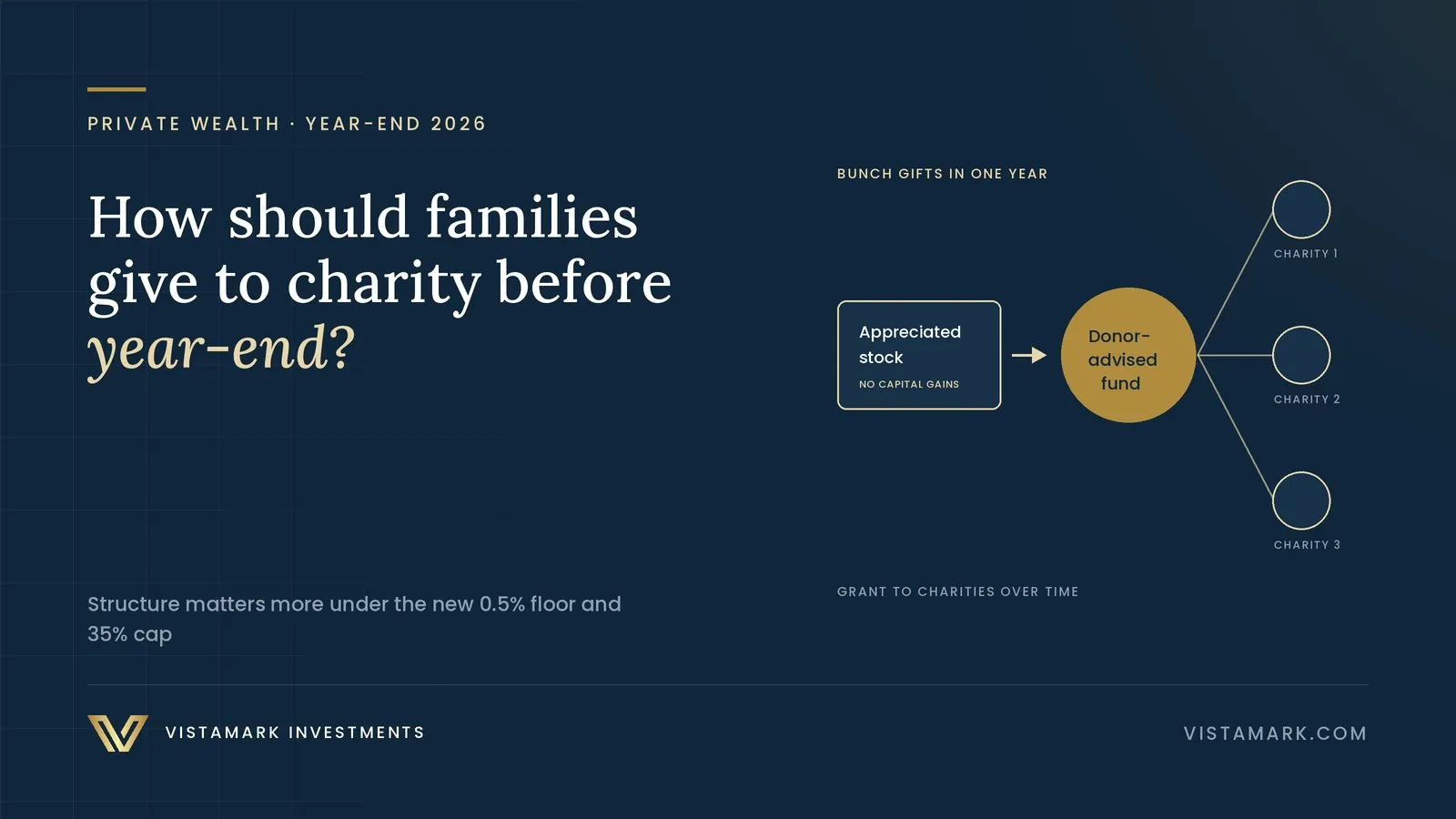
From 2026, itemizers can deduct charitable gifts only to the extent they exceed 0.5% of adjusted gross income, and taxpayers in the top bracket get a maximum benefit of 35 cents per dollar deducted rather than 37 (Mondaq). Both rules favor fewer, larger gifts. A donor-advised fund is a natural way to do that: contribute several years of giving in one year, take one deduction above the floor, and grant the money out over time. The law left the private foundation excise tax unchanged; proposals to raise it for large foundations were dropped before enactment (PKF O’Connor Davies). Our article How Should Families Give to Charity Before Year-End 2026? covers the timing.
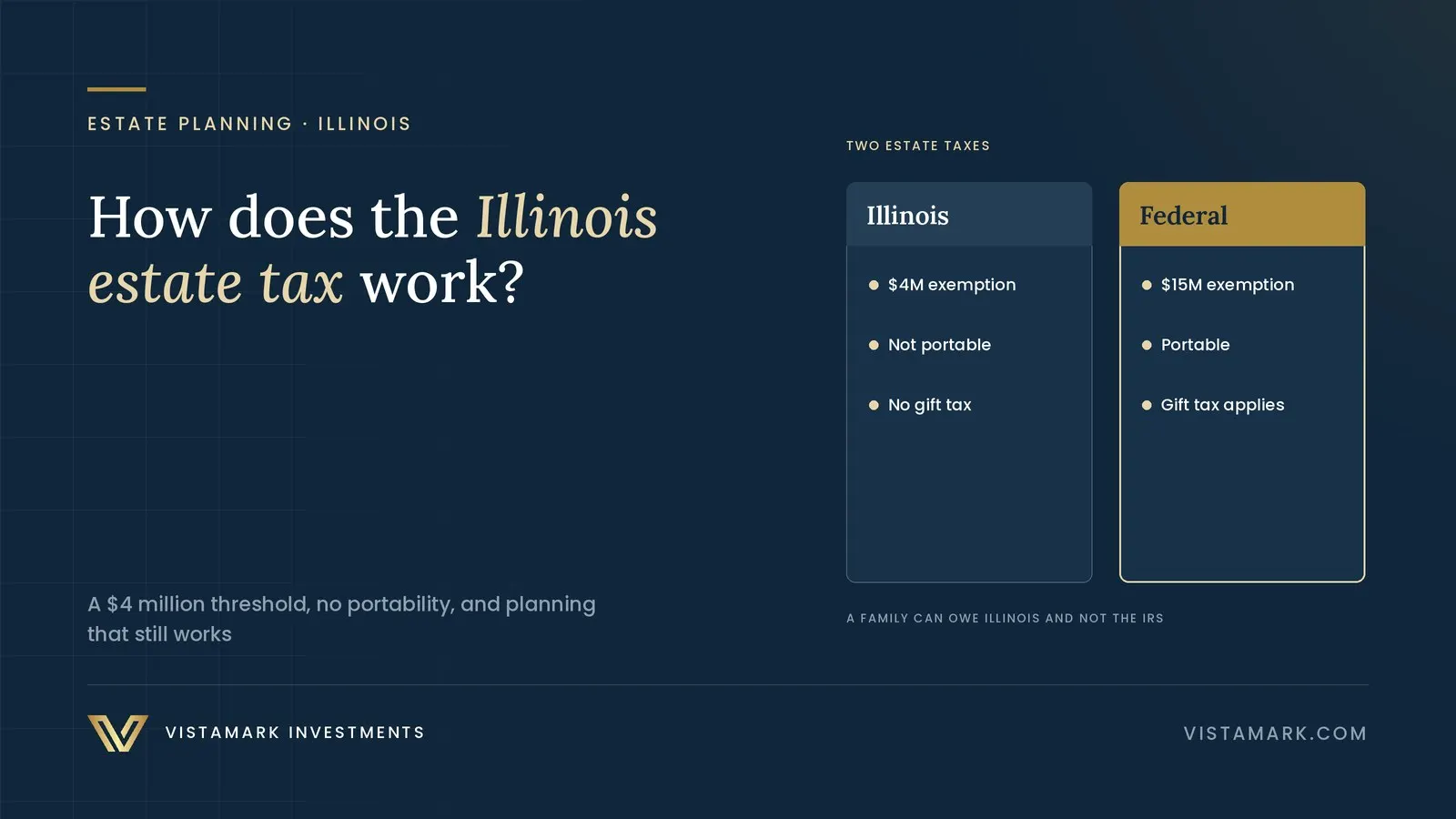
One Illinois point: the state’s flat income tax gives no deduction for charitable gifts, so the federal deduction drives the income tax benefit for a Chicago family. Gifts to charity at death do reduce the Illinois estate tax, which applies to estates above $4 million.
When is a donor-advised fund the better choice?
- You give mainly to established charities and want the simplest administration.
- You want the largest deduction, particularly for gifts of cash or of private company stock or real estate, which a foundation would generally deduct only at cost.
- You want to bunch several years of giving into one tax year, such as the year you sell a business or exercise stock options.
- You prefer to give privately.
When is a private foundation worth the extra cost?
- The family wants a lasting institution with its own name, board and mission, and a formal role for children and grandchildren.
- You want to fund scholarships, grants to individuals or programs the family runs itself.
- You want full control over investments, including the choice of investment advisor.
- The amount is large enough to absorb legal, accounting and administration costs; for many families that means several million dollars or more.
A foundation also brings obligations. It must pay out about 5% of its assets each year, and the self-dealing rules bar most transactions between the foundation and the family, even ones at fair prices. Charitable organizations in Illinois generally register with the Attorney General and file annual reports (Illinois Attorney General). Our article How Should a Private Foundation Meet the 5% Payout Requirement? explains how the payout works with an investment plan.
Where can a Chicago family open a donor-advised fund?
Three kinds of sponsors are common. National sponsors affiliated with large custodians offer low minimums and wide investment menus. The Chicago Community Trust and other community foundations add local grantmaking knowledge and staff who know Chicago nonprofits. Some single-issue and faith-based charities sponsor funds for donors who want to stay within one community. Compare fees, minimum grant sizes, investment options and whether you can keep your own advisor managing the account.
Can a family use both?
Yes, and many do. A common pattern is a donor-advised fund for annual and anonymous giving, alongside a foundation that carries the family’s name and its largest commitments. A charitable remainder trust is a third tool, useful when the family wants lifetime income from appreciated assets before the charity receives the rest.
Where does Vistamark fit?
The VistaWealth Office is Vistamark’s private wealth practice for Chicago-area families. We help families decide between a donor-advised fund, a foundation or both, coordinate the decision with their tax and legal advisors, and manage the charitable assets alongside the rest of the family’s plan. For family foundations, our foundations and endowments practice brings the same investment policy, spending and reporting discipline we provide to institutions. This article is general information, not tax or legal advice.
Sources
- Internal Revenue Service — Donor-Advised Funds
- Internal Revenue Service — Publication 526, Charitable Contributions
- Internal Revenue Service — Tax on Net Investment Income (private foundations)
- Mondaq — New Limitations on Charitable Deductions Take Effect in 2026
- PKF O’Connor Davies — Private Foundations Emerge Largely Unscathed
- Illinois Attorney General — Charity Registration
Market Compass · weekly
Get the Compass by email
One concise recap of the week’s market-moving events and what to watch next, written by our CIO at the end of each market week.

Managing Partner, VistaWealth Office™ — integrated wealth planning for executives, business owners, family offices and charities. More about William →
This article is for informational and educational purposes only and does not constitute investment, legal, tax or accounting advice, or an offer or solicitation to buy or sell any security. Views are those of the author as of the publication date and are subject to change. Vistamark Investments is an SEC-registered investment adviser; see our disclosures.