The investment committee is where a nonprofit's fiduciary duty for its endowment is exercised in practice. A well-structured committee makes consistent, documented decisions and keeps its focus on policy. A poorly structured one drifts into stock picking, defers to its most confident member or rubber-stamps whatever its advisor proposes. The difference usually comes down to a few structural choices.
How large should the committee be?
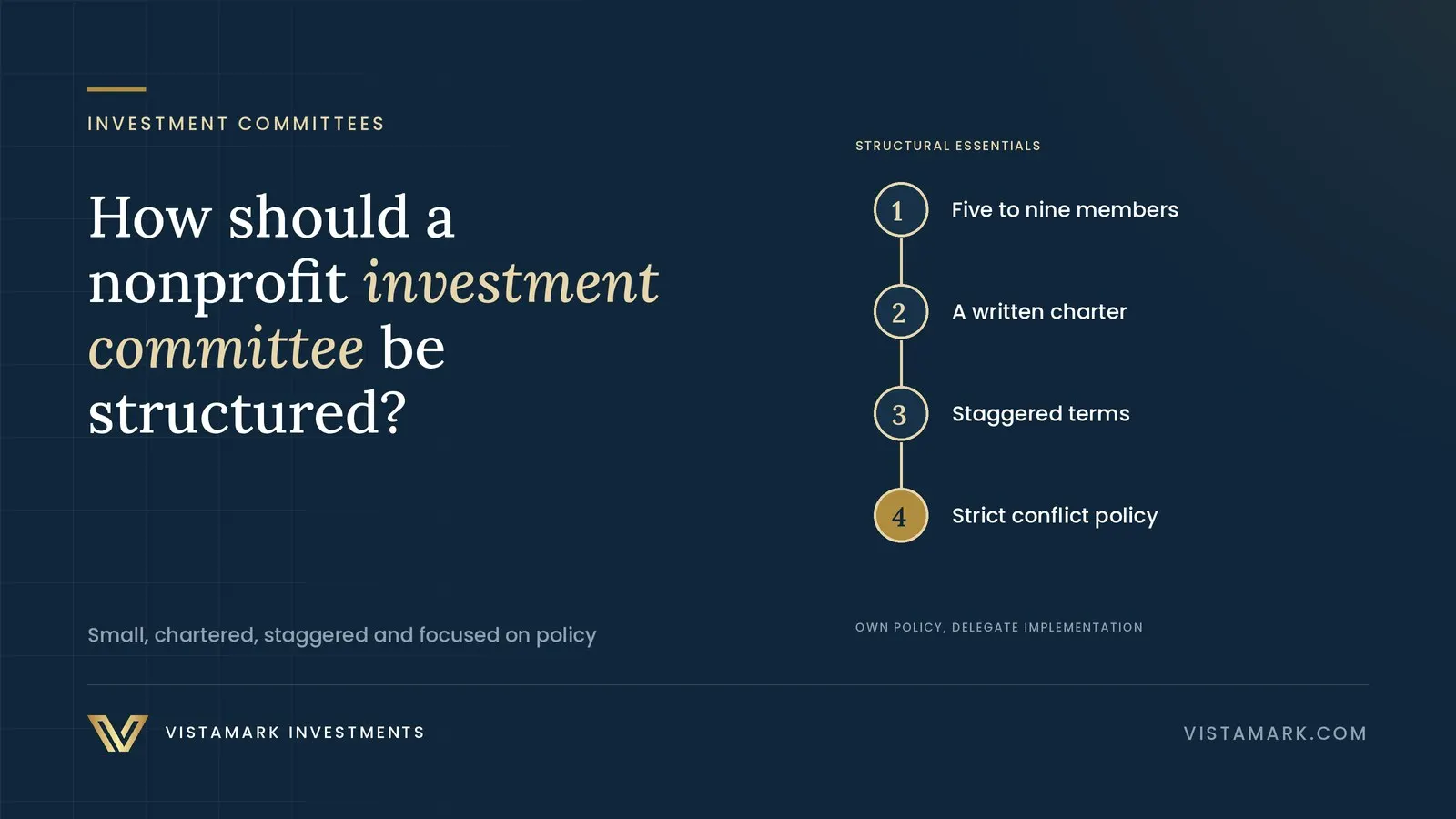
Usually five to nine voting members. Smaller committees can lack perspective and continuity; larger ones struggle to discuss issues in depth and tend to defer to a few voices. An odd number avoids tied votes. Some committees add non-board members with investment expertise, which is generally allowed if the bylaws permit it, but the board remains ultimately responsible.
What should a committee charter include?
- The committee's purpose and the authority delegated to it by the board.
- Membership: number of members, qualifications, terms and how members are appointed and removed.
- Responsibilities: recommending the investment policy, setting asset allocation within board-approved ranges, selecting and monitoring advisors and managers, and reporting to the board.
- Meetings: frequency, quorum and how minutes are kept.
- Conflicts of interest and confidentiality.
What expertise should members have?
A blend. Investment professionals bring market knowledge, but committees made up entirely of portfolio managers can drift toward tactical debates and personal preferences. The best committees also include members with governance, finance, legal or audit experience and at least one person who deeply understands the organization's mission and budget. Every member should understand fiduciary duty under UPMIFA, which requires acting in good faith with the care an ordinarily prudent person would exercise.
Why do term limits and staggered terms matter?
They balance continuity with fresh perspective. Staggered three-year terms, with a limit of two or three consecutive terms, ensure that the committee always includes experienced members while bringing in new ones regularly. They also make it easier to rotate off members who no longer contribute. A thoughtful onboarding process, including the IPS, recent minutes and a meeting with the advisor, helps new members contribute quickly. Our article on a new chair's first 90 days covers onboarding from the chair's perspective.
How should conflicts of interest be handled?
Strictly and in writing. Members should disclose any relationship with managers, advisors or investments under consideration and recuse themselves from related decisions. Many committees prohibit hiring members' firms or investing in funds where members have an economic interest, because even a well-intentioned exception can undermine trust and invite scrutiny.
What should the committee decide, and what should it delegate?
The committee should own policy: objectives, risk tolerance, asset allocation ranges, spending recommendations and the selection and oversight of advisors. It should delegate implementation, such as manager selection within the policy, rebalancing and trading, to staff or an outsourced CIO where it has the resources to oversee them. Many committees spend too much time on individual managers and too little on allocation, which drives most of the portfolio's results. Our build vs. buy article covers the delegation decision in depth.
How often should the committee meet?
Most meet quarterly, with an annual meeting devoted to strategy, the investment policy and the asset allocation. Our fiduciary governance calendar lays out a typical year.
How can a committee evaluate itself?
With a short annual self-assessment: Did we follow our IPS? Did we spend our time on the decisions that matter most? Do we have the expertise we need? Are our minutes a clear record of our reasoning? Vistamark's foundation and endowment practice works with committees on structure, charters and governance as well as investments.
This article is part of our Foundation & Endowment Investment Guide, which collects our writing on the topic with answers to common questions.
Market Compass · weekly
Get the Compass by email
One concise recap of the week’s market-moving events and what to watch next, written by our CIO at the end of each market week.

Partner and Director of Institutional Advisory with more than 20 years advising endowments, foundations, healthcare organizations and retirement plan sponsors. More about Ryan →
This article is for informational and educational purposes only and does not constitute investment, legal, tax or accounting advice, or an offer or solicitation to buy or sell any security. Views are those of the author as of the publication date and are subject to change. Vistamark Investments is an SEC-registered investment adviser; see our disclosures.