An endowment and foundation (E&F) investment committee should choose a policy benchmark that mirrors its own target asset allocation, uses a broad, investable, published index for each asset class, and is written into the Investment Policy Statement before performance is ever reported against it. The benchmark exists to answer one question: is the committee's allocation decision working, separate from whether any manager or advisor is adding value? A benchmark that cannot answer that question cleanly, because it was chosen after the fact, changes too often, or measures the wrong thing, leaves the committee unable to judge the most important decision it makes.
This guide is written for investment committee members, trustees, and professional staff of endowments, foundations, and nonprofit investment pools, particularly those with roughly $25 million to $250 million in investable assets. At that size the committee usually meets quarterly, relies on an outside advisor or outsourced chief investment officer (OCIO) for reporting, and rarely has an internal analyst to check the numbers. The benchmark is the committee's own yardstick, so it is worth understanding well enough to defend.
What Is a Policy Benchmark, in Plain Language?
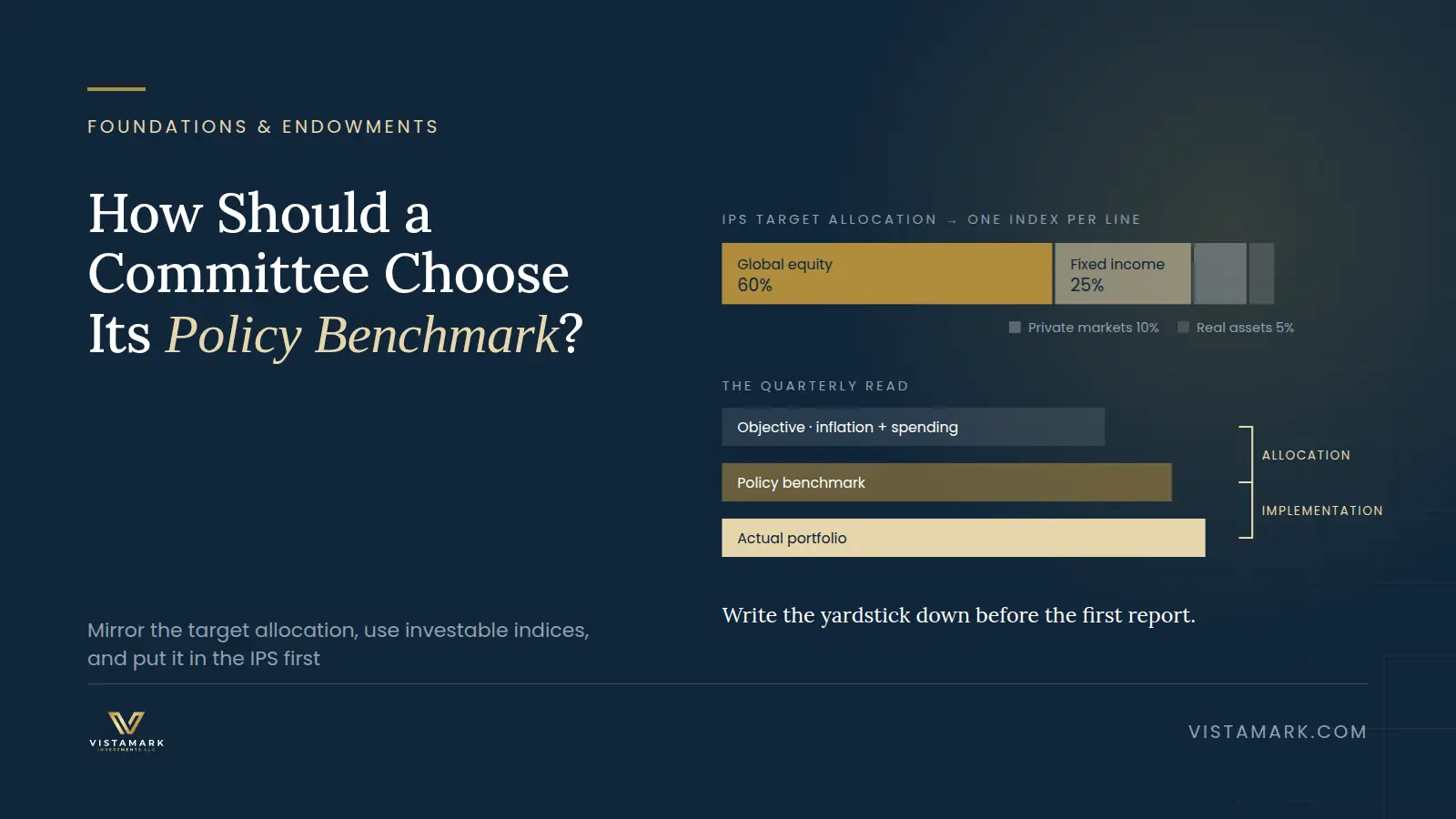
A policy benchmark is a blended index that shows what the portfolio would have returned if the committee had simply held its target allocation in low-cost index funds and done nothing else. If the Investment Policy Statement (IPS) calls for 60 percent global equity, 25 percent fixed income, 10 percent private markets, and 5 percent real assets, the policy benchmark is a weighted blend of one representative index for each of those four categories, at those four weights, rebalanced on a stated schedule.
Three related terms are easy to confuse:
- The policy benchmark measures the allocation decision.
- A manager benchmark is the index a single manager is judged against (a small-cap value manager against a small-cap value index, for example).
- A peer or objective benchmark measures whether the portfolio met the institution's purpose, usually expressed as inflation plus the spending rate, or as a comparison to similar institutions.
A well-run committee uses all three, but the policy benchmark is the one that belongs in the IPS as the primary test of the committee's own work.
Why Does the Committee Need Its Own Benchmark at All?
Committees without a documented policy benchmark tend to judge performance in one of two unhelpful ways. The first is against a single headline index, usually a large-cap domestic equity index, which a diversified portfolio will lag in most strong equity years and lead in most weak ones. Neither result says anything about whether the committee's decisions were sound. The second is against the advisor's own report, which may compare the portfolio to a blend the advisor selected, sometimes a blend that has changed over time.
A policy benchmark written into the IPS in advance solves both problems. It separates the return into layers the committee can act on. The difference between the objective (inflation plus spending) and the policy benchmark tells the committee whether its allocation is capable of meeting the institution's needs over time. The difference between the policy benchmark and the actual portfolio tells the committee whether the advisor's implementation, manager selection, and tactical positioning added or subtracted value. Without the middle layer, the committee cannot tell a good allocation with poor implementation from a poor allocation with good implementation, and the two problems have very different fixes.
This is also a governance point. Under the prudent-investor framework that most states have adopted for charitable funds, the board's obligation is about process: setting a reasonable strategy and monitoring it. A written benchmark is the clearest evidence a committee can produce that monitoring actually happens. The broader case for that kind of documented oversight is made in Beyond the Endowment: How Investment Governance Protects Nonprofit Missions.
What Makes a Benchmark a Good One?
Practitioners generally agree on a short list of qualities.
Specified in advance, so nobody can pick it after seeing the results.
Investable, meaning the committee could actually have bought it through index funds at low cost, which is what makes it a fair alternative to active implementation.
Measurable and published, so the numbers can be checked by anyone with access to the index provider's data, not only by the advisor who prepared the report.
Appropriate to the mandate, meaning the indices reflect the kinds of assets the policy actually permits.
Unambiguous, meaning the IPS states the exact index names, the weights, and the rebalancing rule, so two people building the benchmark independently would arrive at the same number.
The most common failure among mid-sized E&F organizations is not choosing a bad index. It is leaving one of those elements unstated. A benchmark described as "a blend of equity and bond indices consistent with the target allocation" is not a benchmark. It is an invitation to construct one later.
How Should the Committee Choose the Index for Each Asset Class?
Start from the target allocation in the IPS and assign one index per line.
Public equity. Most committees use a broad global index, or a domestic index and a non-domestic index at the policy's home-versus-foreign split.
Investment-grade fixed income. A broad aggregate bond index is the usual choice; a committee whose policy calls for short-duration or Treasury-only holdings should use an index that matches that constraint rather than the broad aggregate.
Real assets. The choice depends on what the policy means by the term: a listed real estate index, a commodity index, an inflation-linked bond index, or a blend.
Private markets are the hard case. Private equity, private credit, and venture funds report on a lag, are valued by appraisal rather than by market price, and cannot be bought as an index. Committees handle this in one of three ways. Some use a public-market proxy, typically a broad equity index plus a fixed premium (for example, a global equity index plus 3 percent annually) to represent the return the committee expects in exchange for illiquidity. Some use a peer-based private-markets index built from fund-level data, accepting that it is not investable. Some simply fold the private allocation into the public equity line of the benchmark and evaluate the private program separately on its own metrics over a longer horizon. Each approach is defensible if it is chosen in advance and stated in writing. A committee that is still building toward its private markets target should also decide how the benchmark treats the interim period, when the actual allocation is well below policy weight. The case for the allocation itself is in Securing Tomorrow, Today: The Indispensable Role of Private Equity in Endowment and Foundation Portfolios.
Whatever index is chosen for each line, the weight should be the policy target, not the current actual allocation. If the benchmark weights float with the actual portfolio, it stops measuring the allocation decision and starts measuring only security selection, which is a different and narrower question.
Should the Benchmark Include a Hedge Fund or "Alternatives" Line?
Only if the policy allocation includes one, and even then with care. Hedge fund indices are built from voluntarily reported, survivorship-biased data and are not investable, so a portfolio compared against them is being compared to something no one could have bought. Many committees instead assign a cash-plus or bond-plus benchmark to a diversifying hedge fund sleeve (short-term Treasury bills plus a stated premium, for instance) because that is the return the sleeve is meant to beat. Others give the sleeve a blend of the equity and bond indices in proportion to its expected market exposure. The wrong answer is to leave the line out, because then the policy benchmark no longer sums to 100 percent of the target allocation and the layered analysis above breaks.
How Often Should the Policy Benchmark Change?
Rarely, and only when the policy allocation changes. The benchmark should be rebalanced to its target weights on a stated schedule, typically monthly or quarterly, so that drift in the index blend does not quietly alter what the committee is measuring. But the composition of the benchmark, meaning the indices and their target weights, should change only when the committee formally amends the target allocation in the IPS.
When that happens, the committee should record the effective date of the change and keep the historical benchmark linked, so that a ten-year comparison uses the benchmark that was actually in force in each year. A benchmark restated retroactively to match the current allocation makes the past look as though the committee always held today's view, which is neither accurate nor useful.
Committees should be especially wary of benchmark changes proposed during or immediately after a period of underperformance. The proposal may be sound, but the timing invites the question of whether the yardstick is being moved to fit the result. The safest practice is to review the benchmark on a fixed calendar, usually alongside the annual IPS review, and to require any mid-cycle change to be minuted with its rationale. A quarter-by-quarter model for that calendar is at The Fiduciary Governance Calendar.
How Should the Committee Use the Benchmark in Meetings?
The benchmark earns its keep in the quarterly performance report, which should show three lines side by side for the trailing one-, three-, five-, and ten-year periods: the objective (inflation plus the spending rate), the policy benchmark, and the actual portfolio. That layout lets the committee ask the two questions that matter. Is the allocation capable of doing the job over time? Is the implementation adding value against the allocation?
Short-period differences between the portfolio and the policy benchmark are mostly noise and should be observed, not acted on. Persistent multi-year shortfalls against the policy benchmark are a different matter, and they are the proper starting point for a conversation about manager changes, advisor performance, or the costs of active implementation. That conversation is easier when the benchmark was set in advance and everyone agreed to it, which is also why it belongs in the IPS rather than in the advisor's reporting template. The related question of when a persistent shortfall justifies action is taken up in our article When Should an Investment Committee Fire an Underperforming Manager?
A committee evaluating advisors or OCIO candidates should also ask each finalist to show its own results against the client's policy benchmark, not against a benchmark the candidate selected. The question separates candidates who are comfortable being measured from those who prefer to choose the measure. The broader selection process is covered in Choosing the Right Investment Advisor for Your Foundation or Endowment.
What Should the IPS Language Actually Say?
The benchmark section of the IPS should fit on one page and contain five things:
- The name of each index and its provider.
- The target weight of each index, summing to 100 percent.
- The rebalancing frequency of the blend.
- The treatment of any asset class that lacks an investable index.
- The rule for changing the benchmark: who approves, when it takes effect, and that history is preserved.
A short statement of the objective benchmark (for example, the Consumer Price Index plus the spending rate, measured over rolling ten-year periods) belongs alongside it.
Committees that have never written this section down often find that the exercise surfaces disagreements about the allocation itself. That is a feature. The benchmark forces the committee to say, in specific terms, what it is trying to do, and a committee that can say that clearly is far better placed to judge everyone it hires to help.
For more information and personalized guidance, please feel free to reach out to Vistamark Investments. You can contact us at 312-895-3001, visit our website at vistamark.com, or send us an email to info@vistamark.com.
This article is part of our Foundation & Endowment Investment Guide, which collects our writing on the topic with answers to common questions.

Managing Partner and Founder; advises families, business owners and family offices through the VistaWealth Office™ and leads Vistamark’s private markets research. More about Sean →
This article is for informational and educational purposes only and does not constitute investment, legal, tax or accounting advice, or an offer or solicitation to buy or sell any security. Views are those of the author as of the publication date and are subject to change. Vistamark Investments is an SEC-registered investment adviser; see our disclosures.