Every well-run endowment, foundation and pension plan has an investment policy statement. Most wealthy families do not. They have a portfolio, an advisor and a set of habits, but no written answer to the questions that matter most when markets fall or a key person is no longer in the room. In Think Like a Family Office, we put the investment policy statement first for a reason: nearly every other good decision depends on it.
What is a family investment policy statement?
A family investment policy statement (IPS) is a short written document, usually five to ten pages, that records why the family invests, what it is trying to achieve, how much risk it will accept, how the money will be allocated and who has authority to decide what. It is the family's rulebook for its capital. It does not pick funds or predict markets; it sets the framework that every individual decision is measured against.
Why does a family need one if its advisor already manages the money?
Because the IPS belongs to the family, not the advisor, and it is written before the hard moments rather than during them. Without one, decisions default to whoever is most anxious or most persuasive at the time. With one, the family has already agreed what it will do when stocks fall 30%, when a child asks for a large distribution or when an exciting private deal arrives. Three benefits stand out:
- Discipline in bad markets. A written rebalancing rule is far easier to follow in a crisis than a judgment call made under stress.
- Accountability for advisors. An IPS defines what success looks like, so the family can judge its advisors against agreed objectives and benchmarks rather than against headlines.
- Continuity across generations. When the founder steps back, the IPS tells heirs, trustees and successor advisors how the wealth has been managed and why.
What should a family investment policy statement include?
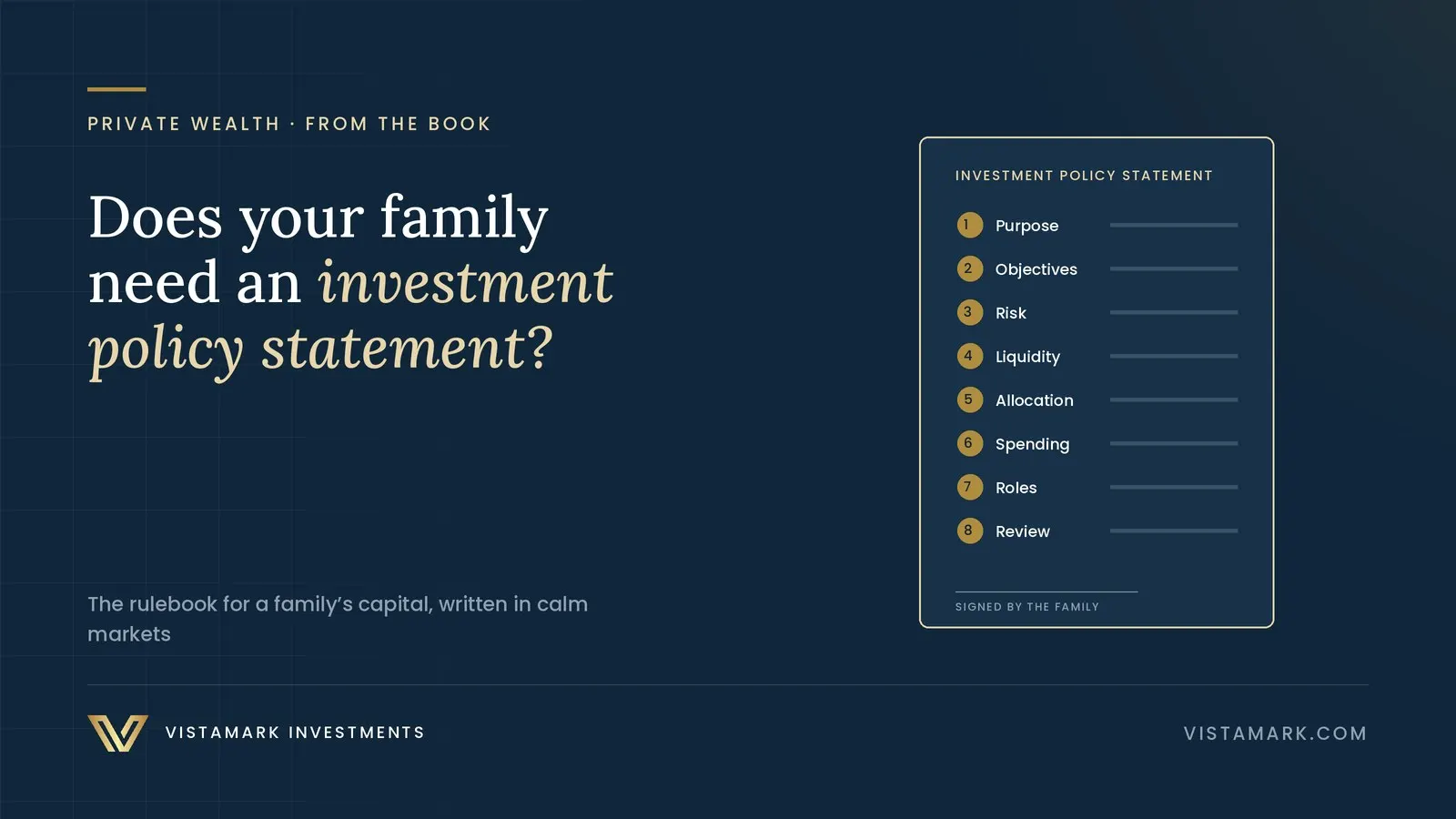
A useful family IPS covers eight things. It does not need to be long, but each section should be specific enough that two different people reading it would make the same decision.
- Purpose and values. What the wealth is for: lifestyle, security, the next generation, philanthropy, a family business. This section is where values-based constraints belong.
- Objectives. A return target stated in real (after-inflation) and after-tax terms, tied to the family's spending and legacy goals.
- Risk tolerance. The largest decline the family could live with without changing course, expressed in dollars as well as percentages.
- Time horizon and liquidity needs. How much must be available in cash and liquid assets over the next one to five years, including known commitments such as taxes, capital calls and large purchases.
- Target allocation and ranges. A target for each asset class with a minimum and maximum, and a rule for rebalancing when an allocation moves outside its range.
- Spending policy. How much the portfolio will distribute each year and how that amount is calculated.
- Roles and decision rights. Who sets policy, who selects managers, who approves exceptions and how often each reviews the results.
- Monitoring and review. The benchmarks used to judge performance and a commitment to review the IPS itself at least once a year and after any major family event.
How is a family IPS different from an endowment's?
The structure is the same, but families face three complications institutions do not. First, taxes: a family should measure returns after tax and decide which entity or account holds each asset. Second, multiple pools: a family's wealth often sits across personal accounts, trusts, partnerships, retirement accounts and a foundation, each with its own beneficiaries and rules. The IPS should say how those pools are coordinated. Third, people: family members have different ages, needs and opinions, so the governance section matters even more than it does for a board.
Who should write it, and who should sign it?
The family should own the document and its advisor should draft it. In practice, that means one or two working sessions to agree on purpose, objectives and risk, followed by a draft the advisor prepares and the family edits. The people who make investment decisions should sign it, and so should any trustees responsible for trust assets. Signing matters: it turns a memo into a commitment.
How often should a family update its investment policy statement?
Review it every year and rewrite it after any major change: the sale of a business, a death or divorce, a large gift, a move to a different state or a shift in the family's goals. Most annual reviews will confirm the document still fits. That is the point; the IPS should change when the family changes, not when the market does.
Where should a family start?
Start with three questions at your next family meeting. What is this money for? What is the worst year we could live with? Who decides when we disagree? Write down the answers. That page is the beginning of an investment policy statement, and it is more than most families have.
If you would like a structured way to see where your family stands, our family office self-assessment includes the investment policy questions from the book. The VistaWealth Office helps families write and maintain their policy as part of an ongoing relationship.
This article is part of our Family Governance Guide, which collects our writing on the topic with answers to common questions.

Founder and CIO of Vistamark; as CIO of Fiducient Advisors, oversaw investment strategy for more than $260 billion in client assets. More about Matthew →
This article is for informational and educational purposes only and does not constitute investment, legal, tax or accounting advice, or an offer or solicitation to buy or sell any security. Views are those of the author as of the publication date and are subject to change. Vistamark Investments is an SEC-registered investment adviser; see our disclosures.