Trusts are the workhorses of estate planning, but the two main types do very different jobs. Choosing between them, and more often deciding how to use both, starts with understanding what each one can and cannot do. This is a general explanation; trust law varies by state, and every family should work with an experienced estate attorney.
What is a revocable trust?
A revocable trust, often called a living trust, is a trust you create during your lifetime and can change or cancel at any time. You usually serve as your own trustee and beneficiary while you are alive, and you name a successor trustee to take over if you become incapacitated or die. Because you keep full control, the IRS treats the assets as yours: income is reported on your own return, and the assets remain part of your taxable estate.
What does a revocable trust actually accomplish?
- Avoids probate for assets titled in the trust, which saves time and cost and keeps the details of your estate private.
- Plans for incapacity, letting your successor trustee manage trust assets without a court-supervised guardianship.
- Simplifies administration when you own property in more than one state.
- Sets out how assets will be managed and distributed after your death, often continuing in trust for children or grandchildren.
A revocable trust does not reduce estate taxes and does not protect assets from your own creditors.
What is an irrevocable trust?
An irrevocable trust is one you generally cannot change or revoke once it is created. When you transfer assets into it, you give up ownership and control; an independent trustee manages the assets for the beneficiaries under the terms you set. Modern trusts often include tools such as trust protectors or decanting provisions that allow limited changes, but the basic bargain is that you trade control for benefits a revocable trust cannot provide.
What can an irrevocable trust do that a revocable trust cannot?
- Remove assets from your taxable estate, including all of their future growth, which matters most for larger estates and for families in states with their own estate tax, such as Illinois.
- Protect assets from creditors and lawsuits, and from a beneficiary's divorce, when properly structured and funded well before any claim.
- Hold life insurance outside the estate through an irrevocable life insurance trust.
- Benefit multiple generations through a dynasty trust that uses the generation-skipping transfer tax exemption.
- Support charitable goals through charitable remainder and lead trusts.
How do revocable and irrevocable trusts compare?
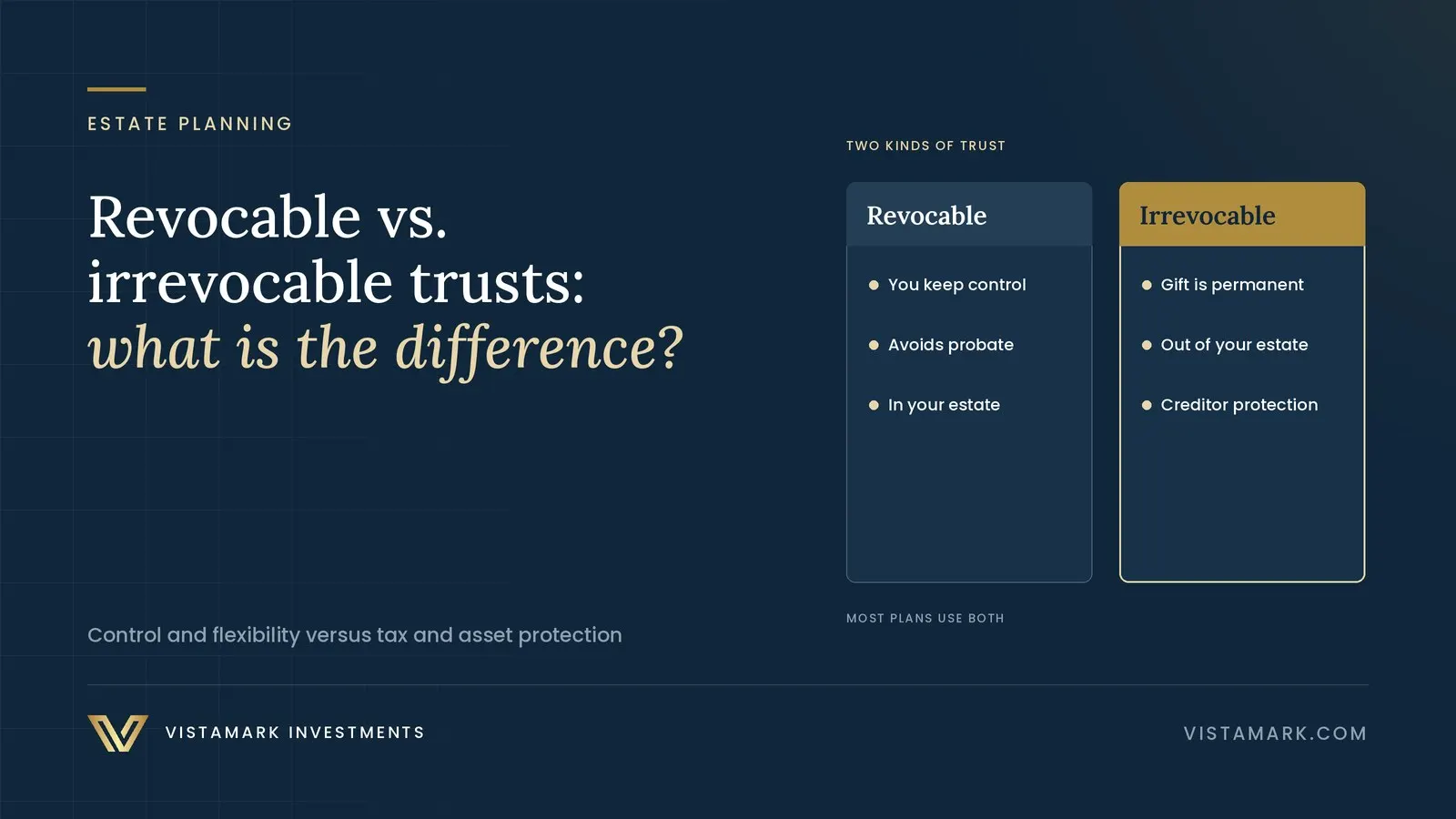
| Revocable trust | Irrevocable trust | |
|---|---|---|
| Can you change it? | Yes, at any time | Generally no |
| Who controls the assets? | You, as trustee | An independent trustee |
| Avoids probate? | Yes, for funded assets | Yes |
| Removes assets from your estate? | No | Usually yes |
| Creditor protection? | No | Often yes, if set up properly and early |
| Income taxes | Reported on your return | Depends on design: grantor trusts report on your return, others pay their own tax |
Do families need both?
Most families with significant wealth do. A revocable trust typically serves as the core of the estate plan, holding most personal assets and directing how they pass. One or more irrevocable trusts then handle specific goals: removing growth assets from the estate, holding insurance, protecting assets or providing for future generations. With the federal exemption now $15 million per person, the case for irrevocable trusts rests less on federal estate tax for many families and more on state taxes, asset protection and control over how wealth is used after the transfer.
What is the most common trust mistake?
Not funding the trust. A revocable trust only avoids probate for assets actually titled in its name or payable to it, and families often sign the document and never retitle accounts or real estate. The second most common mistake is forgetting to coordinate beneficiary designations on retirement accounts and life insurance, which pass outside the trust unless they name it. Review both after creating any trust, and again whenever you open new accounts.
The VistaWealth Office works alongside each family's estate attorney so trusts are funded, invested and administered as the plan intended.
This article is part of our Estate Planning Guide, which collects our writing on the topic with answers to common questions.

Managing Partner, VistaWealth Office™ — integrated wealth planning for executives, business owners, family offices and charities. More about William →
This article is for informational and educational purposes only and does not constitute investment, legal, tax or accounting advice, or an offer or solicitation to buy or sell any security. Views are those of the author as of the publication date and are subject to change. Vistamark Investments is an SEC-registered investment adviser; see our disclosures.