Private credit has grown from a niche into one of the largest alternative asset classes, as non-bank lenders have taken over much of the middle-market lending banks once provided. For foundations and endowments, its appeal is easy to see: higher yields than public bonds, floating rates and regular income. But rapid growth has brought looser terms, more competition and new questions about valuation and liquidity. A committee considering private credit should ask harder questions than "what does it yield?"
What is private credit?
Private credit is lending by non-bank investors directly to companies or against assets, outside public bond markets. The main strategies are:
- Direct lending: senior loans to middle-market companies, often owned by private equity sponsors.
- Asset-based finance: loans secured by receivables, equipment, real estate or other collateral.
- Mezzanine and junior debt: subordinated loans with higher yields and higher risk.
- Distressed and special situations: lending to or buying the debt of troubled companies.
- Specialty finance: royalty, litigation and other niche lending.
What role can private credit play in a foundation portfolio?
Primarily income and diversification. Senior direct lending can complement or partly replace fixed income, offering higher yields with floating rates. Opportunistic and distressed strategies behave more like equity and belong with growth assets. The committee should decide which role it wants before choosing managers, and write the allocation and its purpose into the investment policy statement.
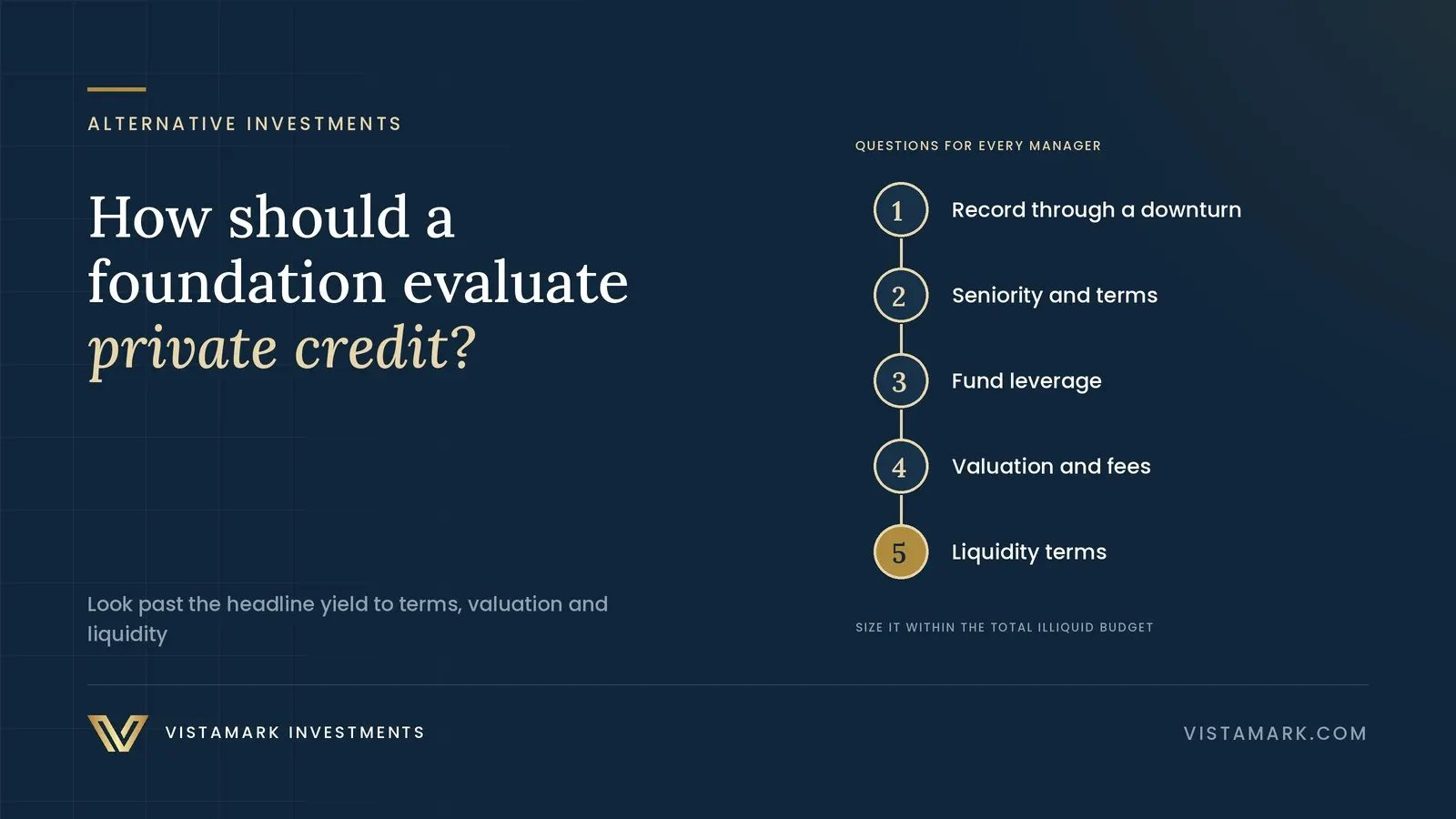
What should a committee ask a private credit manager?
- How have your loans performed through a downturn? Ask for default and recovery data by vintage, including periods of stress, and for examples of workouts.
- Where do you sit in the capital structure? First-lien senior secured loans carry very different risk from second-lien or unitranche loans.
- What protections do your loans have? Covenants, collateral and documentation have weakened in parts of the market; ask how this manager's terms compare.
- How much leverage do you use at the fund level? Fund leverage can raise returns and losses alike.
- How are loans valued, and by whom? Private loans are marked by models and judgment; ask about third-party valuation and how marks changed during past stress.
- What are the total fees? Management fees, incentive fees and fund expenses can consume a large share of the yield.
- What are the liquidity terms? Drawdown funds lock up capital for years; evergreen funds offer periodic redemptions that can be limited when many investors want out.
What are the main risks today?
- Crowding: large inflows have increased competition for loans, pressuring yields and terms.
- Hidden defaults: payment-in-kind interest and amendments can delay the recognition of problems.
- Valuation lag: reported values may move slowly, making returns look smoother than the underlying risk.
- Concentration: many direct lenders finance the same kinds of sponsor-backed companies.
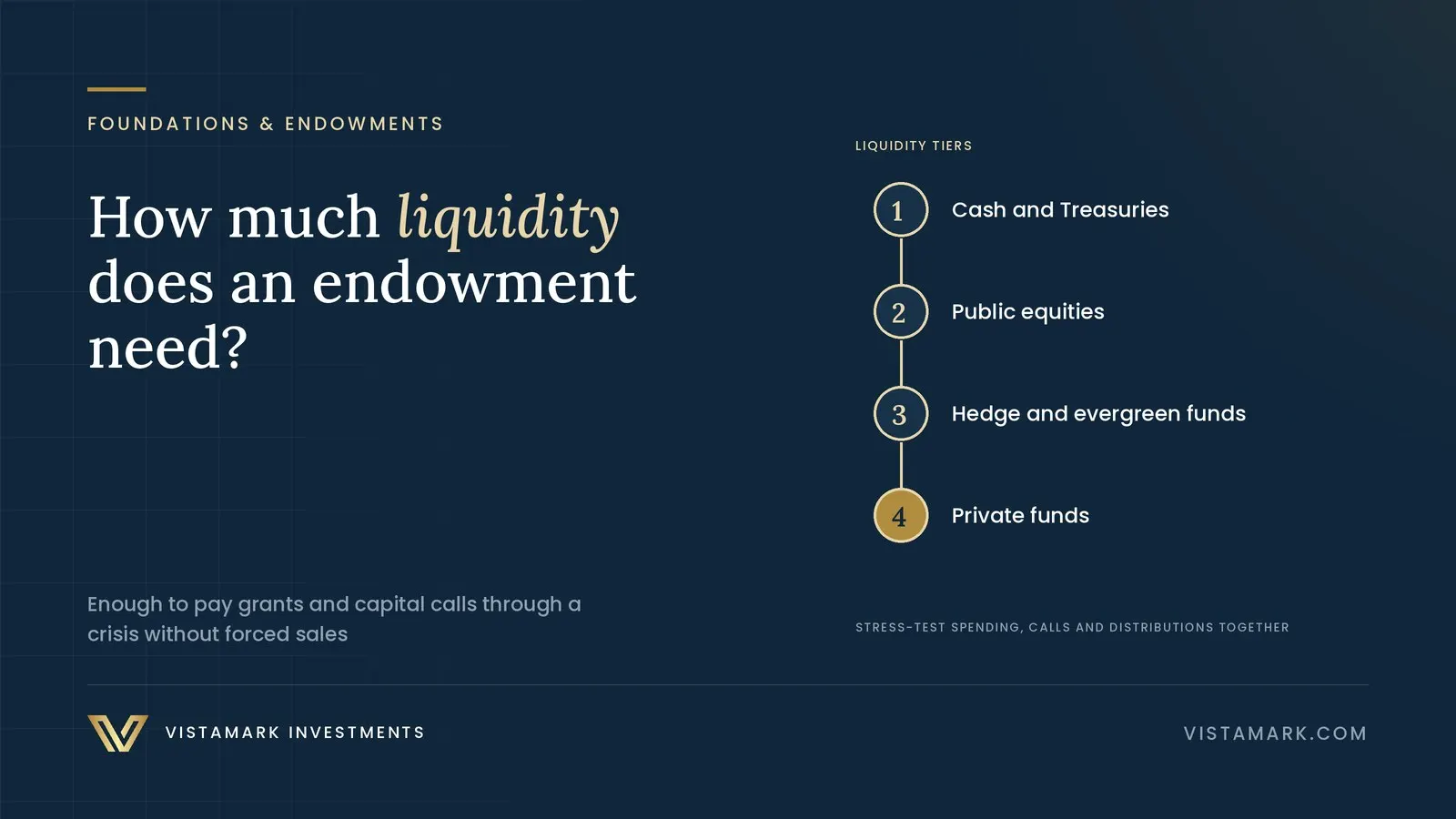
- Liquidity: semi-liquid vehicles can gate redemptions, a risk our liquidity article covers in detail.
How much should a foundation allocate?
It depends on the foundation's liquidity, spending and existing private allocation. Private credit adds to illiquid exposure alongside private equity and real estate, so it should be sized within the total illiquid budget rather than on its own. Many institutions build an allocation gradually across several managers and vintage years to diversify by strategy and timing.
Does private credit create tax issues for a foundation?
It can. Leveraged funds may generate unrelated business taxable income for tax-exempt investors, and some funds offer offshore or blocker structures to avoid it. The committee should understand the tax profile of each investment, and private foundations should consider how net investment income affects the 1.39% excise tax.
Where should a committee start?
Decide what role private credit would play and how much illiquidity the foundation can carry, then run a manager search that tests underwriting, terms and valuation as rigorously as returns. Vistamark's partners have spent careers selecting alternative credit managers. Our foundation and endowment practice builds private credit programs sized to each institution's liquidity and goals.
This article is part of our Foundation & Endowment Investment Guide, which collects our writing on the topic with answers to common questions.
Market Compass · weekly
Get the Compass by email
One concise recap of the week’s market-moving events and what to watch next, written by our CIO at the end of each market week.

Managing Partner and Founder; advises families, business owners and family offices through the VistaWealth Office™ and leads Vistamark’s private markets research. More about Sean →
This article is for informational and educational purposes only and does not constitute investment, legal, tax or accounting advice, or an offer or solicitation to buy or sell any security. Views are those of the author as of the publication date and are subject to change. Vistamark Investments is an SEC-registered investment adviser; see our disclosures.