The short answer. Mission-related investing means investing a foundation’s endowment in ways that advance its charitable purpose while still seeking a competitive, risk-adjusted return. It is different from a program-related investment (PRI), such as a below-market loan to a nonprofit, whose main purpose is charitable and which counts toward a private foundation’s 5% payout. The IRS confirmed in Notice 2015-62 that foundation managers may consider the mission when choosing investments, as long as they act with ordinary business care and prudence. Most foundations start with a written policy, a review of the current portfolio for conflicts with the mission, and a pilot allocation measured on both financial and impact goals.
What are the main forms of mission investing?
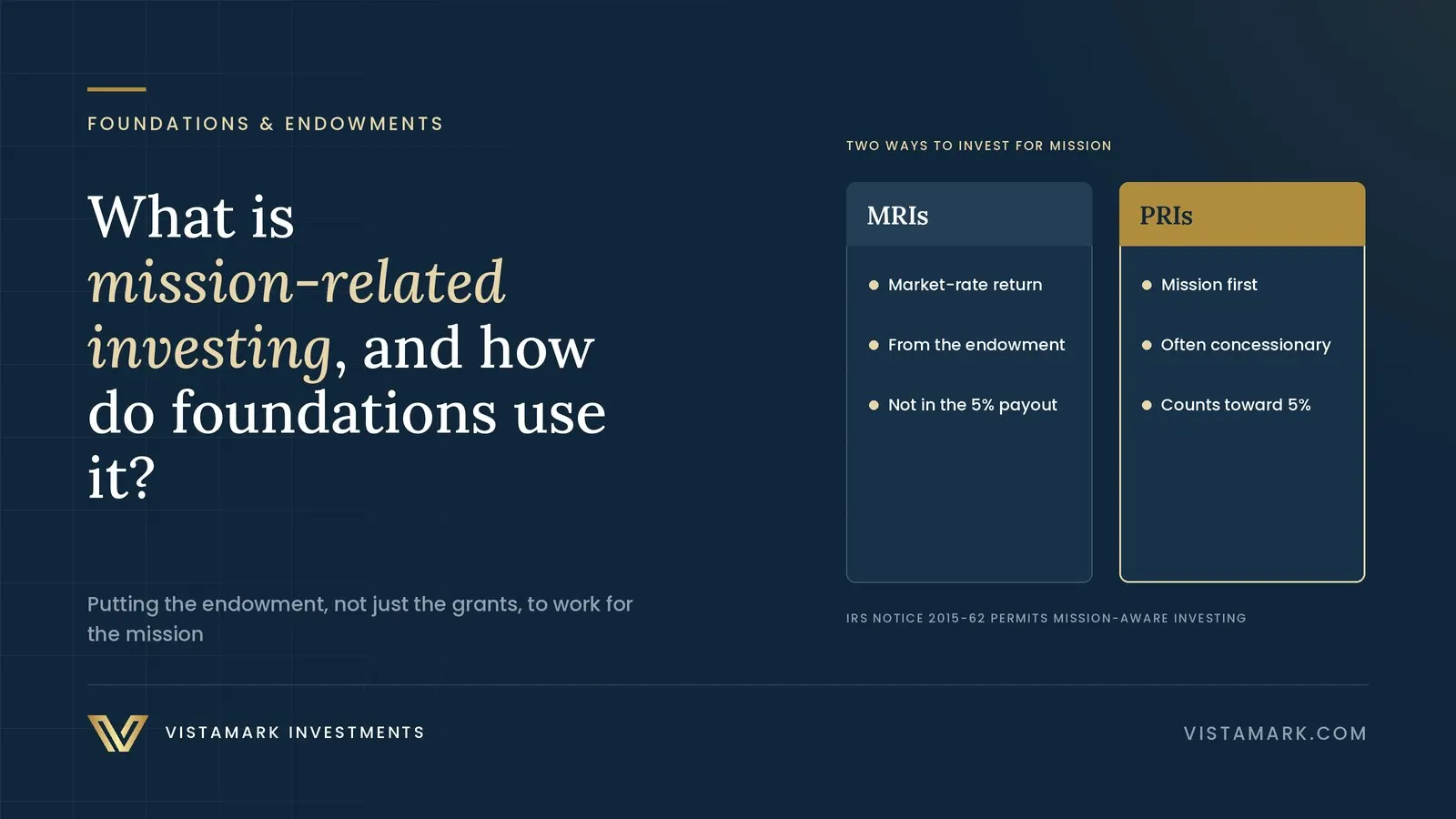
Foundations invest for mission in two main ways: mission-related investments (MRIs), which come from the endowment and seek a market return, and program-related investments (PRIs), which put the charitable purpose first and count toward the 5% payout.
| Mission-related investments (MRIs) | Program-related investments (PRIs) | |
|---|---|---|
| Primary purpose | Market-rate or competitive return, aligned with the mission | Charitable purpose; return is secondary |
| Source of funds | The endowment | Often the grant budget |
| Counts toward the 5% payout? | No | Yes, when made |
| Jeopardizing investment rules | Apply, judged on prudence | Do not apply |
| Typical forms | Impact funds, screened portfolios, green bonds, community development deposits and notes | Below-market loans, loan guarantees, recoverable grants, equity in mission-driven enterprises |
Alongside both, many foundations use exclusionary screens, avoiding companies that conflict with their mission, and shareholder engagement, voting proxies and engaging companies to encourage change. Considering environmental, social and governance (ESG) factors as part of ordinary investment analysis is not, on its own, mission investing; the test is whether the investment is chosen to advance the foundation’s purpose.
Is mission investing consistent with fiduciary duty?
Yes, when it is done prudently. The Uniform Prudent Management of Institutional Funds Act, which Illinois has adopted, lets trustees consider an asset’s special relationship or value to the institution’s charitable purposes (see our article UPMIFA in Plain English). For private foundations, the federal concern is Section 4944, which taxes investments that jeopardize the foundation’s ability to carry out its exempt purposes. In Notice 2015-62, the IRS confirmed that managers may consider the relationship between an investment and the foundation’s purposes, and that a mission-related investment with a lower expected return or higher risk is not automatically jeopardizing if managers exercise ordinary business care and prudence. Program-related investments are excluded from the jeopardizing investment rules altogether.
How should a foundation decide whether to pursue mission investing?
A foundation should define the outcomes it wants, decide what role the portfolio will play, set return expectations, check spending and liquidity needs, and then write the approach into its investment policy statement.
- Define the outcomes. Name the results the foundation wants to influence, such as affordable housing in Chicago, small business lending in underserved Illinois communities, clean energy or public health.
- Decide the goal for the portfolio. Is it to avoid conflict with the mission, to add positive impact, or to provide capital the market will not?
- Set return expectations. Market-rate MRIs belong in the endowment and are judged against its objectives and policy benchmark. Concessionary investments are better treated as PRIs or grants.
- Check spending and liquidity. Impact funds in private markets lock up capital for years; size them against the grant budget and the 5% payout requirement.
- Write it into the investment policy statement. Document the approach, exclusions, impact goals, how financial and impact results will be reported, and who approves mission investments.
What does mission investing look like for an Illinois foundation?
Many Illinois foundations focus on place. Common options include deposits and notes with community development financial institutions (CDFIs) and minority depository institutions serving the Chicago area, such as IFF, a Chicago-based CDFI that finances nonprofit facilities across the Midwest; funds that finance affordable housing or small businesses in Illinois; and municipal and green bonds that fund local projects. Program-related loans to grantees, such as a bridge loan to a nonprofit waiting on a government contract, are often the most direct way to put capital to work for the mission locally.
Do mission investments cost return?
It depends on how they are implemented. Broad screens can create tracking error against a benchmark, sometimes positive and sometimes negative. Carefully selected impact funds in private equity, real assets and credit can target market returns. Concessionary investments, by design, accept less. The committee should state which it is pursuing for each investment and measure it accordingly.
How should impact be measured?
With a small number of metrics tied to the mission, reported regularly alongside financial results. Many investors use the IRIS+ metrics maintained by the Global Impact Investing Network. The best measures are specific, such as affordable housing units financed or small business loans made in a target neighborhood, rather than general scores.
What should a foundation ask an OCIO or consultant about mission investing?
Ask how much mission investing the firm actually does for foundations, how it sources and reports on impact investments, whether it separates market-rate from concessionary investments, how it is paid, and how it will work with grants staff and counsel.
- How many foundations do you manage mission-aligned portfolios for, and can we speak with one?
- How do you source and underwrite impact funds and community investments, and how do you report impact?
- Do you distinguish market-rate MRIs from concessionary PRIs in your recommendations and reports?
- How are you paid, and do you receive any revenue from the managers or products you recommend?
- How will you work with our grants staff, legal counsel and tax advisor?
What are common pitfalls?
The most common pitfalls are adopting a values label without defining it, mixing concessionary and market-rate investments, overlooking fees and liquidity in impact funds, and failing to report impact to the board.
- Adopting a values label without defining what it means for the portfolio.
- Mixing concessionary and market-rate investments without distinguishing their purposes.
- Overlooking fees and liquidity in impact funds, which can be higher and lower, respectively, than conventional alternatives.
- Failing to report impact, which leaves the board unable to judge whether the program works.
What does a first year of mission investing look like?
Most foundations spend the first year in four stages: a board discussion and portfolio review, a written mission investing framework, a small pilot allocation, and a first combined report of financial and impact results to the board.
- Months 1–3: board discussion of purpose; review of the investment policy, spending needs and the current portfolio for conflicts with the mission.
- Months 3–6: a written MRI and PRI framework with return expectations, exclusions and approval rules; counsel reviews any PRIs.
- Months 6–9: approval of a pilot allocation, often starting with screens, proxy voting and one or two community investments.
- Months 9–12: first combined report of financial and impact results to the board, and a decision on whether to expand.
Our faith-based investing guides, such as the Catholic and Quaker guides, show how values translate into investment policy.
Where does Vistamark fit?
Vistamark is an independent, employee- and partner-owned investment firm based in Chicago and Hinsdale. Its foundations and endowments practice serves as outsourced CIO and investment consultant to foundations, endowments and nonprofits, and helps committees write mission investing into the investment policy, build screened and impact allocations, and report financial and impact results together. Every foundation should involve counsel before making program-related investments. This article is general information, not legal or tax advice.
Sources
This article is part of our Foundation & Endowment Investment Guide, which collects our writing on the topic with answers to common questions.
Market Compass · weekly
Get the Compass by email
One concise recap of the week’s market-moving events and what to watch next, written by our CIO at the end of each market week.

Partner and Director of Institutional Advisory with more than 20 years advising endowments, foundations, healthcare organizations and retirement plan sponsors. More about Ryan →
This article is for informational and educational purposes only and does not constitute investment, legal, tax or accounting advice, or an offer or solicitation to buy or sell any security. Views are those of the author as of the publication date and are subject to change. Vistamark Investments is an SEC-registered investment adviser; see our disclosures.