Our partners have advised investment committees for decades, and Matthew Rice wrote Nonprofit Asset Management, the Wiley guide to investing and overseeing nonprofit assets. This guide gathers our articles for board and committee members, organized around the decisions committees actually make, with answers to the questions we hear most.
Key questions
How much must a private foundation distribute each year?
A private non-operating foundation must make qualifying distributions of about 5% of the average market value of its investment assets, reduced by its 1.39% excise tax on net investment income, by the end of the following year. Grants, reasonable administrative costs and program-related investments count; investment management fees do not.
What return does a perpetual endowment need?
Roughly its spending rate plus inflation plus investment costs. A foundation spending 5% with 3% inflation and under 1% of costs needs nominal returns of about 8.5% to 9% over time to preserve its purchasing power.
What does UPMIFA require of investment committees?
UPMIFA requires trustees to manage and invest institutional funds in good faith and with the care of an ordinarily prudent person, considering factors such as the organization's purposes, economic conditions, inflation, expected returns and diversification. It judges the prudence of the process, not investment results, and allows delegation to qualified agents.
Should a foundation hire an OCIO or an investment consultant?
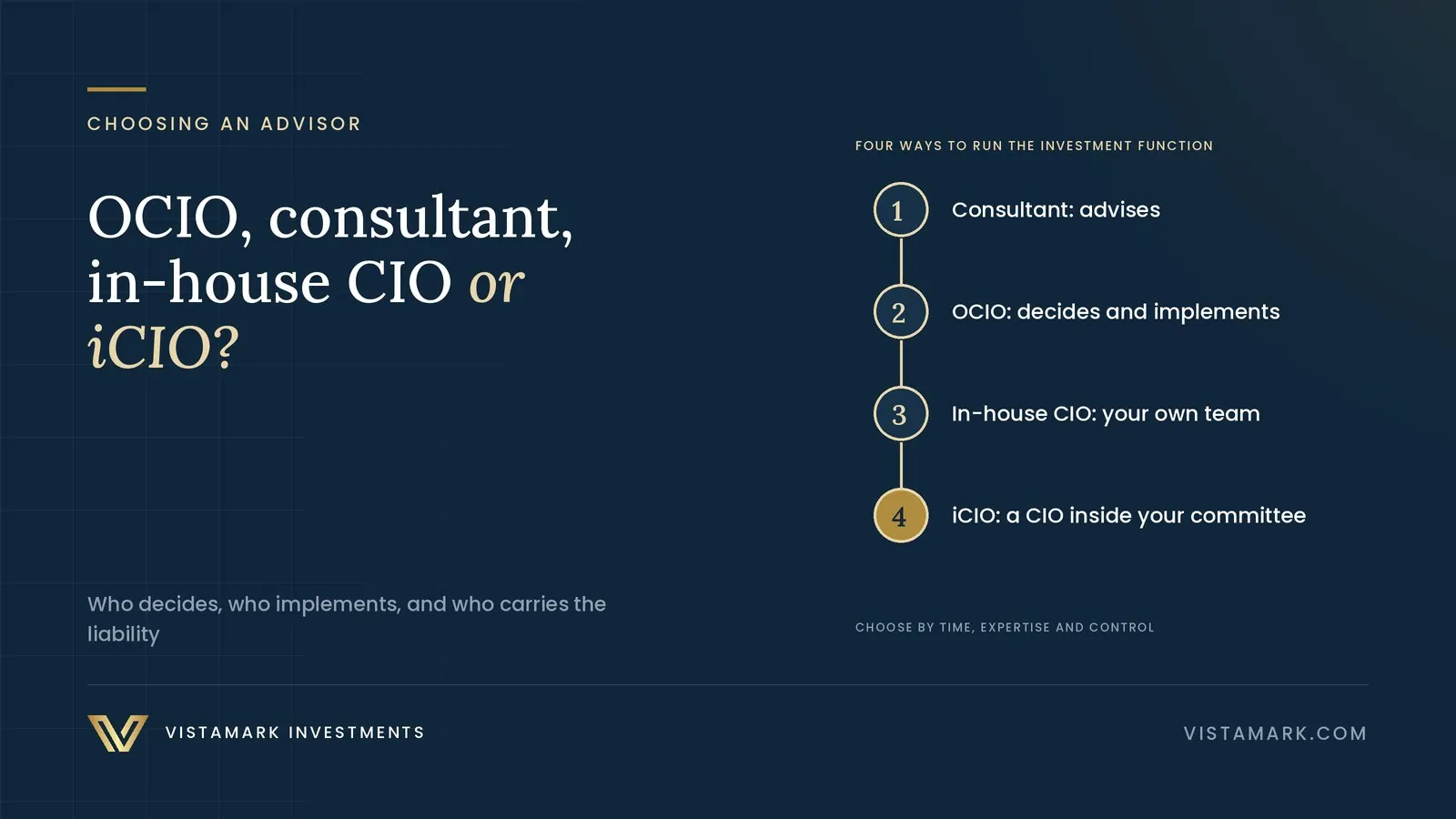
A consultant advises and the committee decides; an OCIO decides and implements within an investment policy the committee approves. Committees with limited time or complex portfolios often prefer an OCIO, while committees that want to make every decision may prefer a consultant.
Policy and spending
- Getting Spending Policy Right: A Practical Guide for Foundation Investment Committees
How foundations set endowment spending: the four common spending formulas, how each affects payout and purchasing power, and what committees must decide. - How Should a Foundation Investment Committee Choose Its Policy Benchmark?
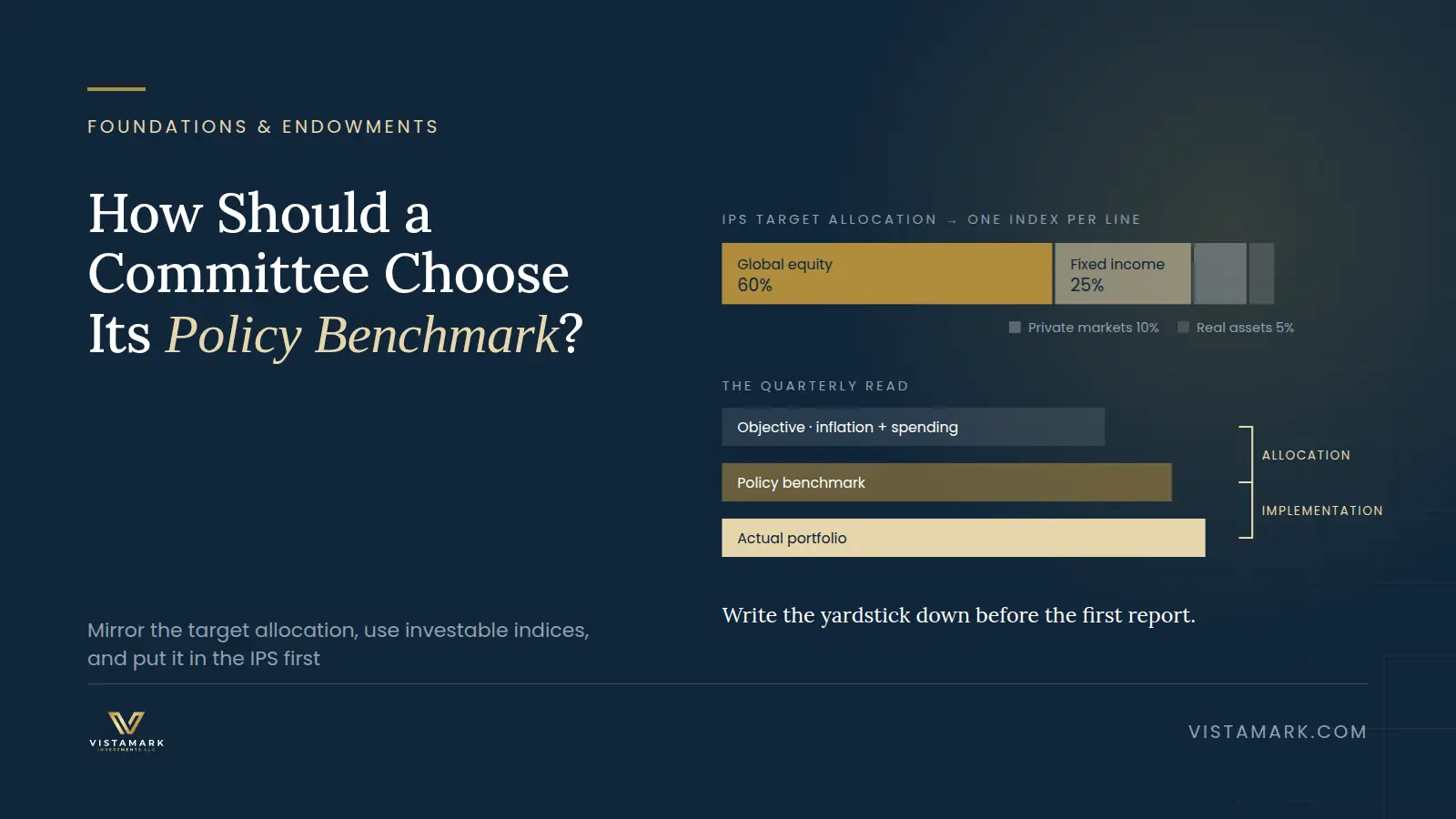
A foundation policy benchmark should mirror the target asset allocation, use investable published indices, and be written into the IPS before it is used. - UPMIFA in Plain English
UPMIFA in plain English: the state law that governs how charities invest and spend endowment funds, and what it requires of investment committees.
The portfolio
- Securing Tomorrow, Today: The Indispensable Role of Private Equity in Endowment & Foundation Portfolios
Why endowments and foundations hold private equity: long-term returns, diversification, inflation protection, typical allocations and liquidity safeguards. - When Should an Investment Committee Fire an Underperforming Manager?
Fire an investment manager when the reason you hired it no longer holds, not just after weak returns. How committees set triggers and stay patient.
Governance and the committee
- What Should a New Investment Committee Chair Do in the First 90 Days?
A new investment committee chair’s first 90 days: read the governing documents, check positioning against policy, meet the team and fix weak process. - The Fiduciary Governance Calendar
The fiduciary governance calendar: what an investment committee should review every quarter and every year, from performance to policy and managers. - Beyond the Endowment: How Investment Governance Protects Nonprofit Missions
How nonprofit investment governance protects the mission: committee duties, oversight and controls, and lessons from Cooper Union, Fisk and the NRA.
Advisors, OCIOs and fees
- OCIO vs. Investment Consultant vs. In-House CIO
OCIO vs. investment consultant vs. in-house CIO: who decides, who carries the liability, what each costs, and where an Integrated CIO (iCIO) fits. - Independent vs. Large OCIO Providers
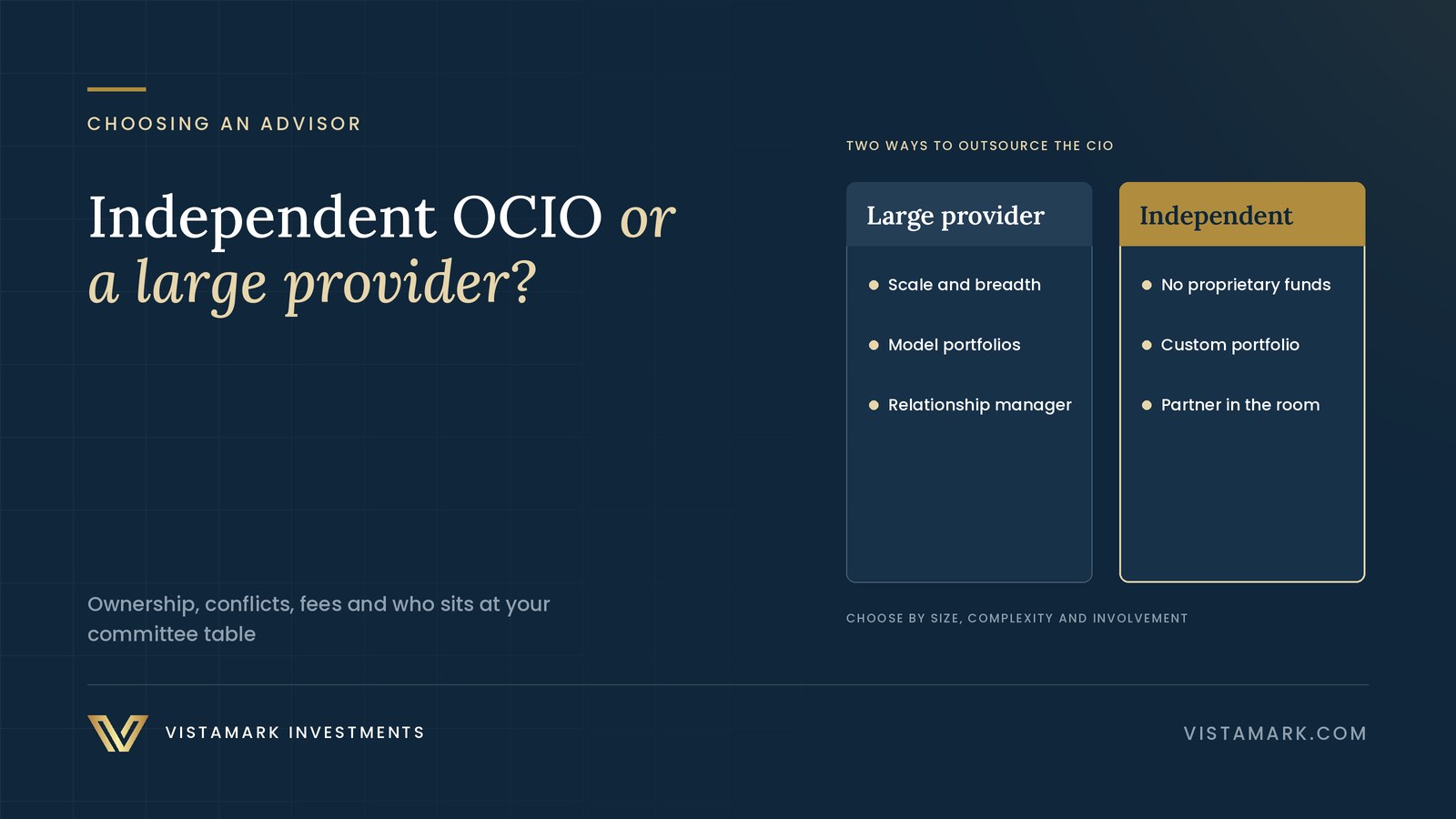
Independent vs. large OCIO providers: how they differ on ownership, conflicts, fees and who attends your meetings, and when each is the better choice. - Choosing the Right Investment Advisor for Your Foundation or Endowment
How a foundation or endowment should choose an investment advisor: test senior access, independence, private-markets skill and fee transparency. - How OCIO Pricing Actually Works: Retainers, Basis Points, and Project Fees
How OCIO pricing works: basis points on assets, flat retainers or project fees, what each covers and how to compare OCIO proposals fairly. - How Much Should an Endowment or Foundation Pay an Investment Advisor or OCIO
What foundations pay an investment advisor or OCIO: typical basis-point fees, the three layers of cost on a portfolio and how to benchmark them. - Build vs Buy: The Real Cost of an Internal Investment Department
The real cost of building an in-house investment team (staff, data, tools and senior time) versus outsourcing to an OCIO, and how to decide. - What Is an Integrated CIO (iCIO)?
Integrated CIO (iCIO) is Vistamark’s high-touch outsourced CIO platform: direct access to senior experts and a deeper partnership than a traditional OCIO.
Related guides: Estate Planning Guide · Tax Planning Guide · Family Governance Guide