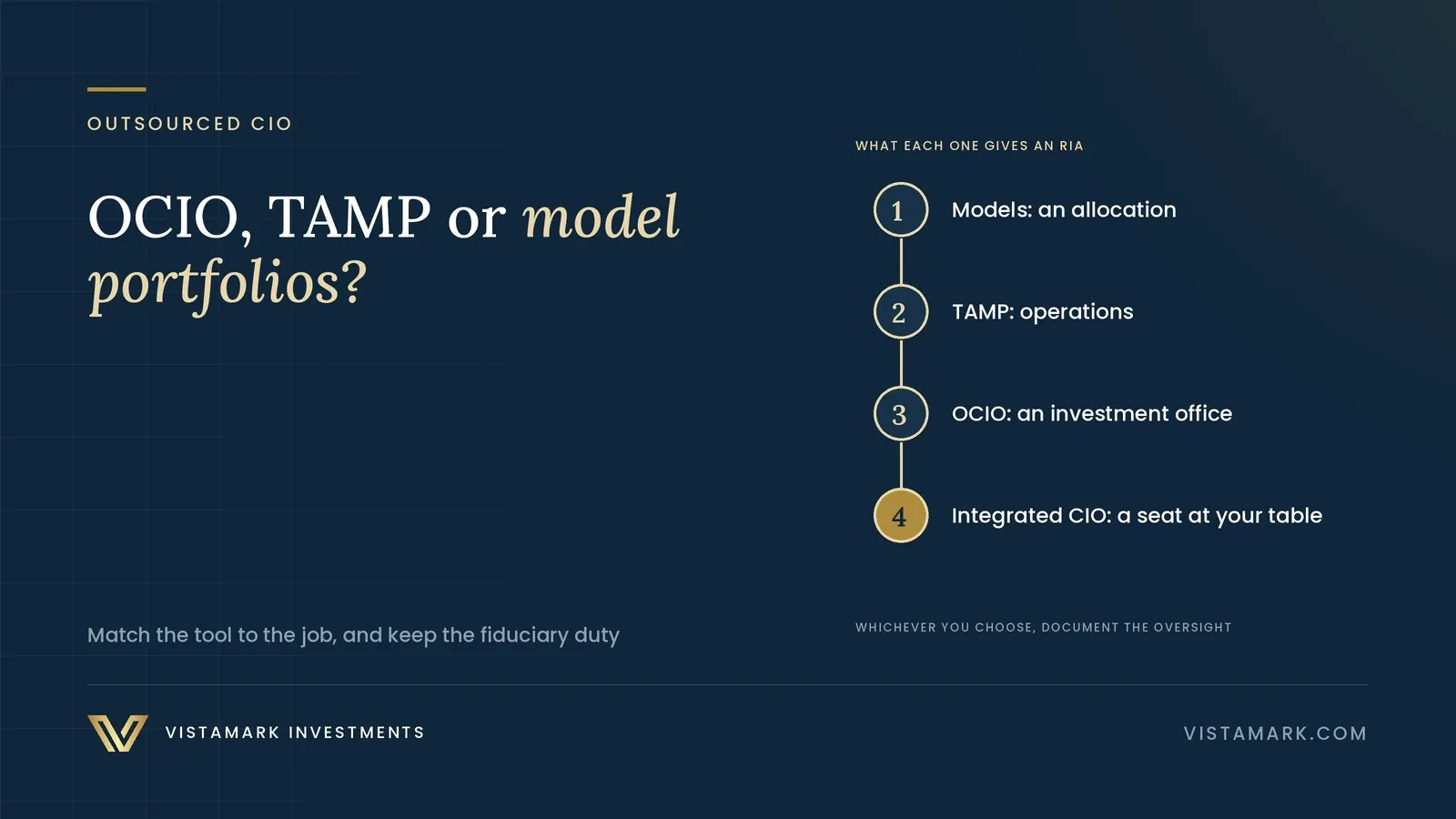
The short answer. Most registered investment advisers (RIAs) should match the tool to the job. Model portfolios suit a firm that has its own investment view and wants consistency at low cost. A turnkey asset management platform (TAMP) suits a firm that wants trading, rebalancing and reporting handled. An outsourced chief investment officer (OCIO) suits a firm whose clients need institutional research, private markets or committee-level oversight it cannot build. Whichever an RIA chooses in 2026, it keeps its fiduciary duty to clients and must oversee the provider.
What is the difference between an OCIO, a TAMP and model portfolios?
Model portfolios are recommended allocations an RIA implements itself or through software. A TAMP is a platform that implements portfolios for the RIA, handling trading, rebalancing, billing and reporting. An OCIO is an outside investment team that takes on the investment function itself: asset allocation, manager research, portfolio construction and, often, investment committee work.
| Model portfolios | TAMP | OCIO | |
|---|---|---|---|
| What the RIA gets | A recommended allocation | Implementation and operations | An investment office |
| Who makes investment decisions | The RIA | The RIA picks strategies; managers on the platform run them | The OCIO, within guidelines the RIA approves |
| Research and due diligence | Mostly the RIA’s | The platform’s, on its own shelf | The OCIO’s, documented for the RIA’s files |
| Private markets | Rarely | Sometimes, through platform products | Usually, with diligence and pacing |
| Investment committee support | None | Limited | Often included |
| Customization by client | Depends on the RIA’s capacity | Within the platform’s menu | High |
Our article What Is an Integrated CIO (iCIO)? adds a fourth option, an outside CIO who works inside the RIA’s own committee and brand.
Which option fits which kind of RIA?
The deciding factors are client complexity, the firm’s own investment depth and how much of advisors’ time goes to investment work instead of clients. A firm with similar clients and a strong investment lead can run models; a firm whose clients need private markets, custom tax management or institutional reporting usually needs an OCIO or a senior internal hire.
| If the firm… | Usually fits |
|---|---|
| Serves similar clients and has a partner who leads investments | Model portfolios, run in-house |
| Wants advisors focused on clients and operations off its plate | A TAMP |
| Serves families with private markets, concentrated stock or trusts | An OCIO, or an OCIO alongside a TAMP |
| Runs a formal investment committee that needs research and minutes | An OCIO or an integrated CIO |
| Is losing its CIO, merging or going independent | An OCIO as a bridge or a permanent solution |
Does outsourcing change an RIA’s fiduciary duty?
No. An RIA owes its clients a duty of care and a duty of loyalty that covers the whole relationship, and hiring a TAMP, model provider or OCIO does not transfer that duty. The firm remains responsible for choosing the provider prudently, overseeing it and making sure each client’s portfolio is suitable (SEC Release IA-5248).
In October 2022 the Securities and Exchange Commission (SEC) proposed a rule that would have required written due diligence and monitoring of outsourced service providers (Release IA-6176). The SEC withdrew that proposal in June 2025 (Federal Register, June 17, 2025), but the fiduciary duty behind it still applies. Firms should keep a written record of why they chose a provider and how they review it each year, and describe the arrangement accurately in their Form ADV Part 2A brochure.
How do the costs compare?
Each option charges in a different place, so an RIA should compare the total cost to the client, not the headline fee. Model portfolios are often free or inexpensive to license, but many are built from the sponsor’s own funds, so the cost sits in fund expenses. TAMPs typically charge an asset-based platform fee on top of the underlying managers’ fees. OCIOs charge an asset-based fee or a flat retainer for the investment office.
The fair comparison adds every layer (platform, manager, fund and advisory fees) and the internal cost of the people and research the firm would otherwise need. Our article How OCIO Pricing Actually Works explains retainers, asset-based fees and project fees, and Build vs. Buy estimates the cost of an internal investment department.
How would two different RIAs decide?
A worked example shows how the same question can lead to different answers. Consider two hypothetical firms: a $300 million RIA with 250 similar retirement-focused households and one partner who enjoys investment work, and a $2 billion RIA with 400 households, many of them business owners and families with trusts, private funds and concentrated stock.
- The $300 million firm can run five or six model portfolios in rebalancing software, keep its investment partner in charge and document a quarterly review. A TAMP is worth it only if operations, not investments, are the bottleneck.
- The $2 billion firm needs manager research, private markets diligence and capital call pacing, tax-aware customization and an investment committee with minutes an examiner can follow. Building that in-house means several senior hires; an OCIO or integrated CIO supplies it as a team, and a TAMP can still handle trading.
The point is not size alone. A small firm with complex clients may need an OCIO sooner than a large firm with simple ones.
Can an RIA combine these options?
Yes, and many do. A common structure uses an OCIO for asset allocation, research and private markets, model portfolios to deliver that view consistently, and a TAMP or rebalancing software for trading and reporting. The firm should make sure the pieces do not duplicate fees and that one party is clearly accountable for each decision.
What should an RIA ask before choosing a provider?
An RIA should ask who will do the work, how the provider is paid in full, what is in scope in writing, who has discretion, and what happens to the models and records if the relationship ends. The answers belong in the firm’s due diligence file.
- Who, by name, builds the portfolios and sits with our committee, and how many other firms do they serve?
- Does the provider earn anything from the funds or managers it recommends?
- How are research, decisions and changes documented for our compliance file and SEC exams?
- Can we see a sample due diligence report on a manager or private fund?
- Who owns the models and research if we part ways, and how does a transition work?
Our free guide, Ten Questions to Ask an OCIO, expands on each question with a scoring sheet.
Where does Vistamark fit?
Vistamark is an independent, employee- and partner-owned investment firm headquartered in Hinsdale, Illinois, in the Chicago area. Its Integrated CIO service gives RIAs, multi-family offices and bank trust departments a senior investment office: capital market assumptions, asset allocation, manager and private markets research, model portfolios and investment committee support, delivered under the firm’s own brand if it chooses, and coordinated with its custodian and trading platform. Vistamark has no minimum. This article is general information, not investment, legal or compliance advice.
Sources
- U.S. Securities and Exchange Commission: Commission Interpretation Regarding Standard of Conduct for Investment Advisers, Release IA-5248 (2019)
- U.S. Securities and Exchange Commission: Outsourcing by Investment Advisers, proposed rule, Release IA-6176 (2022)
- Federal Register: Securities and Exchange Commission, Withdrawal of Proposed Regulatory Actions (June 17, 2025)
- U.S. Securities and Exchange Commission: Form ADV Part 2 instructions
Market Compass · weekly
Get the Compass by email
One concise recap of the week’s market-moving events and what to watch next, written by our CIO at the end of each market week.
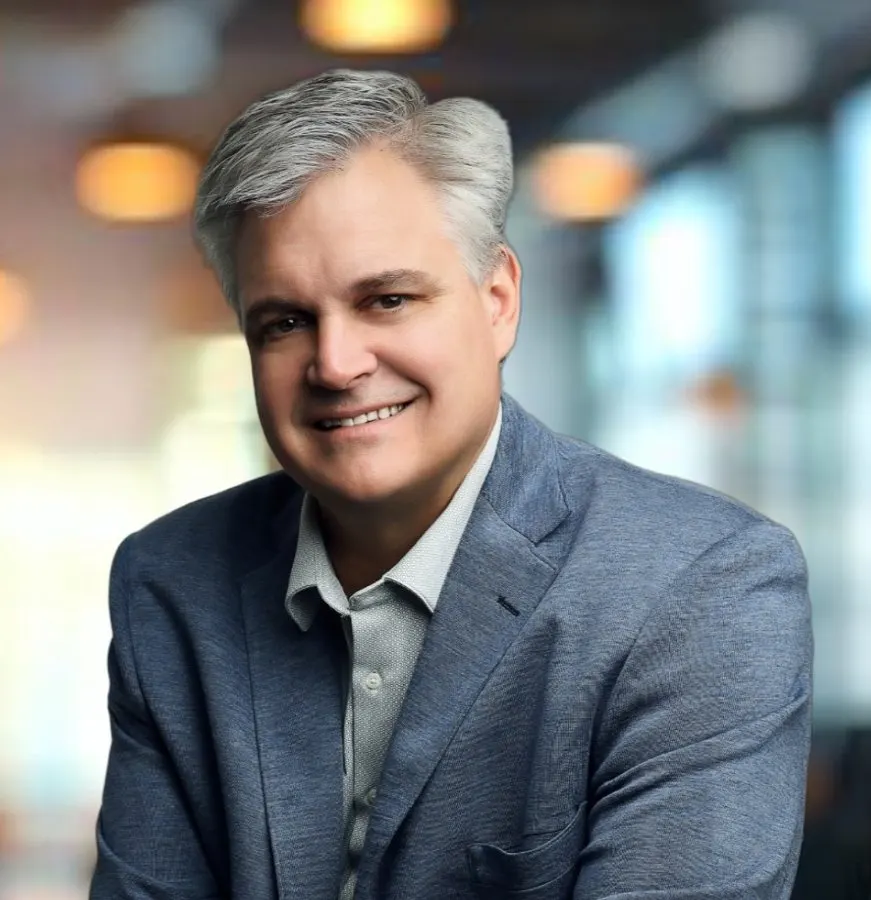
Founder and CIO of Vistamark; as CIO of Fiducient Advisors, oversaw investment strategy for more than $260 billion in client assets. More about Matthew →
This article is for informational and educational purposes only and does not constitute investment, legal, tax or accounting advice, or an offer or solicitation to buy or sell any security. Views are those of the author as of the publication date and are subject to change. Vistamark Investments is an SEC-registered investment adviser; see our disclosures.