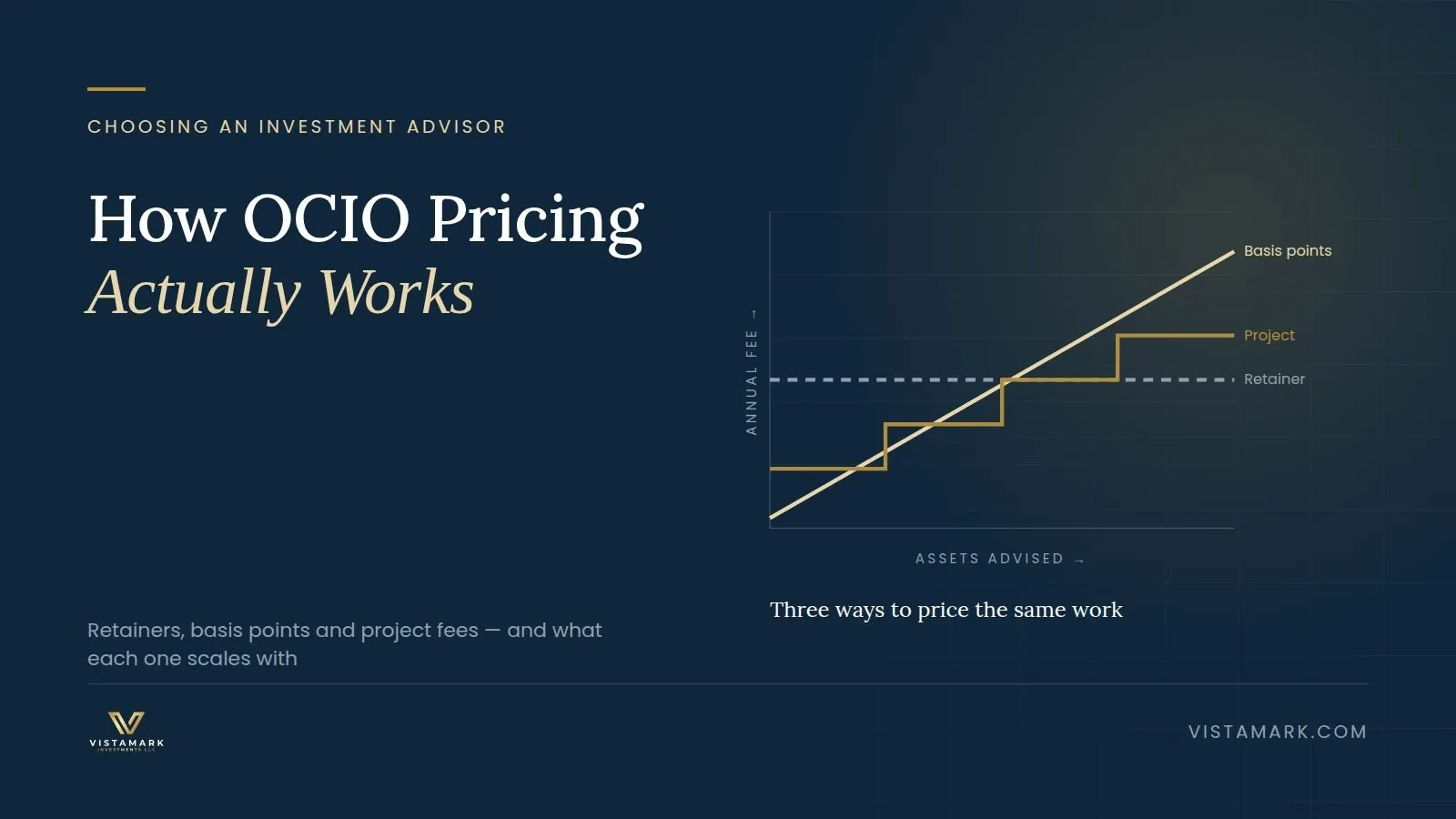
Outsourced CIO relationships are priced three main ways: basis points on the assets the provider advises, a flat retainer (often tiered by service level and by how many advisors are supporting), or a project fee for a defined piece of work such as an allocation study or a manager search. Sub-advisory pricing on individual sleeves is a fourth structure that sits between them. The structure you choose matters more than the headline number, because each one prices a different thing: assets, access, or output.
This guide is written for the people who sign that agreement: founders and principals of RIAs from roughly $100 million to $5 billion in assets, heads of bank and trust-company wealth programs, and family offices of $100 million or more. Firms in that range are large enough that the investment function is a real operation with a real cost, and small enough that the cost is visible on one page of the budget.
Four OCIO pricing structures at a glance
| Structure | What it prices | Works best when | Watch for |
|---|---|---|---|
| Basis points on assets | The assets the provider advises; the fee scales with the book | The provider implements and rebalances with discretion and the work grows with assets | Fees that outrun the work as assets grow; overpaying for easy assets, underpaying for complex ones |
| Flat retainer (tiered) | Access to an investment office at a defined service level and advisor count | RIAs, banks and family offices that need a budgetable line item and explicit scope | Scope drift — a retainer too thin to matter, or one bundling services you never use |
| Project fee | A defined output: allocation study, manager search, IPS rewrite | A firm wants to test the relationship, or needs one decision made well | Recommendations with nobody accountable for implementation |
| Sub-advisory | Management of one sleeve — private markets, alternatives, a model set | You already have an investment function and need depth in one area | Layered fees; the sleeve fee should replace an internal cost, not add to it |
The structure you choose matters more than the headline number, because each one prices a different thing: assets, access or output.
What Are You Actually Buying?
Before comparing prices, be precise about the goods. An outsourced CIO (OCIO) relationship is the purchase of an investment department: capital market assumptions, asset allocation and portfolio construction, manager research and due diligence, rebalancing discipline, trading support, documentation for your compliance file, and a senior person who is accountable when a client's situation does not fit the model.
That is a different purchase from a turnkey asset management program (TAMP), which sells administration and a shelf of model portfolios, and different again from a research partnership or subscription, which sells information. All three can be useful. Only one of them makes decisions and owns them.
This is where most pricing confusion starts. Firms often benchmark an OCIO proposal against their reporting or custody platform and conclude the OCIO is expensive. Those line items are not substitutes. Comparing an investment department to a software license produces a number that is arithmetically correct and strategically useless.
How Do Basis-Point Fees Work, and When Do They Stop Making Sense?
A basis point is one hundredth of one percent. Basis-point pricing charges a percentage of the assets the provider advises, so the fee scales automatically as the book grows.
Basis points work well when the provider's work genuinely scales with assets and when the arrangement includes discretion and implementation rather than advice alone. They work poorly in two situations. First, when your firm is growing quickly, an asset-based fee can outrun the actual increase in work and require frequent renegotiation. Second, when the value delivered is concentrated in a handful of complex situations rather than spread across the book, an asset-based fee charges you for the easy assets and undercharges for the hard ones.
The practical test: ask whether the provider's cost to serve you actually rises with your AUM. If it does not, a flat retainer fee structure may work for your organization.
How Do Flat Retainers Work?
A flat retainer is a fixed monthly or annual fee for a defined scope of service. In the RIA and bank market, retainers are commonly tiered, with each tier adding scope: more frequent portfolio reviews, more advisor-facing support, custom model construction, client-meeting participation, or named senior coverage. Retainers in this market generally run from the low thousands of dollars per month at the entry tiers into the low tens of thousands for full-scope engagements, with the largest full OCIO relationships priced as custom flat fees. Treat those as ranges to test in the market, not as benchmarks.
Retainers have three advantages worth naming. They are budgetable, which matters enormously at banks and trust companies where the wealth program defends a line item annually. They decouple your growth from your cost, so the year you add $200 million is not automatically the year your investment bill jumps. And they make scope explicit, because a fixed fee forces both sides to write down what is included.
The corresponding risk is scope drift in both directions. A retainer that is too thin produces a provider who is technically compliant and practically absent. A retainer that bundles services you never use is a discount you are not receiving. Ask for tier definitions in writing, and ask which tier firms your size actually buy.
When Is a Project Fee the Right First Step?
A project fee buys one defined deliverable: an asset allocation study, a manager search, a due diligence review of an existing lineup, an investment policy statement rebuild, or a plan for a single complicated client situation.
Project engagements are the most underused structure in this market, and they are usually the right first step. They let you test the working relationship on real work at a known cost before you restructure your firm's investment function around a vendor. You learn what no proposal reveals: whether the output is usable in front of a client, how fast the senior people respond, and whether the analysis arrives with a recommendation attached or leaves the judgment call back on your desk.
Consider buying the same small project from both finalists. The difference in the deliverables will tell you more than the difference in the fee schedules.
What About Sub-Advisory Pricing?
In a sub-advisory arrangement, the provider manages a specific sleeve of the portfolio under its own discretion, typically priced in basis points on that sleeve. This structure is common when a firm wants outside management for one part of the portfolio, such as an alternatives allocation or a tax-sensitive equity sleeve, while keeping the rest in-house.
Sub-advisory pricing is straightforward but demands attention to layering. Add the sub-advisory fee, the underlying fund or strategy fees, your own advisory fee, and platform costs, then sum all of these costs to get to a total all-in cost. Layering is where otherwise reasonable arrangements become indefensible.
How Do You Compare Proposals That Are Priced Differently?
Convert everything to one number: the total annual cost of your firm's investment function, all in, at today's assets and at your three-year plan.
Include the provider's fee under each structure, any product or platform costs that ride along with it, the internal staff time the arrangement still requires, and the technology you keep paying for either way. Then compare that total against the honest cost of building the same capability internally, which for most firms below roughly a billion in assets means a credentialed investment lead plus analyst support, research subscriptions, and rebalancing technology. Build it out fully before deciding it is cheaper.
Run the same math at your projected assets. A basis-point arrangement and a retainer that look identical at today's AUM can diverge substantially in three years, and the direction of that divergence should be a deliberate choice rather than a surprise.
Which Questions Separate Providers on Price?
Ask these in writing, of everyone, and compare the answers side by side:
- How do you make money, in full? Advisory fees only, or also revenue from products, funds, or managers on the recommended list? An incomplete answer is itself an answer. Our post on choosing the right investment advisor walks through the same disclosure questions from the institutional side.
- What are the tier definitions, and which tier do firms our size buy? Get scope in writing, including what is explicitly excluded.
- Will you do a paid project first? Willingness to be tested on one piece of work is informative. So is unwillingness.
- What are the term and notice provisions? Month-to-month arrangements with short notice periods exist in this market. If a provider requires a multi-year lock, ask what the lock protects and whom it protects.
- What does private-label cost? If your firm's name is going on the models, reports, and client-facing material, ask whether that is included, priced separately, or unavailable. Ask who owns the work product if the relationship ends.
- Who owns your firm, and what happens to our pricing and service if you are sold? The consolidation wave in wealth-management infrastructure has made this a pricing question, not just a governance one. Sponsor-owned providers operate on defined hold periods, and repricing at the end of one is common enough to ask about in advance.
- What is the cost of leaving? Portability of models, data, and documentation, plus any unwind or transition fees. Providers who make this boring to answer are telling you something.
Price Is Half the Decision. Due Diligence Is the Other Half.
Whatever the fee structure, the price is only half the decision. The other half is due diligence on the provider itself: information security, business-continuity planning, financial condition of the vendor, subcontractor disclosure, and the governance process that approves the relationship. At banks and trust companies this takes the form of a formal vendor-risk review, often run by a committee that applies a higher standard to an outside provider than to an internal hire doing identical work. RIAs and family offices face the same questions with less structure around them, which makes it easier to skip the work and harder to defend the decision later.
Two implications follow. Budget for the review cycle in your timeline, not just the fee in your budget. And ask candidly whether the provider has cleared this kind of review before. A firm that arrives with completed due diligence packages, documented controls, and references from other institutions saves your organization months. Governance discipline is worth paying for, a point our discussion of investment governance develops in the nonprofit context.
Does Any of This Change for Family Offices?
For family offices above $100 million, the structures are the same and the emphasis shifts. Retainers and project fees usually fit better than asset-based pricing, because the work is concentrated in complex, non-recurring problems: concentrated positions with embedded gains, private-markets pacing, and the operating businesses that sit alongside the portfolio. Where private markets are part of the plan, price the diligence work explicitly, given the complexity involved in private equity allocations. A family office should never be more locked into its investment vendor than the family is to its own strategy.
The One-Sentence Version
Price the structure, not the number: basis points when the provider's work truly scales with your assets, a retainer when you want budget certainty and defined scope, and a project fee when what you actually need is to find out whether this is going to work.
Sources and further reading
- U.S. Securities and Exchange Commission — Form ADV Part 2 instructions (Item 5, Fees and Compensation)
- U.S. Securities and Exchange Commission — Investment Adviser Public Disclosure (look up any adviser’s Form ADV)
- Federal Reserve, FDIC and OCC — Interagency Guidance on Third-Party Relationships: Risk Management (SR 23-4, June 2023)
- U.S. Securities and Exchange Commission — Commission Interpretation Regarding Standard of Conduct for Investment Advisers, Release IA-5248 (2019)
For more information and personalized guidance, please feel free to reach out to Vistamark Investments. You can contact us at 312-895-3001, visit our website at vistamark.com, or send us an email to info@vistamark.com.
This article is part of our Foundation & Endowment Investment Guide, which collects our writing on the topic with answers to common questions.

Managing Partner and Founder; advises families, business owners and family offices through the VistaWealth Office™ and leads Vistamark’s private markets research. More about Sean →
This article is for informational and educational purposes only and does not constitute investment, legal, tax or accounting advice, or an offer or solicitation to buy or sell any security. Views are those of the author as of the publication date and are subject to change. Vistamark Investments is an SEC-registered investment adviser; see our disclosures.