Building an internal investment department means hiring credentialed research staff, licensing institutional data and portfolio tools, and committing senior time to run and document a repeatable process. Buying means retaining an outsourced CIO (OCIO), a turnkey asset management program (TAMP), or an overlay provider to do that work under your firm's oversight, often under your own brand. The real comparison is not one analyst's salary against one vendor's fee. It is the fully loaded cost of a defensible investment process, including principal time, key-person risk, and what happens to clients when a research hire leaves. For most founder-led RIAs, bank and trust-company wealth programs, and family offices in the $100MM to $5B range, the honest answer is a hybrid: buy the process, keep the client-facing judgment.
What Does "Build" Actually Include?
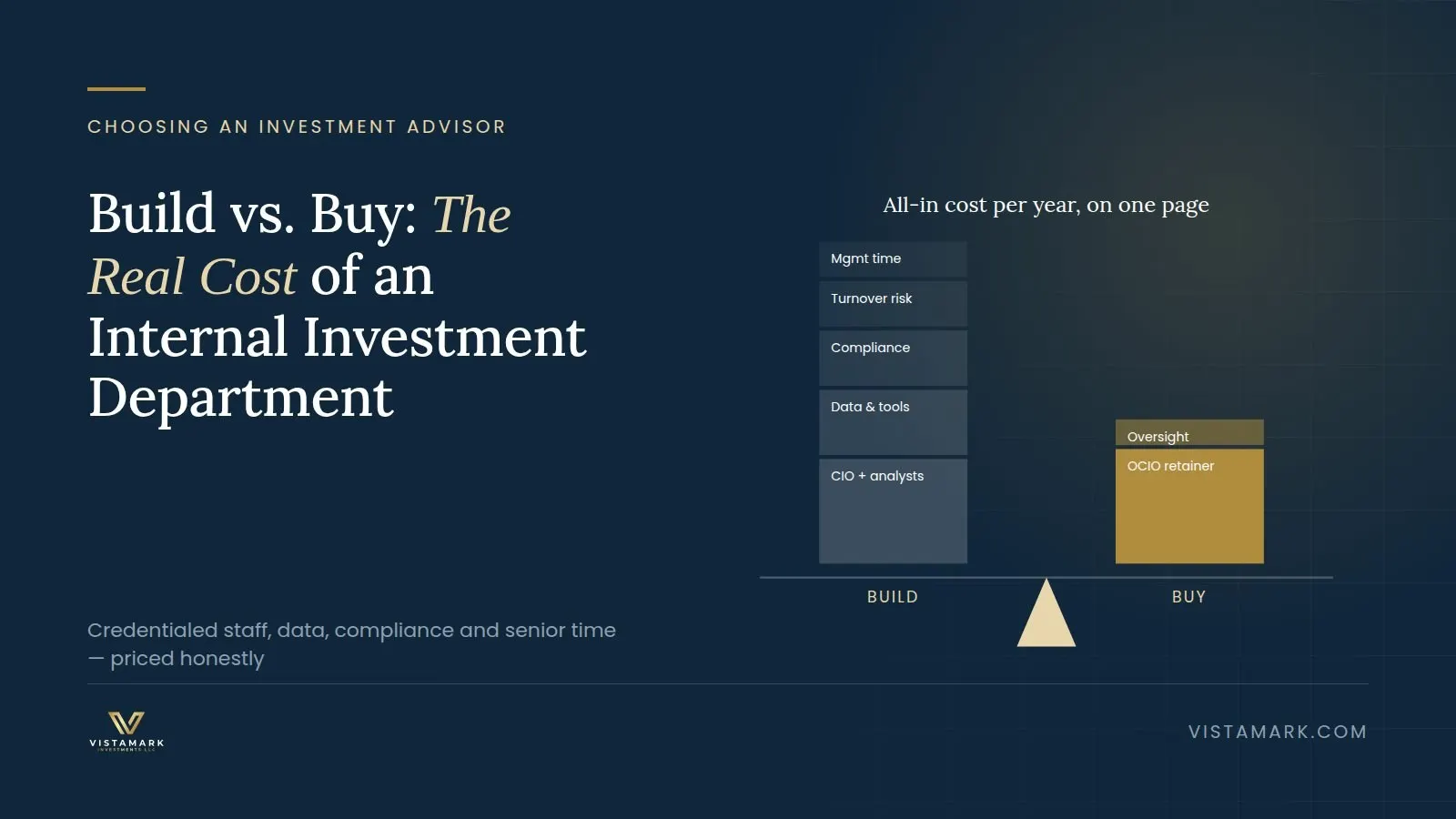
Founders tend to price the build option as one hire. In practice, an internal investment department is a system with at least five parts.
The first part is people. A functioning research function needs at least one credentialed professional (CFA or CAIA is the market norm) who can run asset allocation, manager or fund selection, and portfolio construction, plus someone who can execute rebalancing and trading without errors. One person can hold both roles for a while. One person cannot take vacation, get sick, or resign without the process stopping.
The second part is tools and data. Optimization software, risk analytics, a rebalancing engine, performance reporting, and the market data that feeds all of it are recurring license costs, and someone has to know how to use them.
The third part is process and documentation. A formalized organizational and decision-making structure, a written investment policy, model change logs, and a review calendar are what make the work defensible to clients, examiners, and (at a bank) an audit or risk committee. The same discipline that protects a nonprofit board through investment governance applies to an advisory firm's own models.
The fourth part is oversight time. Someone senior has to oversee the process, review the research, and own the decisions. At a founder-led firm, that someone is usually the founder, and founder time is the scarcest resource in the building.
The fifth part is continuity. If the head of research leaves, the firm needs a plan for the models, the client communications, and the recruiting process, all while keeping the day-to-day train on the tracks.
What Does an Internal Investment Department Really Cost?
Add the five parts together and the true cost of building is easier to see. Compensation for one or two credentialed professionals, recurring software and data licenses, compliance and documentation time, and a meaningful share of a principal's calendar are all annual costs. Then add the costs that never appear on a budget line: the revenue an organization does not generate while running the investment department, the key-person risk of a small team, and the growth the firm turns down because the investment function cannot absorb it.
Compare that total, not the salary line alone, against the annual cost of an outsourced arrangement. Larger firms with an existing research culture may find building is right. Many firms in the $100MM to $5B range find the fully loaded internal number is higher than assumed, and that they were underinvesting in the function rather than saving money.
What Does "Buy" Look Like in Today's Market?
The buy side of the decision is a spectrum, and the market's vocabulary describes points along it.
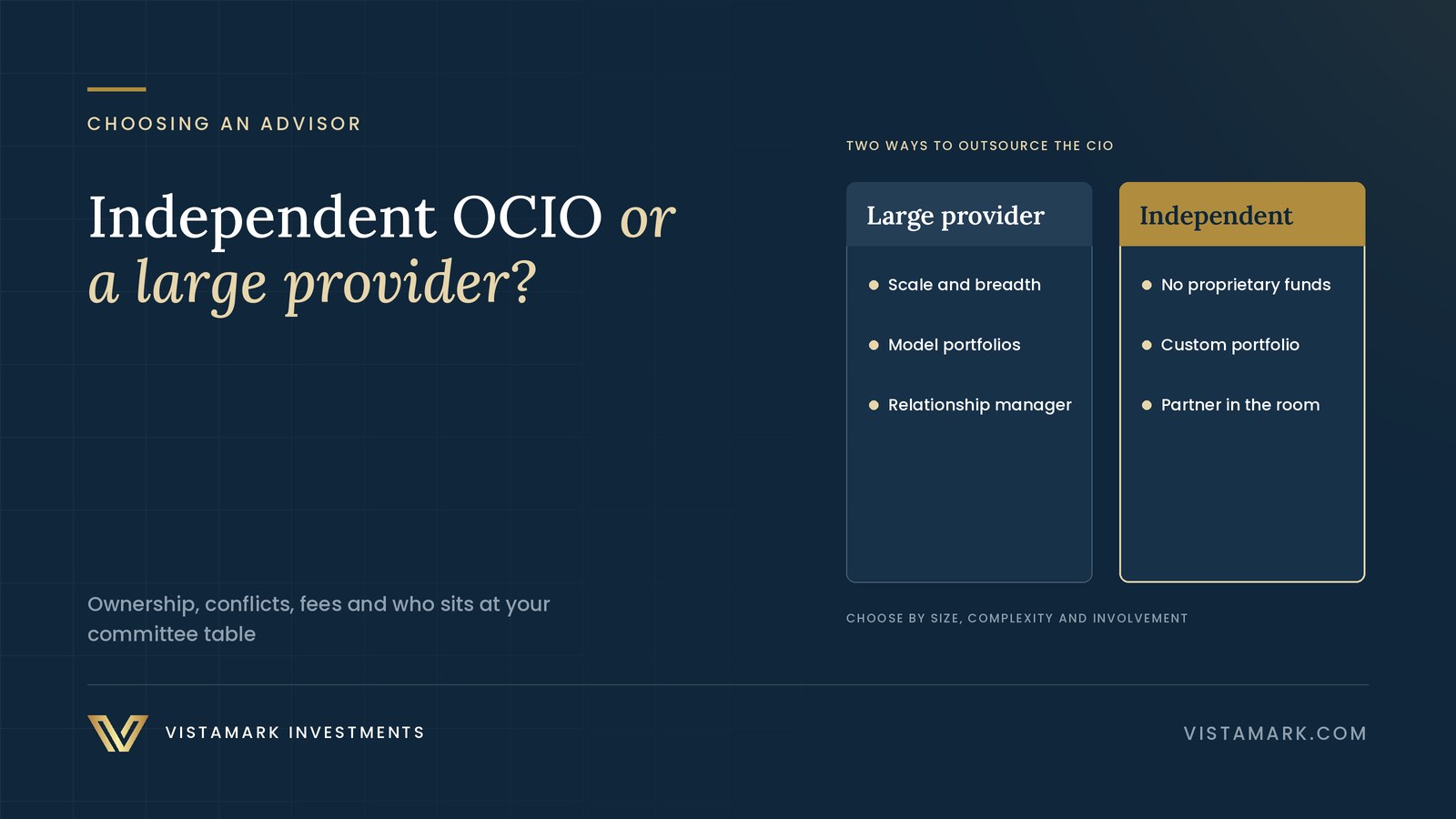
A TAMP supplies models, trading, and often reporting on its own platform, usually under its own brand. An overlay provider manages rebalancing, tax coordination, or a specific sleeve across accounts your firm still controls. A sub-advisor runs a defined portion of the portfolio for a fee on those assets. An outsourced CIO functions as your firm's investment department: asset allocation, manager research, portfolio construction, rebalancing, and committee support, with your firm retaining the client relationship and final authority.
Private-label (or white-label) delivery can attach to most of these. Your firm's name appears on the models and the materials; the provider does the research behind them. The questions that come with that arrangement deserve their own diligence, and we address them in a companion guide on private-label model portfolios.
Engagement structures have also become more flexible. Many providers now offer project-based work, flat monthly retainers, sub-advisory fees on defined sleeves, and full outsourced CIO arrangements, and some will run month-to-month rather than requiring multi-year commitments. That matters because it lets a firm test the relationship on a paid one-off before deciding whether to expand it.
Why Are Firms Revisiting This Decision Now?
Several market realities are pushing the build vs. buy question back onto the agenda.
Consolidation has changed the vendor landscape. Many long-standing TAMPs, platforms, and consulting firms have been acquired, often by private equity buyers, and firms that chose a partner for its ownership culture are finding that the culture changed with the cap table. A firm re-evaluating an incumbent after an acquisition is effectively running a new selection process, and it should apply the rigor an institution would use when choosing an investment advisor.
The bandwidth and expertise gap is real. Firms can win clients faster than they can build research capacity. A common tell is a founder who owns good analytical software but lacks the time and the CFA-level staff to run it.
Clients ask harder questions than they used to. Boards, families, and referral sources expect a documented process and a clear explanation of why the portfolio holds what it holds. Generic off-the-shelf models are harder to defend than they once were, and interest in private-label delivery has grown as a result.
Succession is forcing the issue. At founder-led firms, the investment function often lives in the founder's head. A buyer, a successor, or a merger partner will ask how the models survive the founder's departure, and "buy" can be part of that answer.
What Is Different for Banks and Trust Companies?
A wealth or trust program inside a bank faces a formal gate that an RIA does not: an outside investment partner typically must clear a vendor-risk or operational-risk committee before any account moves. Expect a higher documentation standard for an external provider than for internal staff, and expect the committee to ask about the provider's financial condition, data security, business continuity, and regulatory history.
That process is a cost of buying; plan for it rather than discovering it late. The counterweight is that the same committee will also scrutinize an internal build: staffing depth, model governance, and key-person exposure are vendor-risk questions turned inward.
What Is Different for Family Offices?
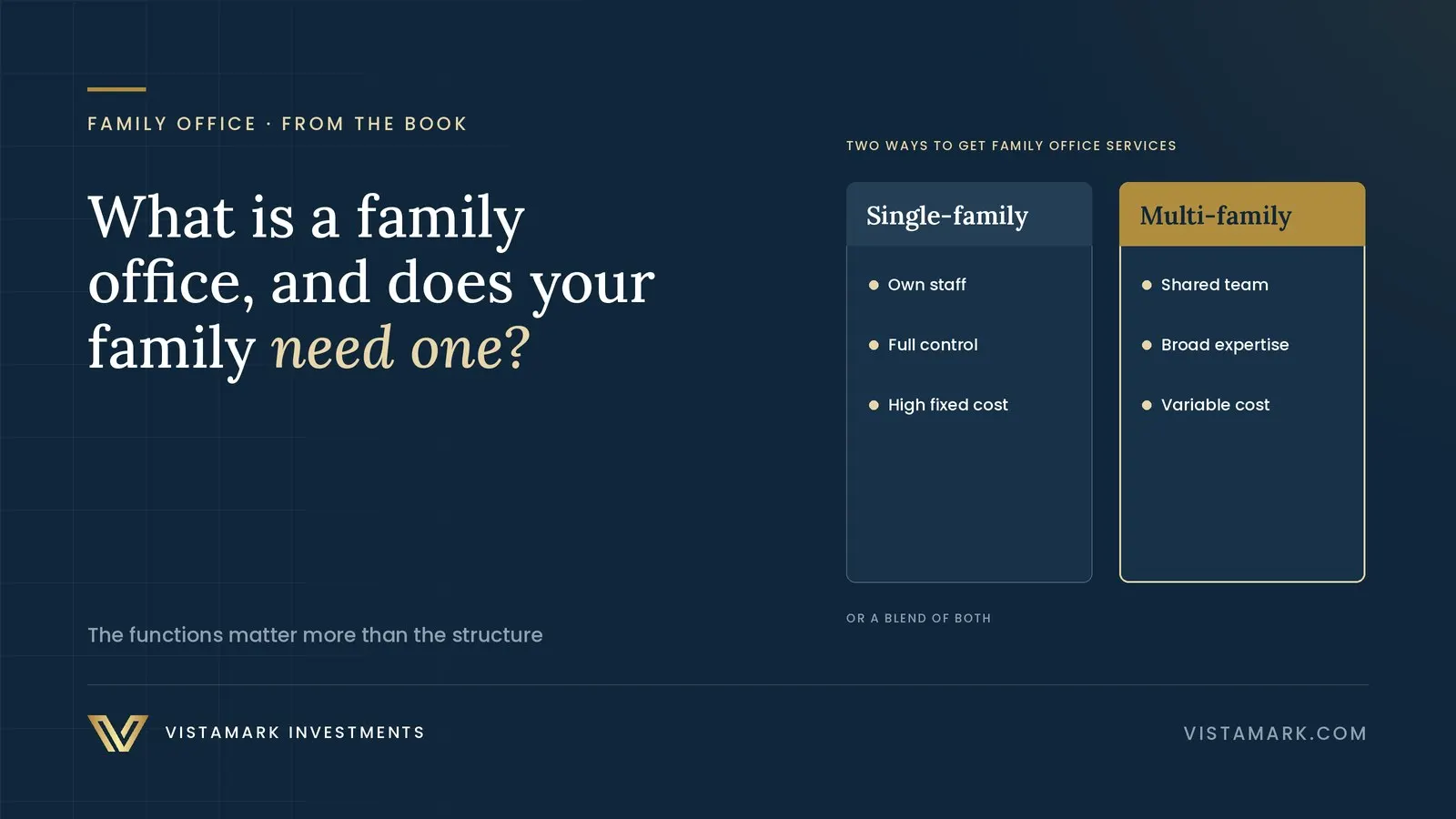
A family office of $100MM or more sits closer to an endowment than to a retail advisory practice. The build vs. buy question there centers on access and diligence in private markets, where the case for private equity in long-horizon portfolios depends heavily on manager selection and pacing discipline. A small internal team rarely has the sourcing network or the diligence bandwidth to do that well alone, which is why many family offices buy research and portfolio construction while keeping governance and final decisions inside the family.
What Should You Ask Any Outsourced Investment Provider?
Whether you are comparing an OCIO, a TAMP, an overlay manager, or a sub-advisor, the same questions separate providers.
- Who actually does the work, and who will I talk to? Ask for the names and credentials of the people doing the research and whether you reach decision-makers or a service desk.
- Who owns the provider, and who will own it in three years? Ownership drives behavior. Ask about outside capital, exit timelines, and what protections you have if the provider is sold.
- How are the models built and rebalanced, and can I see the process? A provider should be able to explain every position in language your clients can absorb, and should show you the disclosures behind any modeled or back-tested figures.
- How is the fee set, and what does it exclude? Ask for all revenue sources, including anything paid by funds or platforms, and whether the fee is flat, asset-based, or project-based.
- Can we start small? Ask whether a paid project or a month-to-month retainer is available before a full commitment, and what notice period applies.
- What happens if we leave? Ask who owns the models, the data, and the client materials, and how a transition would work.
- Can the work carry our brand, and what does that require? If private-label delivery matters, ask what the provider needs from you and how accountability is shared.
How Do You Actually Decide?
Write down the fully loaded cost of building (people, tools, documentation, principal time, continuity) and compare it with the total cost of the outsourced arrangement you would actually sign, including the oversight time that buying still requires. Then ask three questions. Does the firm have, or want, a research culture that would retain credentialed talent? Does the growth plan depend on freeing principal time? What would clients experience the day the head of research resigns?
Firms that answer honestly land in one of three places: build (large firms with research depth), buy (firms whose edge is the client relationship), or a hybrid in which the firm buys the research and process and keeps the client-facing judgment and final authority. The hybrid is a common outcome for firms in the $100MM to $5B range, and it is what a well-structured outsourced CIO, overlay, or private-label relationship is designed to support.
Sources and further reading
- Federal Reserve, FDIC and OCC — Interagency Guidance on Third-Party Relationships: Risk Management (SR 23-4, June 2023)
- U.S. Securities and Exchange Commission — Commission Interpretation Regarding Standard of Conduct for Investment Advisers, Release IA-5248 (2019)
- U.S. Securities and Exchange Commission — Form ADV Part 2 instructions (Item 5, Fees and Compensation)
For more information and personalized guidance, please feel free to reach out to Vistamark Investments. You can contact us at 312-895-3001, visit our website at vistamark.com, or send us an email to info@vistamark.com.
This article is part of our Foundation & Endowment Investment Guide, which collects our writing on the topic with answers to common questions.

Managing Partner and Founder; advises families, business owners and family offices through the VistaWealth Office™ and leads Vistamark’s private markets research. More about Sean →
This article is for informational and educational purposes only and does not constitute investment, legal, tax or accounting advice, or an offer or solicitation to buy or sell any security. Views are those of the author as of the publication date and are subject to change. Vistamark Investments is an SEC-registered investment adviser; see our disclosures.