The financial world for endowments and foundations just got a wake-up call. The “One Big Beautiful Bill Act,” or OBBB, signed into law on July 4, 2025, isn’t just another piece of legislation—it’s a fundamental change to the economics of large-scale charitable investing. Starting in 2026, a new excise tax regime will profoundly impact how major institutions manage their portfolios, a change that will have an immediate and compounding effect.
Important clarification: The OBBB Act specifically targets private foundations and university endowments. Donor-advised funds (DAFs), community foundations, and operating charities are NOT affected by these new excise tax rules. These charitable vehicles continue to operate under the previous tax framework and remain exempt from the progressive rate structure described below.
For any private foundation or university endowment with assets over $50 million, this isn’t a minor adjustment; it’s a call to action. The drag on returns will snowball, impacting future grants and mission-driven spending. Here’s a deep dive into what changed, why it matters, and the advanced strategies you can use to respond.
A New Tiered Tax Structure
Before the OBBB, private foundations and endowments were subject to a flat 1.39% excise tax on their net investment income (NII). It was a straightforward, predictable drag on returns.
Now, things are different. The new law introduces a tiered, progressive rate structure:
Private Foundations:
-
Under $50 million: Still pays the original 1.39% rate
-
$50–250 million: The rate doubles to 2.78%
-
$250 million–$5 billion: The rate jumps to 5%
-
Over $5 billion: The rate reaches a staggering 10%
University Endowments:
-
Student-adjusted endowment levels determine rates up to 8%, depending on their per-student asset levels.
This isn't just an increase; for the largest institutions, it's a dramatic sevenfold hike that fundamentally alters their operating environment.
The Compounding Cost Is Material
Every extra dollar paid in taxes is a dollar that can't be used for grants, research, or scholarships. This is a material change because the impact is immediate and, more importantly, compounding. A slower rate of return year after year means that the drag on a portfolio's value snowballs over time, shrinking its future grantmaking capacity.
Nationally, this is projected to result in $15.9 billion less in grants over the next decade. This projection comes from an analysis by the Center for Charitable Economics. The new tax regime doesn't just affect individual portfolios; it reshapes the philanthropic landscape. It's a behavioral necessity: portfolio turnover, fund structure, and advanced tax strategy are no longer niche concerns—they're central to the mission.
The OBBB's Dollar and Percentage Impact: A Comparative View
The following table highlights the impact of the OBBB Act on portfolios of various sizes, showing the direct dollar cost and the resulting percentage decrease in after-tax returns:
|
Endowment Size |
Pre-OBBB After-Tax Return |
Post-OBBB After-Tax Return |
Tax Increase (Dollar Impact) |
Tax Increase (Percentage Impact) |
|---|---|---|---|---|
|
$50 Million |
7.979% |
7.979% |
$0 |
0.000% |
|
$100 Million |
7.958% |
7.917% |
$41,700 |
0.524% |
|
$200 Million |
7.958% |
7.917% |
$83,400 |
0.524% |
|
$1 Billion |
7.958% |
7.850% |
$1,083,000 |
1.361% |
|
$5 Billion |
7.958% |
7.850% |
$5,415,000 |
1.361% |
Analysis for a $100M Endowment
Consider a $100 million endowment with a 70/30 allocation:
|
Pre-Bill |
Post-Bill |
20-Year Dollar Impact |
|
|---|---|---|---|
| Gross Return (8%) |
$8,000,000 |
$8,000,000 |
|
| NII (3%) |
$3,000,000 |
$3,000,000 |
|
| Excise Tax Rate |
1.39% |
2.78% |
|
| Tax Owed |
$41,700 |
$83,400 |
|
| Net Return After Tax |
$7,958,300 |
$7,916,600 |
|
| Real Net Return |
4.96% |
4.92% |
|
| Reduction of Assets due to new tax drag |
$0 |
~$2.0M |
While the annual difference might seem small, the table shows the power of compounding—that small difference grows exponentially over time.
Analysis for a $200M Endowment
Now let's apply the same logic to a larger, $200 million endowment, which falls into the same 2.78% tax bracket:
|
Pre-Bill |
Post-Bill |
20-Year Dollar Impact |
|
|---|---|---|---|
| Gross Return (8%) |
$16,000,000 |
$16,000,000 |
|
| NII (3%) |
$6,000,000 |
$6,000,000 |
|
| Excise Tax Rate |
1.39% |
2.78% |
|
| Tax Owed |
$83,400 |
$166,800 |
|
| Net Return After Tax |
$15,916,600 |
$15,833,200 |
|
| Real Net Return |
4.96% |
4.92% |
|
| Reduction of Assets due to new tax drag |
$0 |
~$3.9M |
For a $200 million endowment, the new tax bill doubles the annual excise tax, from $83,400 to $166,800, representing a substantial new drain on returns and future spending capacity.
Analysis for a $1B Endowment
The tiered structure truly comes into focus with larger endowments. A $1 billion endowment falls into the 5% tax bracket:
|
Pre-Bill |
Post-Bill |
20-Year Dollar Impact |
|
|---|---|---|---|
| Gross Return (8%) |
$80,000,000 |
$80,000,000 |
|
| NII (3%) |
$30,000,000 |
$30,000,000 |
|
| Excise Tax Rate |
1.39% |
5.00% |
|
| Tax Owed |
$417,000 |
$1,500,000 |
|
| Net Return After Tax |
$79,583,000 |
$78,500,000 |
|
| Real Net Return |
4.82% |
4.71% |
|
| Reduction of Assets due to new tax drag |
$0 |
~$59.3M |
For a $1 billion portfolio, the annual tax owed more than triples, increasing from $417,000 to $1.5 million. This translates to a notable decrease in the real net return and a significant amount of lost mission-driven capital.
Analysis for a $5B Endowment
Finally, let's analyze a $5 billion endowment, which also falls into the significantly higher 5% tax bracket:
|
Pre-Bill |
Post-Bill |
20-Year Dollar Impact |
|
|---|---|---|---|
| Gross Return (8%) |
$400,000,000 |
$400,000,000 |
|
| NII (3%) |
$150,000,000 |
$150,000,000 |
|
| Excise Tax Rate |
1.39% |
5.00% |
|
| Tax Owed |
$2,085,000 |
$7,500,000 |
|
| Net Return After Tax |
$397,915,000 |
$392,500,000 |
|
| Real Net Return |
4.96% |
4.85% |
|
| Reduction of Assets due to new tax drag |
$0 |
~$487.8M |
For the largest endowments, the impact of the OBBB Act is magnified. The annual tax owed increases more than threefold, resulting in a more significant drop in the real net return compared to smaller endowments.
The High Cost of High Turnover and UBTI
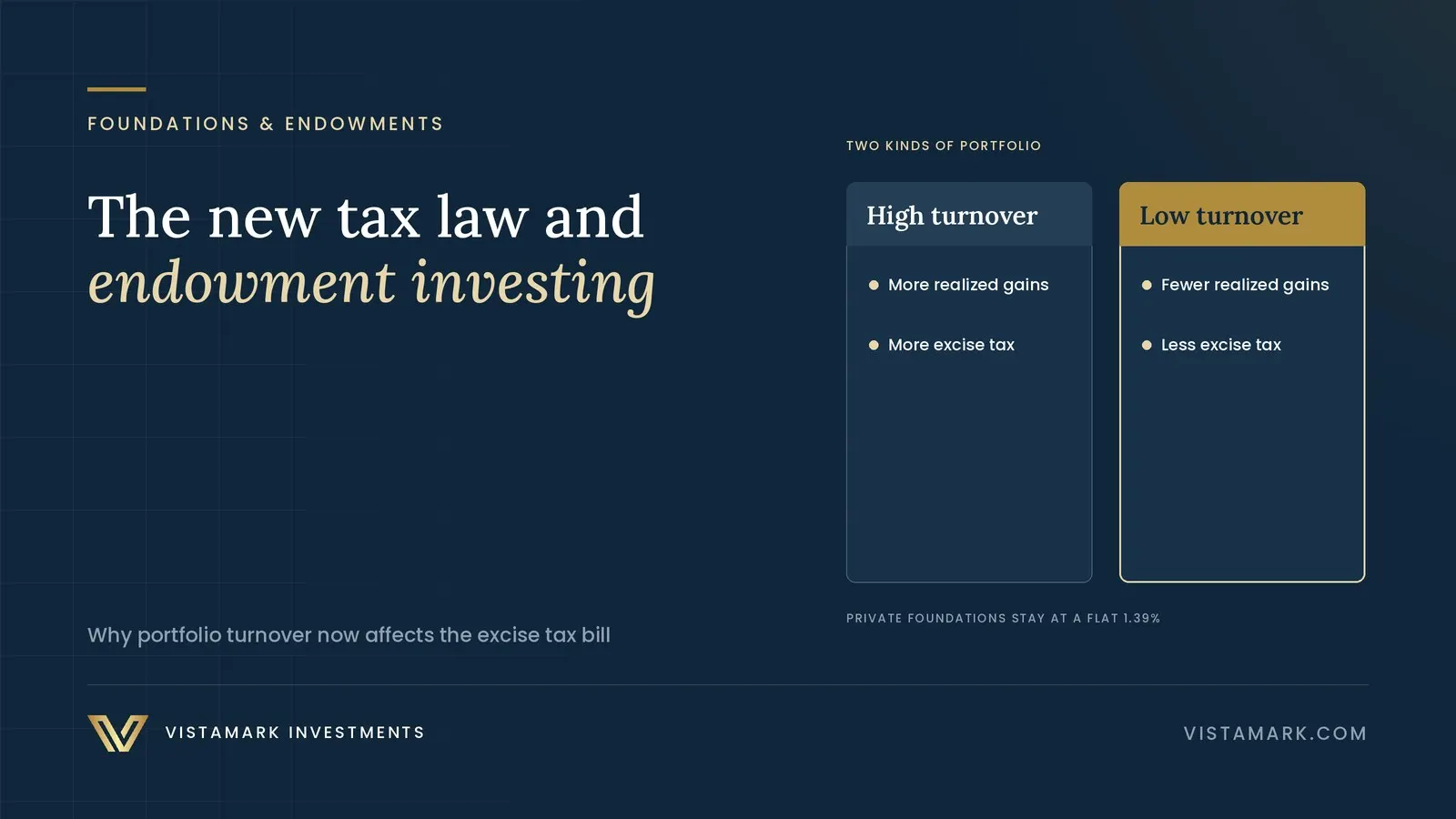
The new tax structure makes portfolio turnover a critical variable. Portfolio turnover measures how frequently investments within a portfolio are bought and sold over a specific period, typically one year. The excise tax applies to net investment income (NII)—which includes interest, dividends, realized capital gains, and other earnings. The rate of turnover directly determines how much NII is recognized annually, and therefore, how much excise tax is owed.
What is the difference between high- and low-turnover portfolios?
-
Low-Turnover Portfolio (Buy-and-Hold Strategy): A long-term investment approach with minimal trading. This results in lower realized gains, modest NII, a smaller excise tax bill, and a portfolio that grows faster after taxes.
-
High-Turnover Portfolio (Active Trading Strategy): Frequent buying and selling of securities. This generates much higher realized gains (NII) every year, exposing a greater proportion of assets to the excise tax and leading to a substantial after-tax return reduction.
How does portfolio turnover affect the endowment excise tax?
A portfolio with high turnover realizes more net investment income (NII) annually, which in turn subjects more of the fund to the higher excise tax rates:
|
Strategy |
Low Turnover ($200M) |
High Turnover ($200M) |
20-Year Dollar Impact |
|---|---|---|---|
| Realized NII (% of assets) |
3% |
8% |
|
| Excise Tax Owed |
$166,800 |
$444,800 |
|
| Reduction of Assets due to new tax drag |
$0 |
~$3.9M (low-turnover) vs. ~$10.5M (high-turnover) |
As you can see, a high-turnover portfolio for a $200 million endowment can nearly triple the annual excise tax bill, magnifying the drag on returns.
An even more severe threat comes from Unrelated Business Taxable Income (UBTI). Onshore funds in the U.S. that use leverage or engage in direct operating activity can trigger a separate 21% corporate tax on top of the new OBBB excise rates. This double-taxation is a powerful disincentive. The solution is often an offshore blocker structure (such as a corporation in Cayman or BVI), which can shield the endowment from UBTI, passing only passive income that is subject to the lower excise tax.
The Net Cost on Returns
To further illustrate the impact, here are the calculated net rates of return for a $200 million portfolio after accounting for the new excise tax:
-
Low-Turnover Portfolio: The net return after the new excise tax is approximately 7.92%
-
High-Turnover Portfolio: The net return after the new excise tax is approximately 7.78%
This is a powerful illustration of the direct impact of the OBBB Act. It's important to remember that these figures only account for the new excise tax and do not include other potential fees or costs, which would further reduce the final return.
Advanced Strategies for Proactive Response
Forward-thinking organizations are already adapting by building a tax-mitigation strategy into their core investment policy. Here are some of the key advanced strategies:
-
Tax-loss harvesting: Strategically sell losing positions to offset gains and shrink your annual NII.
-
Income deferral: Favor investment vehicles like private equity or real assets with long holding periods and low distributed income.
-
Asset location optimization: Place high-yield or high-turnover assets in sub-entities that are subject to lower tax rates.
-
Strategic spending: Manage the timing of grants and spending to help manage year-end asset levels and avoid higher excise rate brackets.
-
Manager due diligence: Select managers and fund structures that are explicitly designed to be tax-aware and UBTI-conscious.
-
OCIO partnerships: Partner with specialized firms who can integrate all these strategies in a disciplined, mission-driven way.
The new reality rewards those who are proactive. Building tax mitigation, turnover control, and structural selection into your policy will protect capital for future generations and ensure resources go to charitable missions, not unnecessary taxes.
Final Thoughts
The "Big Beautiful Bill" changes the rules of the game. For large private foundations and university endowments, excise taxes have doubled, tripled, and in some cases, increased sevenfold. Tax-aware and UBTI-aware management is no longer an optional luxury—it's a necessity for sustainability and mission fulfillment.
The compounding effects mean that early action is critical; every year of inaction makes it harder to recover lost value. The new era rewards the disciplined and the proactive, ensuring that more capital remains dedicated to its intended charitable mission rather than flowing to unnecessary tax obligations.
For institutions affected by these changes, the message is clear: portfolio turnover, investment structure, and tax strategy are now central to preserving charitable capital and maximizing mission impact. Those who adapt quickly will maintain their philanthropic capacity, while those who delay risk seeing millions of dollars diverted from their charitable purposes to government coffers.
For more information and personalized guidance, please feel free to reach out to Vistamark Investments. You can contact us at 312-895-3001, visit our website at vistamark.com, or send us an email to info@vistamark.com.

Founder and CIO of Vistamark; as CIO of Fiducient Advisors, oversaw investment strategy for more than $260 billion in client assets. More about Matthew →
This article is for informational and educational purposes only and does not constitute investment, legal, tax or accounting advice, or an offer or solicitation to buy or sell any security. Views are those of the author as of the publication date and are subject to change. Vistamark Investments is an SEC-registered investment adviser; see our disclosures.