Updated October 2026 to reflect the One Big Beautiful Bill Act, which made the 2017 tax rates permanent.
A Roth conversion is one of the few planning decisions that can lower a family's lifetime tax bill substantially, and one of the easiest to get wrong. The case for converting has changed since 2025: the main argument many people relied on, that tax rates were scheduled to rise in 2026, no longer applies, because the One Big Beautiful Bill Act made the current brackets permanent. The decision now rests on your own situation.
What is a Roth conversion?
A Roth conversion moves money from a traditional IRA, or a pre-tax 401(k) after you leave an employer, into a Roth IRA. The converted amount is added to your taxable income for the year. In exchange, the money then grows tax-free, qualified withdrawals are tax-free, and Roth IRAs have no required minimum distributions during the owner's lifetime. There is no income limit on conversions, and since 2018 a conversion cannot be reversed.
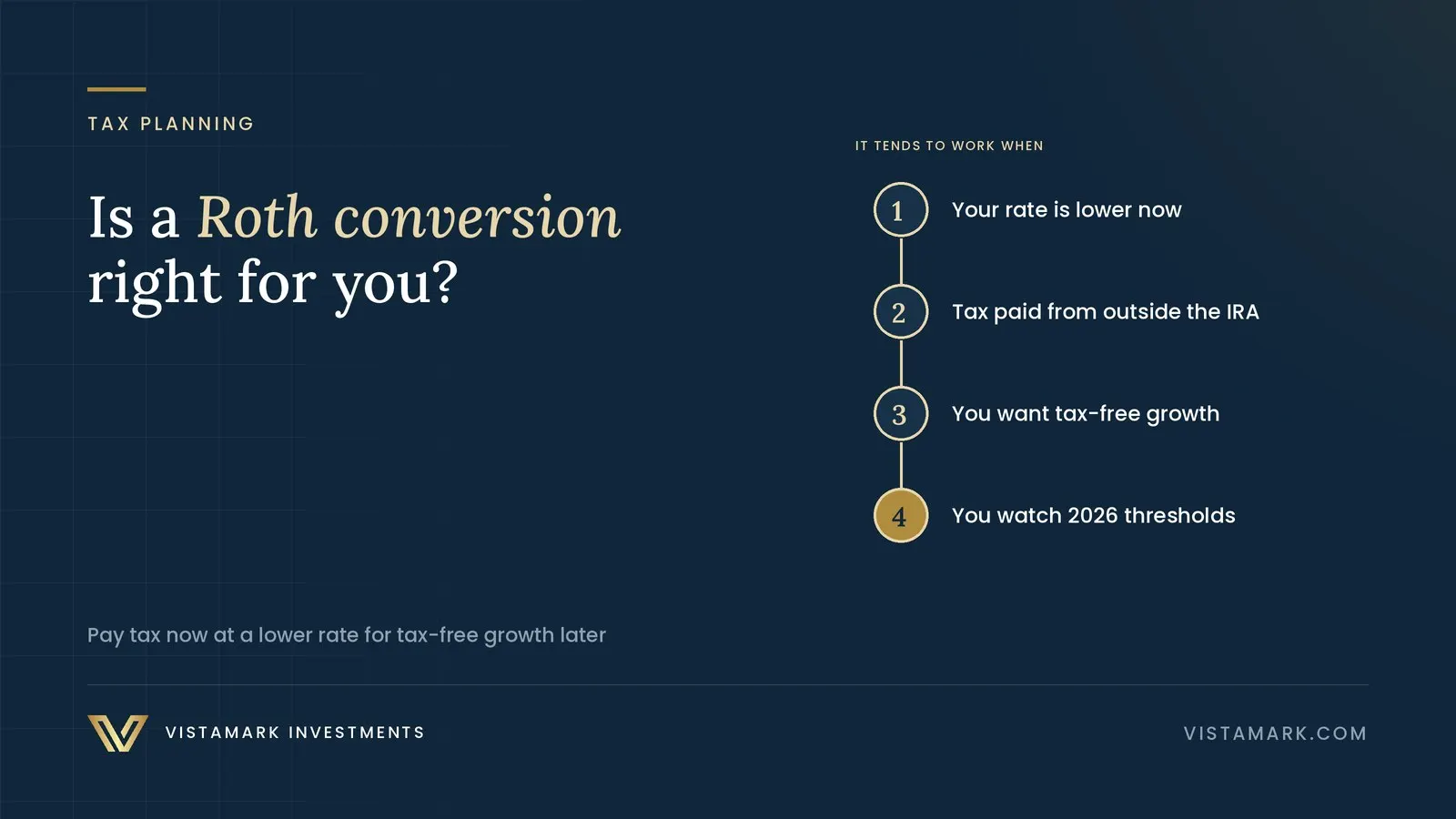
When does a Roth conversion make sense?
- You are in a lower bracket now than you expect to be later. The classic window is between retirement and the start of required minimum distributions at 73, when earned income has stopped but RMDs and Social Security have not yet piled on.
- You can pay the tax from outside the IRA, which keeps the full balance growing tax-free.
- Your heirs are likely to be in high brackets. Most non-spouse heirs must empty inherited IRAs within ten years; inheriting a Roth instead lets them do so tax-free.
- You want to reduce future RMDs, which can push income into higher brackets, Medicare surcharges and the taxation of Social Security.
- Markets have fallen, so the same number of shares converts at a lower taxable value.
When is a Roth conversion a poor idea?
- You expect to be in a lower bracket in retirement than you are today.
- You would have to pay the tax from the IRA itself, particularly before age 59½, when the withdrawal could also be penalized.
- You plan to leave the IRA to charity, which pays no income tax on it anyway.
- You may need the money within five years; each conversion has its own five-year clock for penalty-free access to the converted principal before age 59½.
What thresholds should you watch in 2026?
Converted income can cross several lines at once, so model a conversion against all of them:
- Your federal bracket, and the next bracket up.
- Medicare IRMAA, which looks back two years; 2026 income sets 2028 premiums. See our IRMAA guide for the brackets.
- The state and local tax deduction phase-down, which begins at roughly $500,000 of modified adjusted gross income in 2026.
- The 3.8% net investment income tax, which a conversion does not trigger directly but can expose other investment income to by raising your income.
- The AMT exemption phaseout, which now begins at $500,000 for single filers and $1,000,000 for joint filers.
- State income tax: Illinois exempts retirement income, including Roth conversions, from state tax, while Arizona taxes it at a flat 2.5%.
How much should you convert?
Rarely all at once. Most families convert in slices over several years, "filling up" a bracket or stopping just below an IRMAA or deduction threshold each year. The right amount comes from a multi-year projection comparing lifetime taxes, including those your heirs will pay, with and without conversions.
Can conversions be combined with charitable giving?
Yes. A charitable gift in the same year can offset some of the conversion income, and donors who bunch several years of giving into a donor-advised fund sometimes pair that year with a larger conversion. After 70½, qualified charitable distributions from the remaining traditional IRA reduce future taxable income further. Our year-end giving guide covers the 2026 rules.
Where should you start?
Ask your CPA or advisor for a ten-year tax projection that shows your bracket each year with and without conversions, including RMDs, Social Security and Medicare premiums. Conversions must be completed by December 31 to count for the year. This article is general information, not tax advice; the VistaWealth Office models conversions as part of each family's retirement income plan.
This article is part of our Tax Planning Guide, which collects our writing on the topic with answers to common questions.

Founder and CIO of Vistamark; as CIO of Fiducient Advisors, oversaw investment strategy for more than $260 billion in client assets. More about Matthew →
This article is for informational and educational purposes only and does not constitute investment, legal, tax or accounting advice, or an offer or solicitation to buy or sell any security. Views are those of the author as of the publication date and are subject to change. Vistamark Investments is an SEC-registered investment adviser; see our disclosures.