In today’s dynamic market, investors are constantly seeking innovative ways to generate income and manage risk. Enter Covered Call ETFs – a powerful hybrid that’s been gaining significant traction. These funds offer an interesting middle ground, blending traditional equity exposure with options strategies to deliver enhanced income and a degree of risk mitigation. But what exactly are they, and are they the right fit for your financial goals? Let’s unpack the world of Covered Call ETFs.
How do covered call ETFs work?
At their core, Covered Call ETFs hold a diversified portfolio of stocks, much like a traditional equity ETF. The crucial difference lies in their systematic approach to selling call options on these very holdings. The magic happens when the premiums collected from selling these options are then distributed to you, the investor, often on a monthly or quarterly basis. This mechanism allows these ETFs to generate yields significantly higher than what you'd typically find in standard equity funds, making them a magnet for income-focused investors, especially in periods of low interest rates.
Where do covered call ETF returns come from?
Covered call ETF returns come from three sources: option premiums collected by selling call options, which are the main source of income; dividends from the stocks the fund holds; and limited price appreciation, because selling calls caps how much of a market rally the fund keeps.
So, how do these ETFs actually generate returns? It's a three-pronged approach:
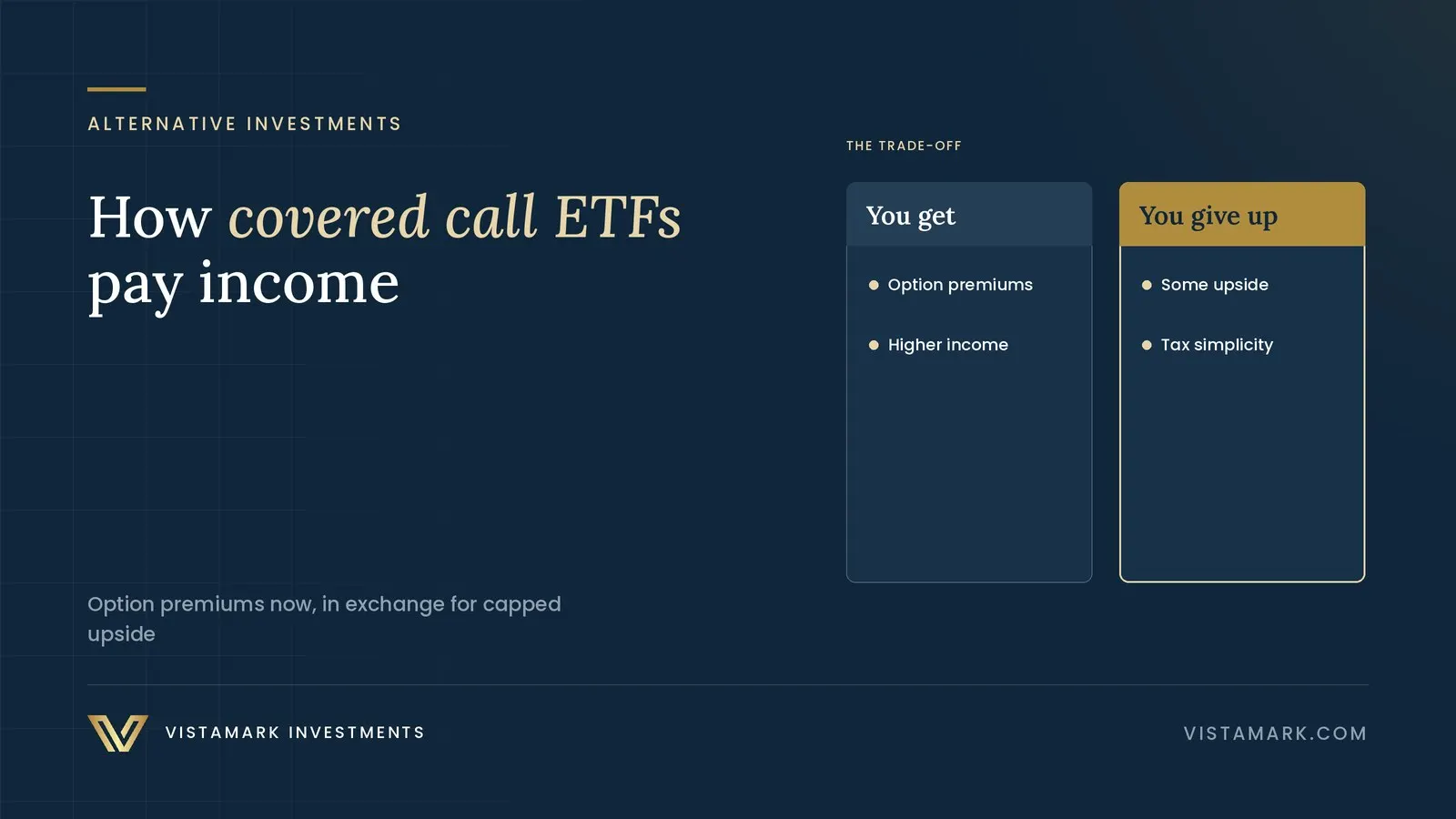
- Option Premiums: This is the primary driver of income. By selling call options, the ETF generates immediate cash flow, which is then passed on to you. However, it's important to note that this also caps your potential upside if the underlying stocks experience a sharp rally.
- Dividends: You still benefit from the dividends paid by the underlying stocks held within the ETF's portfolio, adding another layer to your income stream.
- Capital Gains: If the underlying stocks appreciate in value, you can still benefit from capital gains, but only up to the strike price of the sold option. Any gains beyond that are essentially forfeited to the call buyer.
What is the difference between at-the-money and out-of-the-money covered call ETFs?
At-the-money strategies sell calls with strike prices close to the current market price, which brings in more premium income but gives up almost all of the upside. Out-of-the-money strategies sell calls with higher strike prices, which produces less income but lets the fund keep more of a rising market.
Not all Covered Call ETFs are created equal. Their strategies often differ based on how they set the strike price of the call options they sell:
- At-the-Money (ATM) Calls: This strategy involves selling call options with strike prices very close to the current market price of the underlying stock. The benefit here is maximizing premium income, leading to higher yields. However, this also means significantly limiting your potential for capital appreciation. ATM strategies are often favored in range-bound markets where maximizing income is the primary goal.
- Out-of-the-Money (OTM) Calls: With this approach, the ETF sells call options with strike prices above the current market price of the underlying stock. While this generates less premium income than ATM calls, it allows for more upside participation if the stocks rise moderately. Some ETFs, for instance, specifically utilize OTM strategies to strike a balance between consistent yield and potential growth.
Can covered call strategies be used outside large-cap stocks?
Yes. Although most covered call ETFs write options on large-cap indexes such as the S&P 500 or Nasdaq-100, the same approach is also applied to REITs, sector funds, small-cap stocks and some commodity-linked holdings, each with its own mix of income and risk.
While most Covered Call ETFs focus on large-cap equities, often tracking popular indices like the S&P 500 or Nasdaq-100, the covered call strategy isn't limited to just stocks. You might also find these strategies applied to:
- REITs (Real Estate Investment Trusts): Generating income from real estate portfolios with the added boost of option premiums.
- Gold and Commodities: Some funds may employ covered calls on commodity ETFs or futures contracts, though liquidity and premium levels can vary.
- Fixed Income: While less common, the strategy can even be applied to certain fixed-income instruments like convertible bonds or preferred shares.
Diversifying across these asset classes can offer alternative avenues for both return generation and risk management within a broader portfolio.
What are the pros and cons of covered call ETFs?
The main advantages are higher current income and somewhat lower volatility, since option premiums cushion modest declines. The main drawbacks are capped upside in strong markets, losses that still follow the market down in sharp sell-offs, and distributions that are often taxed less favorably than qualified dividends.
Like any investment strategy, Covered Call ETFs come with their own set of advantages and disadvantages.
Pros:
- Enhanced Income: The primary draw, providing a reliable stream of income from option premiums and dividends.
- Reduced Volatility: The income generated from options can help buffer against modest market downturns, leading to a smoother investment ride.
- Ideal for Income Seekers: Particularly attractive for retirees or those who prioritize steady cash flow over aggressive growth.
- Effortless Strategy: Offers a convenient way to implement a covered call strategy without the complexity of managing individual options trades.
Cons:
- Capped Upside: This is the most significant trade-off. Your potential gains are limited to the strike price of the sold call option, meaning you'll miss out on significant upside in strong bull markets.
- Underperformance in Rallies: During prolonged bull runs, these ETFs can underperform traditional equity funds as their stocks are "called away" at the strike price.
- Partial Downside Protection: While they offer some buffer, they do not provide full downside protection. Significant drops in the underlying stocks can still lead to substantial losses.
- Tax Inefficiency: This is a crucial consideration. Option premiums are typically taxed as ordinary income, which can lead to a higher tax burden for investors in higher tax brackets.
How are covered call ETF distributions taxed?
Depending on the fund, income from selling call options is often taxed as short-term capital gain at ordinary income rates rather than as qualified dividends, and part of a distribution may be a return of capital that lowers your cost basis. For that reason many investors hold covered call ETFs in IRAs or other tax-deferred accounts.
The tax implications of Covered Call ETFs are distinct and often a significant concern for investors in taxable accounts:
- Option Premiums: The income generated from selling call options is generally treated as short-term capital gains, meaning it's taxed at ordinary income rates, regardless of how long you hold the ETF. This can create a higher tax burden compared to qualified dividends or long-term capital gains.
- Dividends: If the underlying stocks pay qualified dividends, those may be taxed at lower, more favorable rates.
- Capital Gains: Any gains realized from the ETF selling underlying stocks may qualify for long-term capital gains rates if held for the required period.
- Return of Capital: Occasionally, distributions may be classified as a return of capital, which defers taxes but reduces your cost basis.
Given the potential for "tax drag" due to the ordinary income treatment of option premiums, Covered Call ETFs are often more suitable for tax-advantaged accounts like IRAs or 401(k)s.
Who should consider covered call ETFs, and where do they fit in a portfolio?
Covered call ETFs tend to suit income-focused investors and retirees who can accept limited upside, and they work best in flat or moderately rising markets. Many investors use them as a small satellite position rather than a replacement for core stock holdings.
Before investing, consider these strategic points:
- Market Outlook: Covered Call ETFs tend to perform best in sideways or moderately bullish markets. In strong, sustained bull markets, their capped upside can be frustrating.
- Risk Tolerance: They are best suited for investors who prioritize income and some degree of risk management over aggressive growth.
- Tax Location: To mitigate the tax burden, consider holding these ETFs within tax-advantaged retirement accounts.
Are covered call ETFs a good investment?
Covered Call ETFs offer an interesting tool for enhancing portfolio income and potentially smoothing out returns, particularly for income-oriented investors or those nearing retirement. However, they are not a universal solution. Their capped upside potential and the tax implications of option premiums in taxable accounts necessitate a thorough understanding before investing.
By understanding the various strategies employed (ATM vs. OTM), considering asset class diversification, and being mindful of their tax treatment, you can make an informed decision. For those seeking reliable income with a built-in layer of risk management, Covered Call ETFs can play a valuable role in a well-diversified portfolio. Always weigh the trade-offs, align them with your personal financial goals, tax situation, and your outlook on the market before making your investment choice.
For more information and personalized guidance, please feel free to reach out to Vistamark Investments. You can contact us at 312-895-3001, visit our website at vistamark.com, or send us an email to info@vistamark.com.
Market Compass · weekly
Get the Compass by email
One concise recap of the week’s market-moving events and what to watch next, written by our CIO at the end of each market week.

Managing Partner and Founder; advises families, business owners and family offices through the VistaWealth Office™ and leads Vistamark’s private markets research. More about Sean →
This article is for informational and educational purposes only and does not constitute investment, legal, tax or accounting advice, or an offer or solicitation to buy or sell any security. Views are those of the author as of the publication date and are subject to change. Vistamark Investments is an SEC-registered investment adviser; see our disclosures.