Institutions build portfolios to maximize returns because most of them pay little or no tax. Families pay tax on interest, dividends and realized gains, often at the highest federal and state rates. That single difference changes how a family should build its portfolio. In Think Like a Family Office, after-tax asset allocation is the bridge between institutional discipline and private wealth: use the institutional process, but measure everything after tax.
What does after-tax asset allocation mean?
It means choosing the mix of asset classes, and the accounts, trusts and entities that hold each one, to maximize the return the family keeps after taxes for a given level of risk. A traditional allocation asks which investments to own. An after-tax allocation also asks where to own them, how to own them and when to sell them.
Why can't a family just copy an endowment's allocation?
Because two portfolios with the same pre-tax return can deliver very different after-tax results. High-yield bonds, actively traded hedge funds and real estate investment trusts generate income taxed at ordinary rates, which for top-bracket families can approach half of the return once state tax is included. Broad equity index funds held for the long term defer most of their tax until the family chooses to sell, and gains are taxed at lower long-term rates. An allocation that looks optimal before tax can be mediocre after it.
What are the main levers of after-tax allocation?
There are five, and each one is under the family's control:
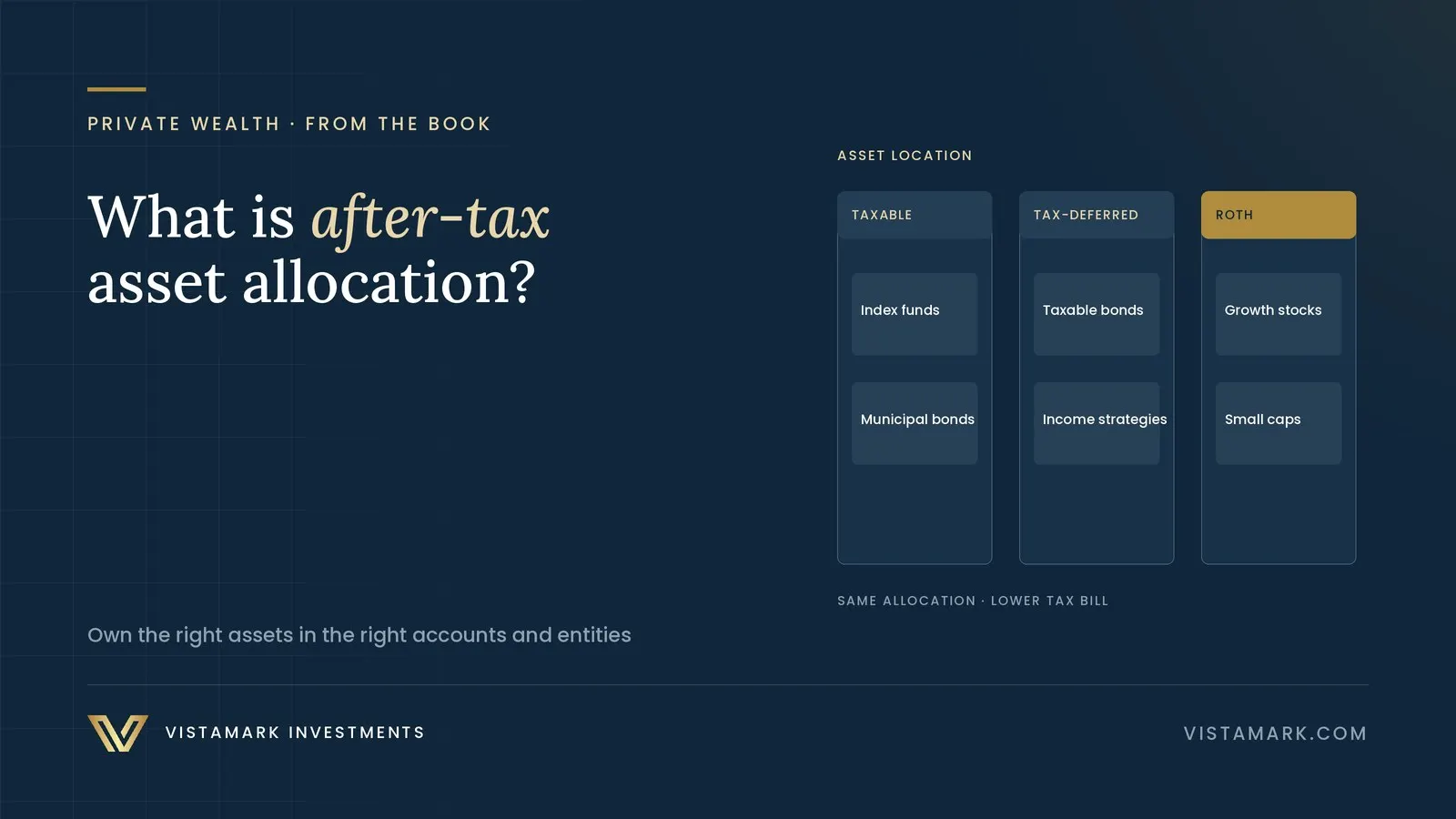
- Asset location. Hold tax-inefficient assets, such as taxable bonds and income-heavy strategies, in IRAs, 401(k)s and other tax-deferred accounts. Hold tax-efficient assets, such as index funds and municipal bonds, in taxable accounts. Put the highest expected-growth assets in Roth accounts, where growth is never taxed.
- Vehicle choice. The same exposure can be owned through an ETF, a mutual fund, a separately managed account, a direct-indexing account or a private partnership, each with different tax consequences.
- Loss harvesting. Realizing losses as they occur, while staying invested in a similar but not substantially identical holding, creates offsets against gains elsewhere in the family's balance sheet.
- Gain management. Deciding when to realize gains, and in which year and which entity, can lower the family's lifetime tax bill. Highly appreciated assets may be better given to charity or held for a step-up in basis at death than sold.
- Entity planning. Trusts, family partnerships and private foundations have different tax treatment, so the same asset can be taxed differently depending on who owns it.
How much difference does it make?
It varies with the family's tax bracket, state, turnover and mix of accounts, so be wary of anyone quoting a single number. What is consistent is the direction: taxes are usually the largest cost in a taxable family portfolio, often larger than investment fees, and they compound. A portfolio that defers taxes keeps more money working, year after year. Measuring returns after tax is the only way to see the difference.
What are common after-tax allocation mistakes?
- Managing each account in isolation. Each account holds the same balanced mix, so bonds sit in taxable accounts and stocks in IRAs, the opposite of what location would suggest.
- Rebalancing by selling winners in taxable accounts when the same rebalancing could be done with new cash, in tax-deferred accounts or with harvested losses.
- Chasing pre-tax returns in strategies whose gains are mostly short-term and taxed at ordinary rates.
- Letting the tax tail wag the dog. Refusing to diversify a concentrated position to avoid a tax bill can cost far more than the tax if the position falls.
Where should a family start?
Begin with a single consolidated view of every account and entity, showing the asset class, the account type and the unrealized gain or loss of each holding. Most families have never seen their wealth this way, and the opportunities are usually obvious once they do: bonds sitting in taxable accounts, cash idle in Roth IRAs, losses that were never harvested. From there, set the target allocation at the family level, assign assets to the accounts where they are taxed least, and measure performance after tax. The family's investment policy statement is the right place to record that approach.
The VistaWealth Office manages family portfolios on an after-tax basis across accounts and entities, working with each family's CPA and estate attorney.
This article is part of our Tax Planning Guide, which collects our writing on the topic with answers to common questions.

Founder and CIO of Vistamark; as CIO of Fiducient Advisors, oversaw investment strategy for more than $260 billion in client assets. More about Matthew →
This article is for informational and educational purposes only and does not constitute investment, legal, tax or accounting advice, or an offer or solicitation to buy or sell any security. Views are those of the author as of the publication date and are subject to change. Vistamark Investments is an SEC-registered investment adviser; see our disclosures.