Index funds made diversified investing cheap and simple. Direct indexing keeps the diversification but changes how it is owned: instead of one fund share, you own the individual stocks that make up the index, in a separately managed account in your name. That small change opens up tax and customization opportunities a fund cannot offer, at a modest extra cost.
How does direct indexing work?
A manager buys a portfolio of individual stocks designed to track an index, such as the S&P 500 or a total market index, closely. Because you own each stock directly, the manager can sell individual positions that have fallen in value to realize tax losses and replace them with similar stocks to keep the portfolio tracking the index. It can also exclude companies you choose, or adjust weights, without disturbing the rest of the portfolio. Technology now makes this practical for accounts far smaller than it once required.
What are the benefits of direct indexing?
- Tax-loss harvesting at the stock level. Even when the overall market is up, many individual stocks are down. Harvesting those losses creates offsets for gains elsewhere, such as from a business sale, real estate or concentrated stock.
- Customization. You can exclude a former employer's stock you already own too much of, or companies that conflict with your values.
- Managing a concentrated position. A direct index can be built around an existing holding, underweighting the stock's sector and gradually diversifying as losses become available.
- Charitable giving. Individual lots with large gains can be given to charity, removing the gain entirely.
What are the drawbacks?
- Higher cost than a low-cost index fund or ETF, typically a management fee on top of trading.
- Tracking difference. The portfolio will not match the index exactly, especially as harvesting and exclusions accumulate.
- Diminishing harvesting. After several years of rising markets, most positions carry gains and fewer losses are available, a pattern that long/short tax strategies are designed to address.
- Complexity. Hundreds of positions and tax lots make statements longer, and moving the account later can be cumbersome.
- Wash-sale coordination. Harvested losses can be disallowed if you or your spouse buy substantially identical securities in other accounts within 30 days.
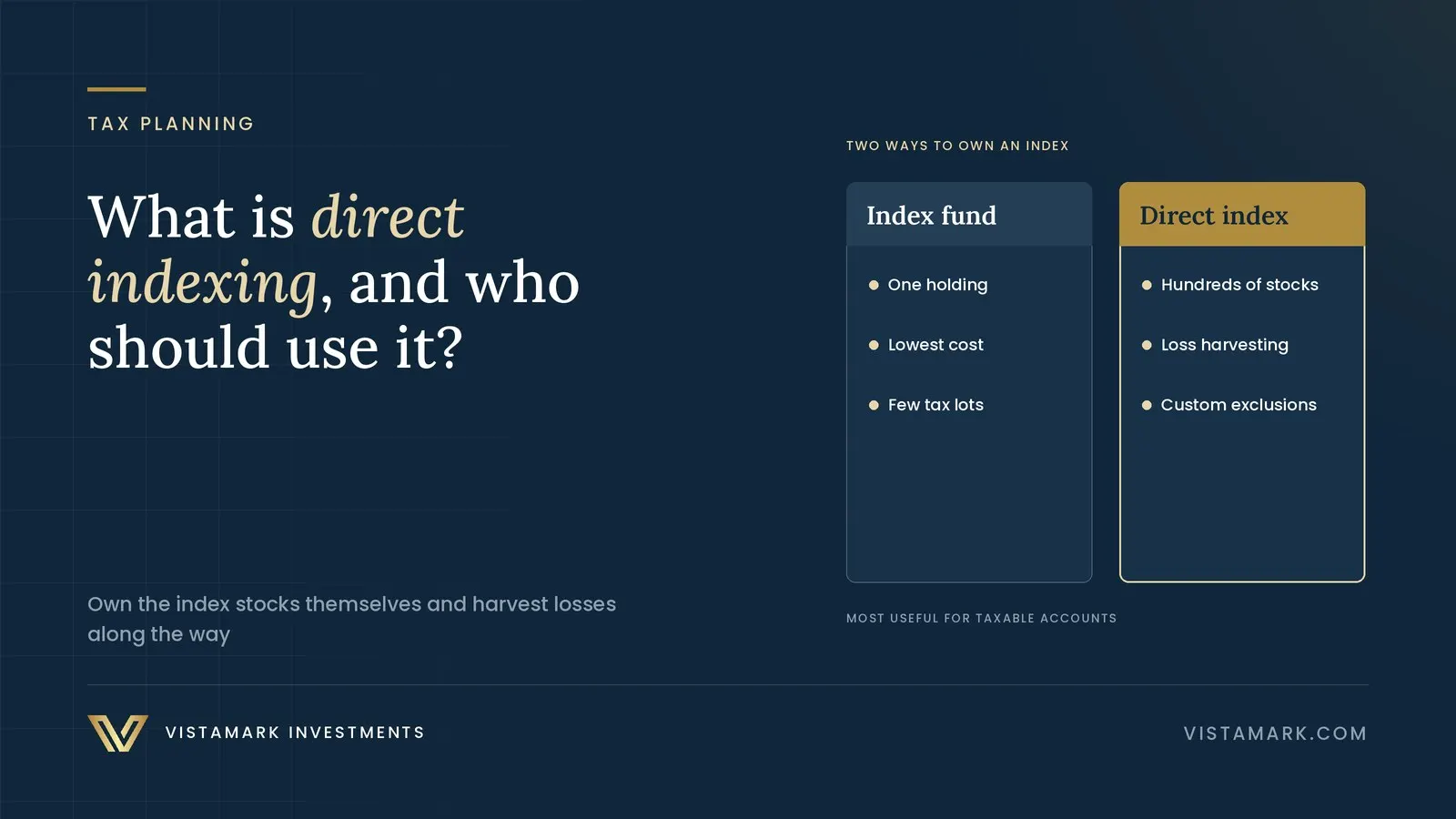
How does direct indexing compare with an index fund?
| Index fund or ETF | Direct indexing | |
|---|---|---|
| What you own | Shares of a fund | The individual stocks |
| Cost | Lowest | Higher, but often offset by tax savings in taxable accounts |
| Loss harvesting | Only when the whole fund is down | Stock by stock, all the time |
| Customization | None | Exclusions, tilts, values screens |
| Best home | Any account | Taxable accounts |
Who should use direct indexing?
It makes the most sense for investors who have a meaningful taxable account, pay high federal and state tax rates and expect realized gains to offset, for example from selling a business, real estate or a concentrated position. It is also useful for anyone who wants to exclude specific companies. It adds little in an IRA or other tax-deferred account, where losses have no tax value, and for small or low-tax accounts a plain index fund is usually the better choice.
How should direct indexing fit into a family's plan?
As one part of an after-tax asset allocation, not a standalone product. The losses it generates are most valuable when someone is coordinating them with gains across the family's accounts, entities and planned transactions. We cover the broader discipline in our guides to year-round tax-loss harvesting and concentrated stock strategies. The VistaWealth Office uses direct indexing where it fits a family's tax picture.
This article is part of our Tax Planning Guide, which collects our writing on the topic with answers to common questions.

Managing Partner and Founder; advises families, business owners and family offices through the VistaWealth Office™ and leads Vistamark’s private markets research. More about Sean →
This article is for informational and educational purposes only and does not constitute investment, legal, tax or accounting advice, or an offer or solicitation to buy or sell any security. Views are those of the author as of the publication date and are subject to change. Vistamark Investments is an SEC-registered investment adviser; see our disclosures.