When it comes to investing, the age-old debate of active management versus passive management isn’t just about personal preference; it’s deeply tied to the unique characteristics of different asset classes and how efficient their markets are. Understanding where each approach shines can be a game-changer for optimizing returns, managing risk, and keeping costs down.
When does passive management work best?
Passive management, often through index funds or ETFs, aims to simply mirror the performance of a market benchmark. This approach thrives in highly efficient markets where information is quickly absorbed into asset prices, making it tough for individual managers to consistently beat the market after fees.
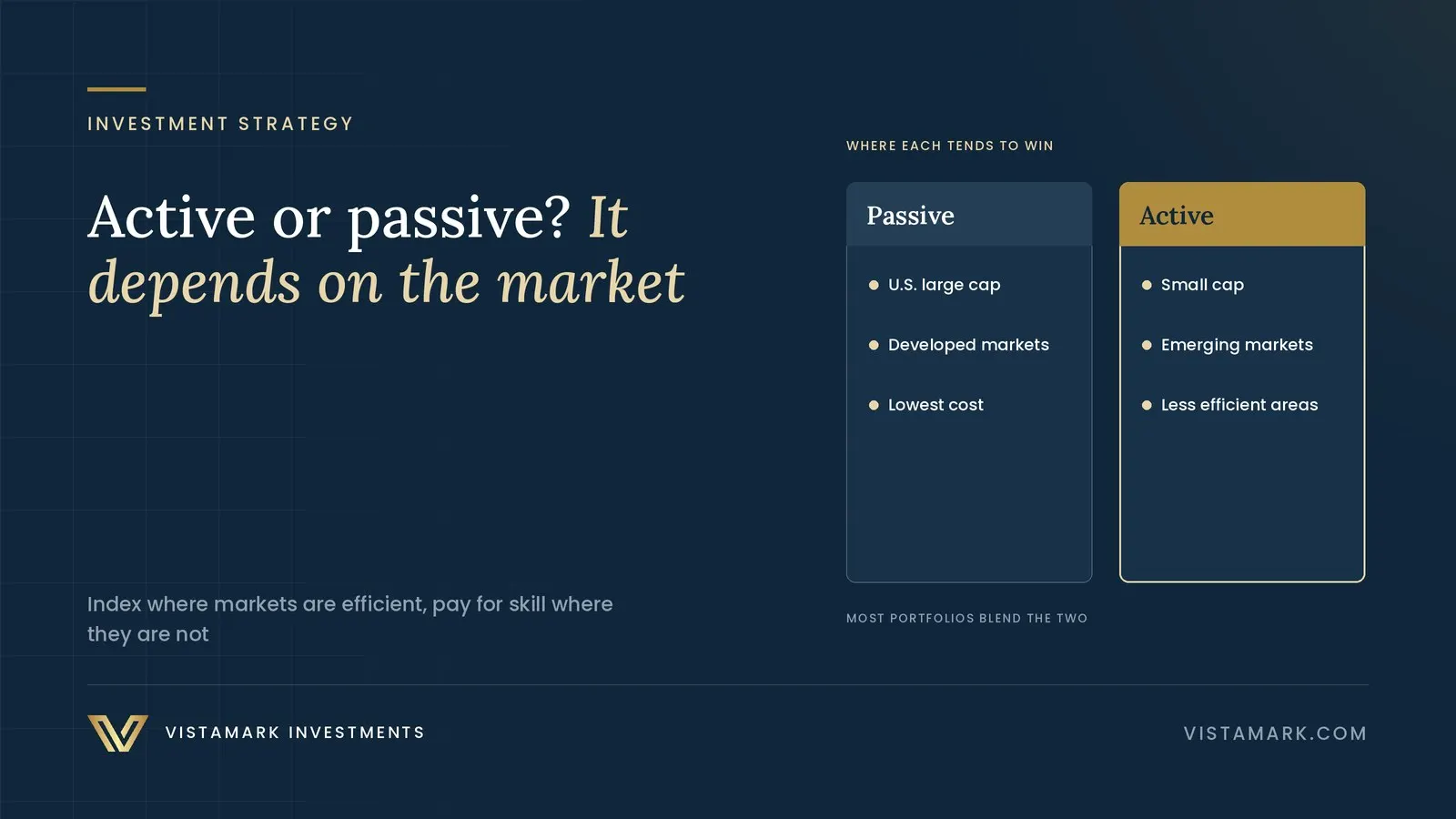
- Large-Cap Equities (Especially U.S. Large Cap): The U.S. large-cap equity market, like the S&P 500, is incredibly efficient. There's a ton of analyst coverage, and information spreads rapidly. Because of this, it's really hard for active managers to consistently outperform their benchmarks once you factor in their fees and trading costs. Historically, passive index funds in this space have generally done better than most active managers simply due to their lower costs.
- Developed Market Equities: Similar to large-cap U.S. stocks, international developed markets are also quite efficient. Passive strategies are appealing here because index funds and ETFs offer broad diversification at a very low cost.
- Some Fixed Income Segments (e.g., U.S. Treasuries): Highly liquid and transparent parts of the bond market, like U.S. Treasuries, are relatively efficient. Passive strategies can work well here, though some nuances exist in other bond segments.
When does active management add value?
Active management involves portfolio managers making specific decisions about what to buy and sell, aiming to outperform a benchmark. This approach tends to be more fruitful in markets that are less efficient or more complex.
- Small- and Mid-Cap Equities: These market segments are less efficient than their large-cap counterparts. There are fewer analysts covering them, and less information is readily available. This creates more opportunities for skilled active managers to identify mispricings and potentially generate higher returns. For example, small-value funds have often outperformed their benchmarks more frequently than large-cap funds, pointing to greater opportunity here.
- Emerging Market Equities: Emerging markets are typically less transparent, less liquid, and often face unique local risks and inefficiencies. Savvy active managers can add significant value by navigating these complexities, making their expertise crucial.
- Specialty and Alternative Asset Classes: Assets like real estate, infrastructure, and certain commodities often lack comprehensive and easily investable public indices. Active management is usually essential to effectively access and manage these unique investments.
- Complex or Illiquid Fixed Income (e.g., High Yield, Emerging Market Debt): Many fixed income indices are incredibly difficult to replicate due to the sheer number and diversity of securities, their illiquidity, and structural challenges. Active managers can more effectively exploit inefficiencies, manage credit risk, and navigate liquidity constraints in these complex segments than passive strategies can.
- Private Equity: Investing in private companies (not publicly traded) requires significant due diligence, expertise in deal sourcing, and active portfolio management. There are no passive indexes to track private equity, making active management the only viable approach to identify, invest in, and exit private companies.
- Hedge Funds: These are actively managed investment funds that employ a variety of strategies to generate returns, often in both up and down markets. Their strategies (e.g., long/short equity, global macro, event-driven) are inherently active and depend on the manager's skill in exploiting market inefficiencies and mispricings. There is no passive equivalent for hedge funds.
- Real Estate: While publicly traded REITs (Real Estate Investment Trusts) offer a passive way to invest in real estate, direct real estate investments (e.g., commercial properties, development projects) require active management. This includes property acquisition, management, leasing, and eventual sale, all of which are highly localized and demand active oversight.
- Commodities: While some broad commodity indices exist, direct investment in specific commodities or through futures contracts often benefits from active management. Commodity markets can be highly volatile and influenced by diverse factors (geopolitical events, supply shocks, weather), where skilled managers can add value through strategic timing and selection.
When should investors blend active and passive management?
Sometimes, the best approach isn't so clear-cut, and a blend of active and passive might be most suitable.
- Core Fixed Income: While some segments of core fixed income (like Treasuries) are efficient, others (such as corporate or municipal bonds) present challenges for passive replication. This is due to index construction, liquidity, and concentration risks. Passive bond funds might, for instance, overweight the most indebted issuers, while active managers can be more selective and avoid such pitfalls.
- Sector and Thematic Investing: Passive strategies offer a low-cost way to get exposure to specific sectors or investment themes. However, in less efficient or rapidly changing sectors, active managers might be able to outperform by making timely decisions.
Understanding Investment Strategies
To summarize, here's a quick look at the types of strategies generally employed:
- Passive Strategies typically involve index investing (tracking broad market indices), market-cap or equal-weighted portfolios, and factor-based passive portfolios (like value or momentum). They also extend to asset allocation using index funds and ETFs.
- Active Strategies involve security selection, market timing, tactical asset allocation, specialized strategies (such as long/short or event-driven), and opportunistic investing in inefficient markets.
Should a portfolio use active or passive management?
Ultimately, passive management excels in efficient, liquid, and transparent markets—especially large-cap equities and some fixed income. Conversely, active management is more likely to add value in less efficient, illiquid, or complex markets, such as small/mid-cap stocks, emerging markets, high-yield bonds, and real assets. This also extends to specialized investments like private equity, hedge funds, and certain commodities and direct real estate opportunities, where active management is often a necessity rather than a choice.
Many investors find success by blending both approaches: using passive funds for their core, broad market exposures and allocating to active strategies in segments where there's a higher potential for an active manager to truly add value or where index construction poses problems. A thoughtful asset allocation, carefully tailored to the unique characteristics of each asset class, is key to capturing the benefits of both active and passive management.
For more information and personalized guidance, please feel free to reach out to Vistamark Investments. You can contact us at 312-895-3001, visit our website at vistamark.com, or send us an email to info@vistamark.com.

Founder and CIO of Vistamark; as CIO of Fiducient Advisors, oversaw investment strategy for more than $260 billion in client assets. More about Matthew →
This article is for informational and educational purposes only and does not constitute investment, legal, tax or accounting advice, or an offer or solicitation to buy or sell any security. Views are those of the author as of the publication date and are subject to change. Vistamark Investments is an SEC-registered investment adviser; see our disclosures.