This guide gathers our tax articles for individuals and families, from portfolio-level strategies such as after-tax allocation and loss harvesting to specific rules such as the alternative minimum tax, Medicare surcharges and qualified small business stock. Tax rules change often; each article shows when it was published or last updated, and nothing here replaces advice from your own CPA.
Key questions
What changed in the tax code for 2026?
The One Big Beautiful Bill Act made the 2017 tax rates permanent and, starting in 2026, added a 0.5% of income floor and a 35% value cap on itemized charitable deductions, raised the state and local tax deduction cap to about $40,000 with a phase-down above roughly $500,000 of income, tightened the AMT exemption phaseout and set the estate exemption at $15 million per person.
What is the most valuable tax strategy for a wealthy family?
Usually managing the whole portfolio on an after-tax basis: holding each asset in the account where it is taxed least, harvesting losses, and timing gains and income deliberately. These steps compound every year, while most single-year tactics help only once.
Are Roth conversions still worth doing now that tax rates are permanent?
They can be, especially in lower-income years before required distributions begin, but the case now rests on your own expected future bracket, Medicare surcharges and estate plans rather than on a scheduled tax increase.
Does moving to another state reduce taxes?
It can reduce state income and estate taxes significantly, but only if you genuinely change your domicile; states such as Illinois look at where your home, family, time and business ties really are.
Portfolio tax strategy
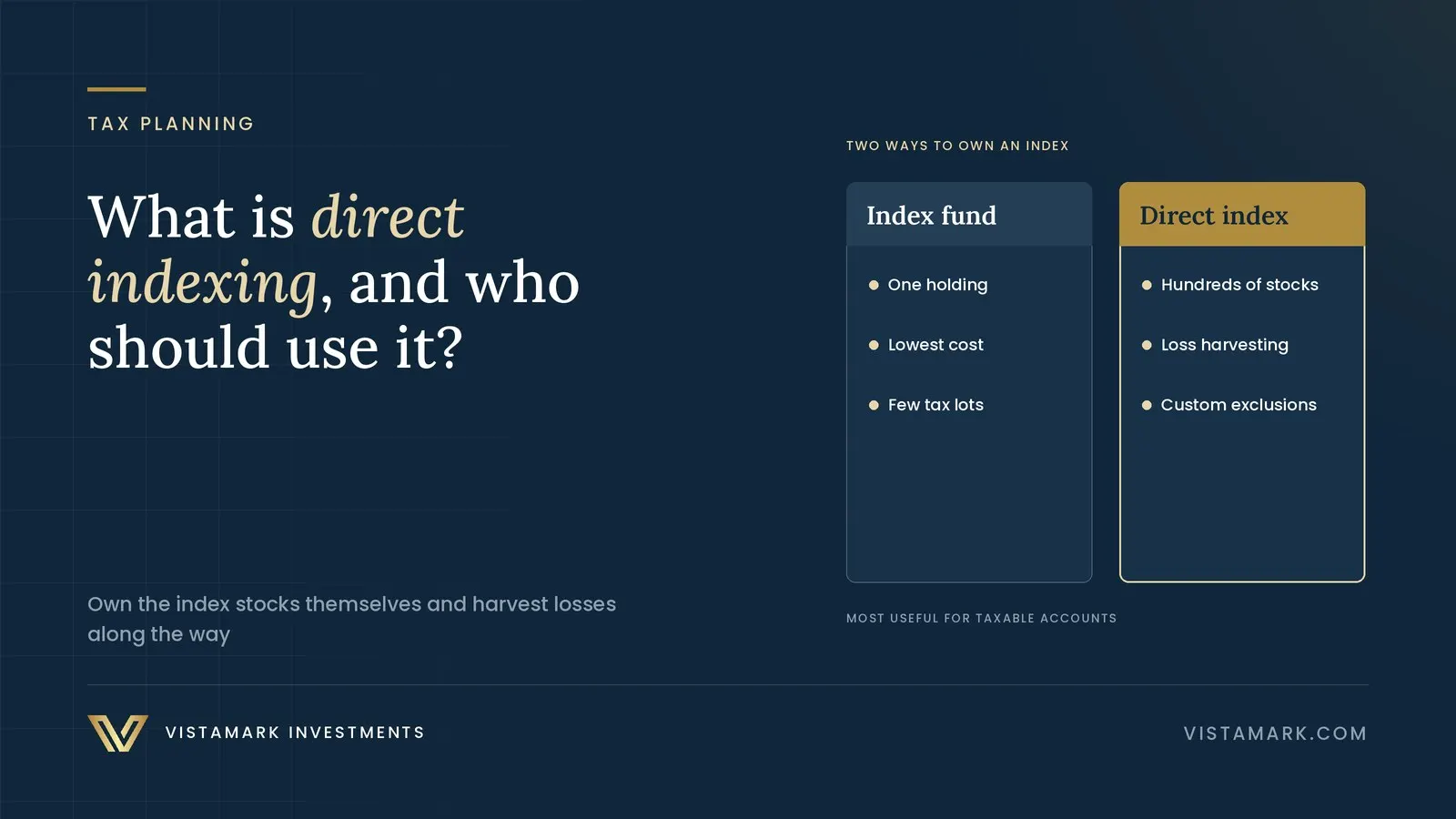
- What Is Direct Indexing, and Who Should Use It?
What direct indexing is, how stock-level tax-loss harvesting and customization work, the costs and drawbacks, and who benefits most. - Turning Losses Into Opportunities: The Value of Year-Round Tax-Loss Harvesting
Why tax-loss harvesting should run year-round, and how long/short strategies keep generating losses after years of gains when long-only runs dry. - Tax Loss Harvesting: Strategies and Portfolio Integration for Optimal After-Tax Returns
How tax-loss harvesting works: offset gains and up to $3,000 of income, avoid the wash-sale rule (including across IRAs) and fit it into asset location. - How to Blend After-Tax, Roth, and Traditional Qualified Accounts to Optimize After-Tax Investment Returns
Asset location made simple: which investments belong in taxable, traditional and Roth accounts, and how to sequence retirement withdrawals to cut taxes.
Rules to plan around
- Is the Alternative Minimum Tax Lurking in Your Financial Future? Here’s How to Stay Safe.
2026 AMT rules: $90,100/$140,200 exemptions now phase out from $500,000/$1M at 50%. Who is exposed, how ISOs trigger AMT and how to plan around it. - Don’t Let the Medicare IRMAA Ambush Your Retirement: How to Avoid or Appeal the Surcharge
2026 Medicare IRMAA brackets: surcharges start at $109,000 single / $218,000 joint (2024 income). How to appeal with Form SSA-44 and plan around cliffs. - The Roth IRA Conversion Conundrum: Is It Right for Your Retirement?
Should you convert to a Roth IRA in 2026? When it pays, when it doesn't, the IRMAA, SALT and AMT thresholds to watch, and how to size conversions.
Business owners and concentrated stock
- What Is QSBS, and How Did the 2025 Tax Law Change It?
QSBS explained: Section 1202 rules and the 2025 changes, with 50/75/100% exclusions at 3/4/5 years and a $15M cap for stock issued after July 4, 2025. - Breaking Free from Concentrated Stock Positions: Advanced Tax Strategies That Transform Your Portfolio
How a 130/30 long/short tax strategy lets investors diversify a low-basis concentrated stock position while harvesting losses to offset the gains. - A Strategic Guide to Hedging Your Concentrated Stock Position
How to hedge a concentrated stock position without selling: collars, protective puts, covered calls, prepaid forwards, swaps and proxy hedges.
Charitable giving
- Charitable Giving After Recent Tax Law Changes: What Nonprofits and Donors Need to Know
OBBBA charitable rules for 2026: a 0.5% of AGI floor for itemizers, a 35% cap and a $1,000/$2,000 deduction for non-itemizers, and what to do about them.
Related guides: Estate Planning Guide · Family Governance Guide · Foundation & Endowment Investment Guide