The 5% payout rule shapes almost every investment decision a private foundation makes. It sets the minimum the foundation must spend each year, and through that, the return the portfolio must earn to preserve the foundation's purchasing power. Yet many trustees know the headline number without knowing how the calculation actually works. This article explains the mechanics. Foundations should confirm their own calculations with their CPA each year.
What does the 5% payout rule require?
Under Section 4942 of the Internal Revenue Code, a private non-operating foundation must make qualifying distributions at least equal to its distributable amount. The distributable amount is roughly 5% of the average fair market value of the foundation's assets not used directly for charitable purposes, mainly its investment portfolio, reduced by the excise tax on net investment income. The foundation has until the end of the following tax year to distribute each year's amount.
How is the asset base calculated?
- Securities are generally valued monthly and averaged over the year.
- Cash is also averaged, but an amount equal to 1.5% of total assets is treated as held for charitable activities and excluded.
- Other assets, such as real estate or private investments, are valued using reasonable methods, often annual appraisals.
- Assets used directly in charitable activities, such as a building housing the foundation's programs, are excluded.
What counts toward the 5%?
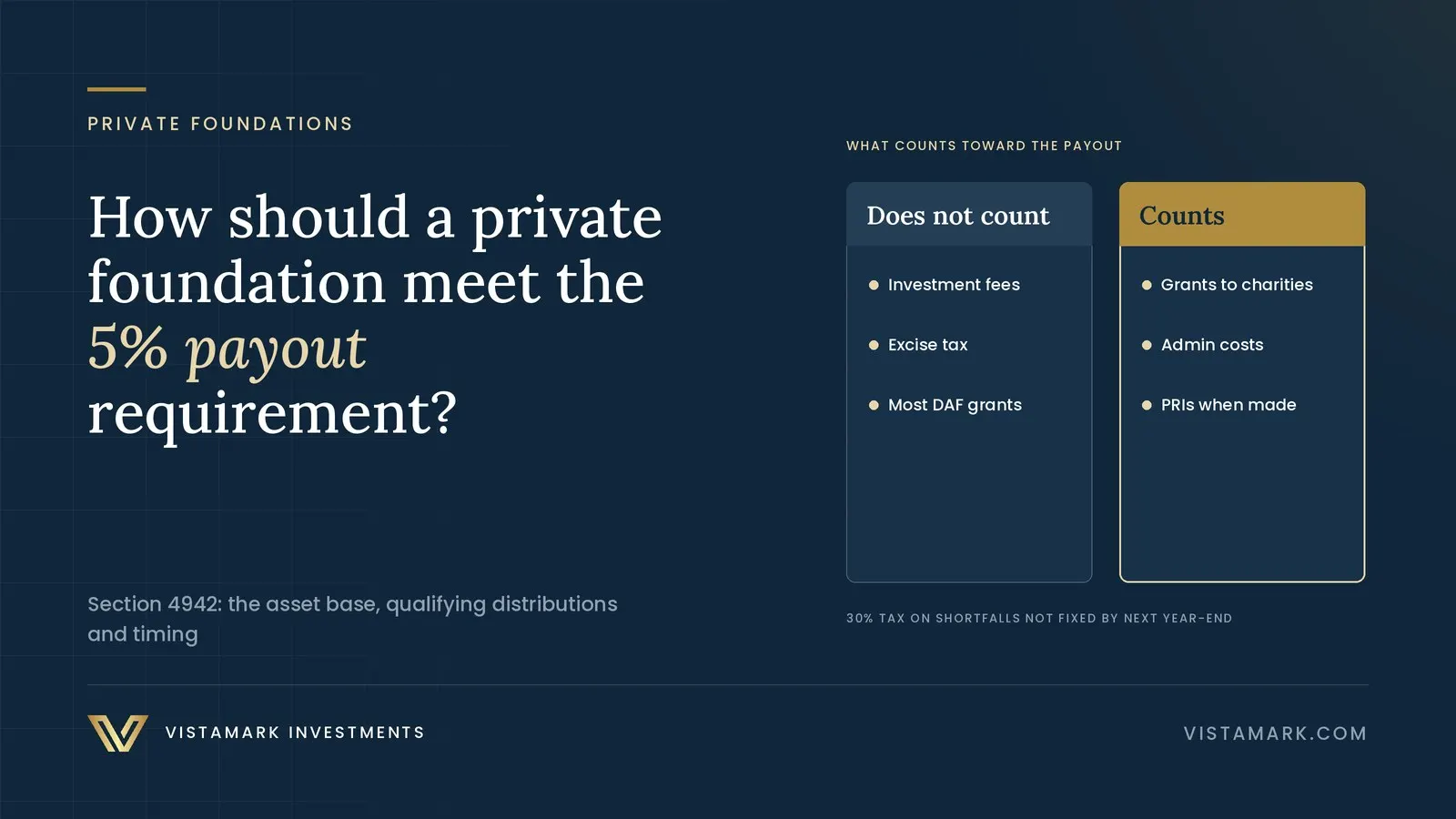
- Grants to public charities and other qualifying grants.
- Reasonable and necessary administrative expenses related to grantmaking and charitable activities.
- Program-related investments, such as below-market loans made primarily to advance the foundation's mission.
- Amounts set aside for specific future projects, with IRS approval or under strict conditions.
- Direct charitable activities the foundation runs itself.
Investment management fees are not qualifying distributions, though they reduce net investment income. Grants to a donor-advised fund or to another private foundation qualify only in limited circumstances, so check with counsel before relying on them.
What happens if a foundation falls short?
An initial excise tax of 30% applies to any undistributed amount not paid by the end of the following year. If the shortfall still is not corrected, an additional tax of 100% can apply. In practice, the first tax is avoided by catching up in time. If a foundation distributes more than required, the excess can generally be carried forward for up to five years to offset future requirements.
How does the 5% rule affect investment strategy?
A foundation that intends to exist in perpetuity must earn, after fees, at least its payout plus inflation over time. With a 5% payout, inflation of a few percent and costs, that typically means a long-term return target of 8% or more, which requires a growth-oriented portfolio with meaningful equity and private market exposure. It also requires liquidity planning: the foundation must be able to fund grants every year, including after market declines, without selling illiquid assets at poor prices. Our article on endowment liquidity covers this in more detail.
Should a foundation distribute exactly 5%?
Not necessarily. Many foundations treat 5% as a floor. Some pay out more in years of high need or to spend down over a defined period. Others smooth grants by basing them on a multi-year average of assets, as described in our spending policy guide, while making sure the legal minimum is met each year. The legal requirement and the board's spending policy are related but distinct decisions.
Did the 2025 tax law change the payout rule?
No. The One Big Beautiful Bill Act left the 5% requirement unchanged, and the private foundation excise tax remains a flat 1.39% of net investment income. A proposal in the House version to raise foundation excise tax rates was dropped from the final law.
What should the committee monitor?
Ask staff or the advisor for a payout schedule each quarter showing the estimated distributable amount, distributions made year to date, any carryforward and the liquidity available to fund the remainder. Pair it with the investment report so the committee sees spending and returns together. Vistamark's foundation and endowment practice builds payout and liquidity planning into every investment policy we manage.
This article is part of our Foundation & Endowment Investment Guide, which collects our writing on the topic with answers to common questions.
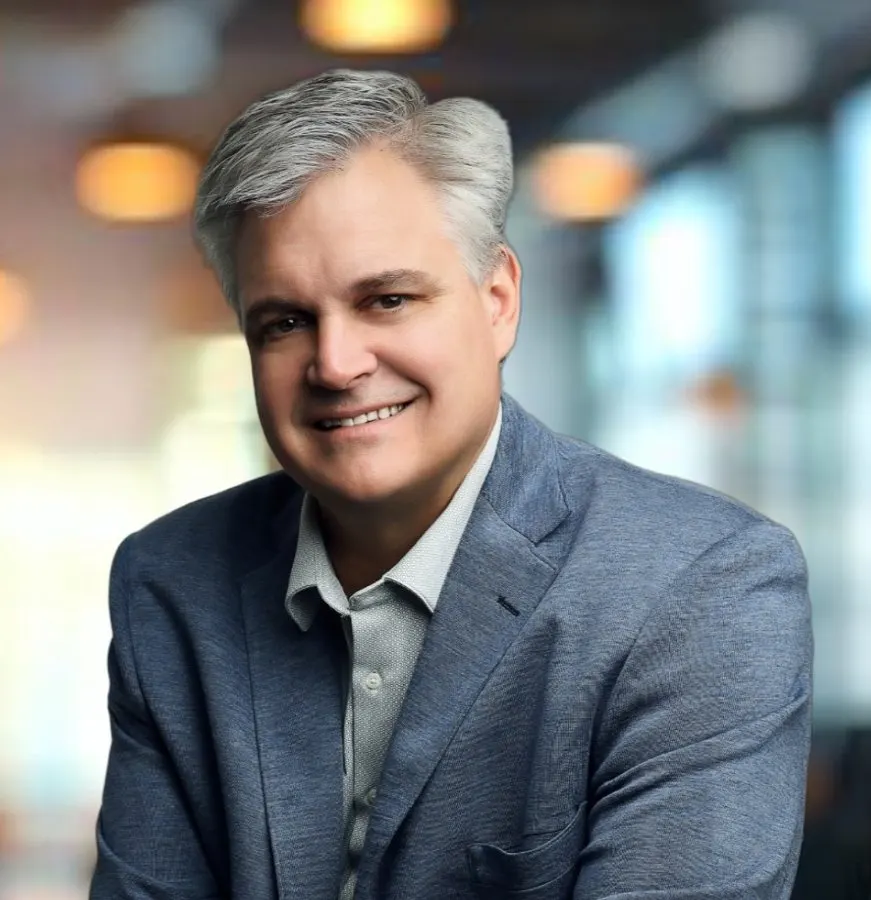
Founder and CIO of Vistamark; as CIO of Fiducient Advisors, oversaw investment strategy for more than $260 billion in client assets. More about Matthew →
This article is for informational and educational purposes only and does not constitute investment, legal, tax or accounting advice, or an offer or solicitation to buy or sell any security. Views are those of the author as of the publication date and are subject to change. Vistamark Investments is an SEC-registered investment adviser; see our disclosures.