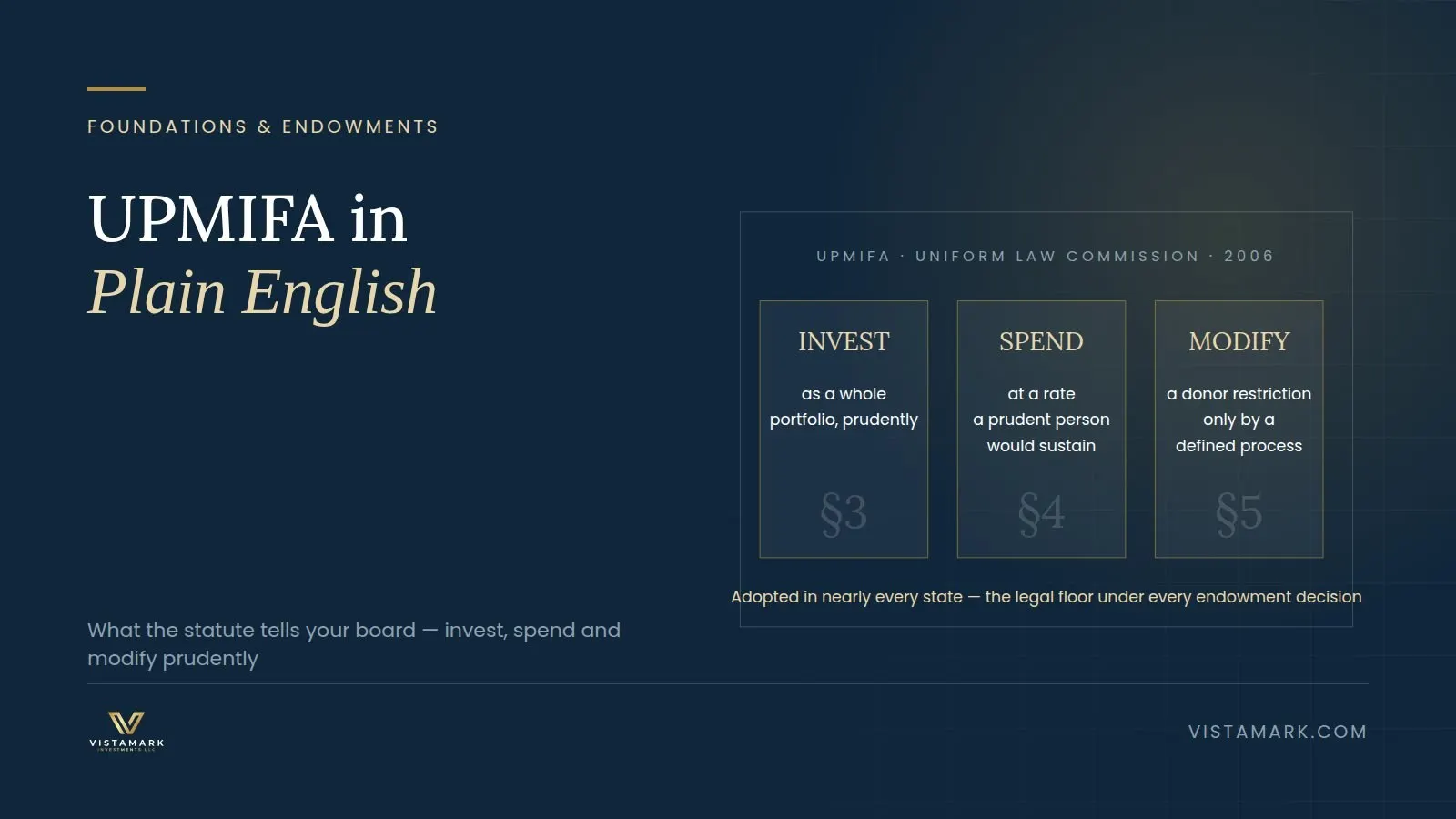
UPMIFA, the Uniform Prudent Management of Institutional Funds Act, is the state law that governs how charitable institutions invest and spend endowment funds in nearly every U.S. state. In plain terms, it tells your board three things: invest the endowment prudently as a whole portfolio, spend from it at a rate a prudent person would consider sustainable, and follow a defined process if you ever need to modify a donor's restriction. If you serve on the board or investment committee of an endowment and foundation (E&F) organization, or of any nonprofit with an invested pool, UPMIFA is the legal floor under almost every investment decision you make.
This guide translates the statute into the language of a board meeting: what it covers, what it requires, and what your committee should actually do about it.
What Is UPMIFA and Why Does It Exist?
UPMIFA was approved by the Uniform Law Commission in 2006 and has since been adopted, in some form, by nearly every state (Pennsylvania is the most prominent exception, operating under its own statutory rules). It replaced an older law, UMIFA, which dated from 1972.
The change that matters most to board members is conceptual. The old law anchored everything to "historic dollar value," the original dollar amount of each endowment gift. Institutions generally could not spend below that floor, which produced strange results: a gift made decades ago had a floor that inflation had rendered almost meaningless, while a recent gift could be frozen entirely by one bad market year.
UPMIFA eliminated the historic dollar value floor and replaced it with a single unifying standard: prudence. The board may spend, or accumulate, as much of an endowment fund as it determines is prudent for the uses, benefits, purposes, and duration for which the fund was established. That is a more flexible standard, but also a more demanding one, because flexibility shifts responsibility onto the board's judgment and the board's process.
Which Funds Does UPMIFA Cover?
UPMIFA applies to "institutional funds," meaning funds held by a charitable institution for its own charitable purposes. That includes true endowments (funds a donor restricted to be held long term), and it also reaches board-designated or "quasi" endowments in its investment conduct rules, since those are still institutional funds even though the board can undo its own designation.
One point of precision matters here. The quasi endowment is a concept particular to the endowment structure: it exists because a nonprofit that holds an endowment can also set aside unrestricted assets of its own and manage them alongside the donor-restricted corpus. A foundation, whether public or private, has no equivalent. A foundation's assets are already the charitable pool itself, governed by the foundation's own purposes, its governing documents, and, for private foundations, the federal minimum distribution rules. There is no such thing as a "quasi foundation," and a foundation board should not borrow the term or the framework. The discussion that follows therefore applies to endowment-holding organizations specifically.
For those organizations, a common example is excess operating reserves. A nonprofit that has built reserves well beyond what it needs for near-term operations may decide to invest a portion of those dollars in the higher-return assets typical of an endowment, such as public equities or diversified growth strategies, rather than leaving them in cash. Because the board designated those funds itself, it retains the ability to pull them back in their entirety if circumstances require. That flexibility is the defining feature of a quasi endowment, and it also shapes how the money should be managed: the investment horizon is long enough to justify growth assets, but the portfolio has to be liquid enough that a full recall does not force sales at the wrong time. Best practice is to set an explicit ceiling on the amount that may be designated as quasi endowment, expressed as a percentage of total reserves or of the operating budget, so that the growth allocation never crowds out the liquidity the organization depends on. Documenting that ceiling, together with the conditions under which the board would draw the funds back, is what keeps the arrangement prudent under UPMIFA rather than merely ambitious.
It generally does not apply to charitable trusts managed by a corporate or individual trustee that is not itself a charity; those are governed by trust law and the prudent investor rules that apply to trustees. If your organization holds both an endowment and beneficial interests in outside trusts, the two live under different legal regimes, and your Investment Policy Statement should say so. For a fuller treatment of what belongs in that document, see our guide on how investment governance protects nonprofit missions.
What Does UPMIFA Require of the Board When Investing?
The investment conduct rules will feel familiar to anyone who has worked with modern fiduciary standards. In plain language, the statute asks the board to do the following.
First, act in good faith and with the care an ordinarily prudent person in a like position would exercise under similar circumstances. Prudence is judged by the process you followed at the time, not by how the investment turned out.
Second, consider each investment decision in the context of the whole portfolio, not in isolation. A single volatile asset class can be entirely prudent as part of a diversified whole. This portfolio-level view is what allows perpetual institutions to hold growth assets, including allocations like the ones discussed in our piece on private equity in endowment and foundation portfolios, provided the overall mix fits the fund's purposes and time horizon.
Third, diversify, unless the institution reasonably determines that special circumstances justify not doing so. A concentrated gift of founder stock, for example, requires an explicit, documented decision, not silence.
Fourth, incur only reasonable costs. The statute does not say cheap; it says appropriate and reasonable in relation to the assets, the purposes of the institution, and the skills available to it.
Fifth, the board may delegate investment management to external advisors or managers, and for most E&F institutions in the $25MM to $250MM range that is the practical reality. Delegation is expressly permitted, but it comes with its own duty: select the agent prudently, set the scope and terms of the delegation, and monitor performance and compliance on an ongoing basis. Hiring an advisor does not discharge the board's duty; it changes the duty into one of selection and oversight. Our article on choosing the right investment advisor for your endowment and foundation walks through what that selection process should look like.
How Does UPMIFA Govern Spending From an Endowment?
This is the section most boards actually use. When deciding how much to appropriate for spending in a given year, UPMIFA directs the board to consider seven factors: the duration and preservation of the endowment fund; the purposes of the institution and of the fund; general economic conditions; the possible effect of inflation or deflation; the expected total return from income and appreciation; the institution's other resources; and the institution's investment policy.
Notice what those seven factors add up to. They are, in effect, the outline of a written spending policy. A board that adopts a clear spending rule (a percentage of a multi-year average of market values is the most common structure), documents how the rule reflects these factors, and revisits it periodically is doing exactly what the statute contemplates. A board that sets spending by informal negotiation each budget season is technically making an appropriation decision without the record the statute expects.
Some states added an optional provision creating a rebuttable presumption that spending above 7% of a fund's average value in a year is imprudent. Whether or not your state adopted it, the number is a useful signal of where legislators believed the danger zone begins. It is a ceiling concept, not a target.
What Happens When an Endowment Is "Underwater"?
An endowment fund is commonly called underwater when its market value falls below the original value of the donor's gift. Under the old law, spending from an underwater fund was effectively prohibited. Under UPMIFA, it is permitted if it is prudent under the same seven factors, subject to any state-specific variations and to the donor's express instructions in the gift instrument.
That does not make underwater spending routine. It means the board must make a considered judgment: does continuing the spending serve the fund's long-term purpose, or does it erode a perpetual asset to solve a temporary budget problem? Accounting rules require underwater amounts to be tracked and disclosed, so the decision will be visible in the financial statements. The right posture is neither automatic suspension nor automatic continuation, but a documented decision made against the fund's purpose and horizon.
Can a Board Modify or Release a Donor Restriction?
Sometimes a restriction stops making sense: the program it funded no longer exists, or the fund is too small to administer. UPMIFA provides three main paths.
The simplest is donor consent. If the donor is available and willing, the donor can release or modify the restriction in writing.
The second is court modification. An institution can ask a court to modify a restriction that has become impracticable, wasteful, or impossible to achieve, generally with notice to the state attorney general, who oversees charitable assets.
The third is a streamlined release for small, old funds. For funds below a dollar threshold set by each state and older than a set number of years (twenty years in the uniform act), the institution may release or modify the restriction itself after notifying the attorney general, provided the new use remains consistent with the donor's charitable purposes. Thresholds vary by state, so this is a check-your-statute item, not a from-memory item.
The practical lesson for boards sits upstream of all three paths: gift agreements drafted today should anticipate change, with clearly stated purposes and, where the donor agrees, built-in flexibility language.
What Should Your Investment Committee Do With This?
For most E&F organizations in the $25MM to $250MM band, UPMIFA compliance is not a separate project; it is a byproduct of ordinary good governance, evidenced in writing. Four documents do most of the work:
- An Investment Policy Statement that states objectives, asset allocation, and the diversification rationale.
- A spending policy that names its rule and connects it to the seven factors.
- Minutes that record the reasoning behind significant decisions, including any decision not to diversify and any decision about an underwater fund.
- An advisory or OCIO agreement, where management is delegated, with defined scope, reporting, and review cadence, monitored on a schedule the committee actually keeps.
A useful annual exercise is to ask, for each of those four documents: does this exist, is it current, and could we hand it to a regulator or a successor trustee without explanation? If the answer is yes three times over, your E&F board is likely already meeting the standard the statute sets.
This article is general educational information, not legal advice. Your state's version of UPMIFA may differ in its details, and counsel should confirm the specifics.
Sources and further reading
- Uniform Law Commission — Uniform Prudent Management of Institutional Funds Act (2006), final act
- Internal Revenue Service — Taxes on Failure to Distribute Income, Private Foundations (IRC §4942)
- Internal Revenue Service — Taxes on Jeopardizing Investments, Private Foundations (IRC §4944)
For more information and personalized guidance, please feel free to reach out to Vistamark Investments. You can contact us at 312-895-3001, visit our website at vistamark.com, or send us an email to info@vistamark.com.
This article is part of our Foundation & Endowment Investment Guide, which collects our writing on the topic with answers to common questions.

Partner and Director of Institutional Advisory with more than 20 years advising endowments, foundations, healthcare organizations and retirement plan sponsors. More about Ryan →
This article is for informational and educational purposes only and does not constitute investment, legal, tax or accounting advice, or an offer or solicitation to buy or sell any security. Views are those of the author as of the publication date and are subject to change. Vistamark Investments is an SEC-registered investment adviser; see our disclosures.