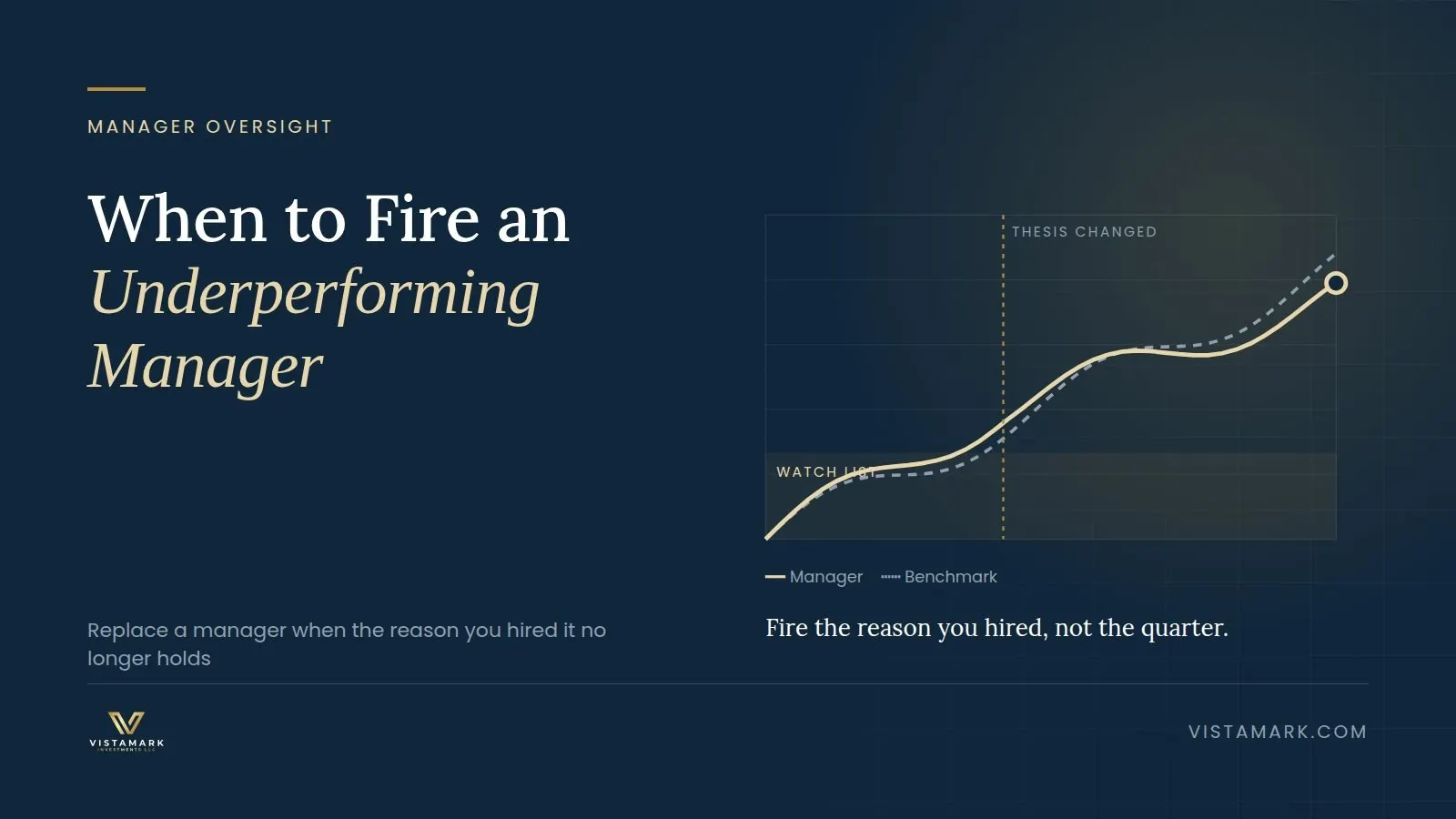
An endowment and foundation (E&F) investment committee should replace a manager when the reason it hired that manager no longer holds, not simply when recent returns are disappointing. The clearest triggers are a change in the people or process that produced the record, a departure from the mandate the committee agreed to, a breach of the institution's investment guidelines, or underperformance that persists across a full market cycle with no explanation the manager's own process would predict. Short-term underperformance on its own is usually a reason to review, not a reason to act, because most sound strategies go through multi-year stretches that trail their benchmark.
This guide is written for investment committees, boards, and professional staff of endowments, foundations, and nonprofit pools, particularly institutions in the $25 million to $250 million range. Pools of that size typically hold enough separate managers that a review lands on the agenda several times a year, but rarely have a dedicated staff analyst preparing the case. The committee needs a repeatable way to decide, and it needs to write that way down before a manager is in trouble.
Why Is "Fire the Underperformer" the Wrong Default?
Hiring and firing on recent performance is the most common mistake committees make. The pattern runs like this: a manager trails its benchmark for two or three years, the committee grows uncomfortable, the manager is replaced by one with a strong recent record, and the replaced manager's style then comes back into favor while the new hire's record cools. The committee has sold low, bought high, and possibly paid transition costs on both legs.
This keeps happening for two reasons. First, three years is not long enough to separate skill from style. Value and growth, small companies and large ones, domestic and international markets each go through multi-year stretches where one side dominates, and a manager who owns the out-of-favor side will trail for the whole stretch regardless of ability. Second, the committee that hired the manager is often not the committee that reviews it. Members rotate, the original thesis is forgotten, and the only thing left to judge is the number on the page.
The remedy is a written standard that tells the committee what it is watching for, so the decision rests on evidence rather than mood. E&F organizations with a formal governance framework, as described in Beyond the Endowment: How Investment Governance Protects Nonprofit Missions, usually find that manager oversight is where the framework earns its keep.
What Should a Manager Monitoring Policy Say?
A manager selection and monitoring policy is a short section, usually one to two pages within the Investment Policy Statement or an appendix to it, that states manager selection criteria, how ongoing monitoring will be measured, and what events will trigger a formal review. Its purpose is to make the committee's future decisions consistent with its past ones. Four elements belong in it.
Permitted asset classes. Each investment manager should fall into one or more permitted asset classes, such as "large-cap domestic equity" or "diversified core bond." When the committee later asks whether an investment is permissible in the first place, this section is doing its job, and it should include any specific constraints particular to the investor.
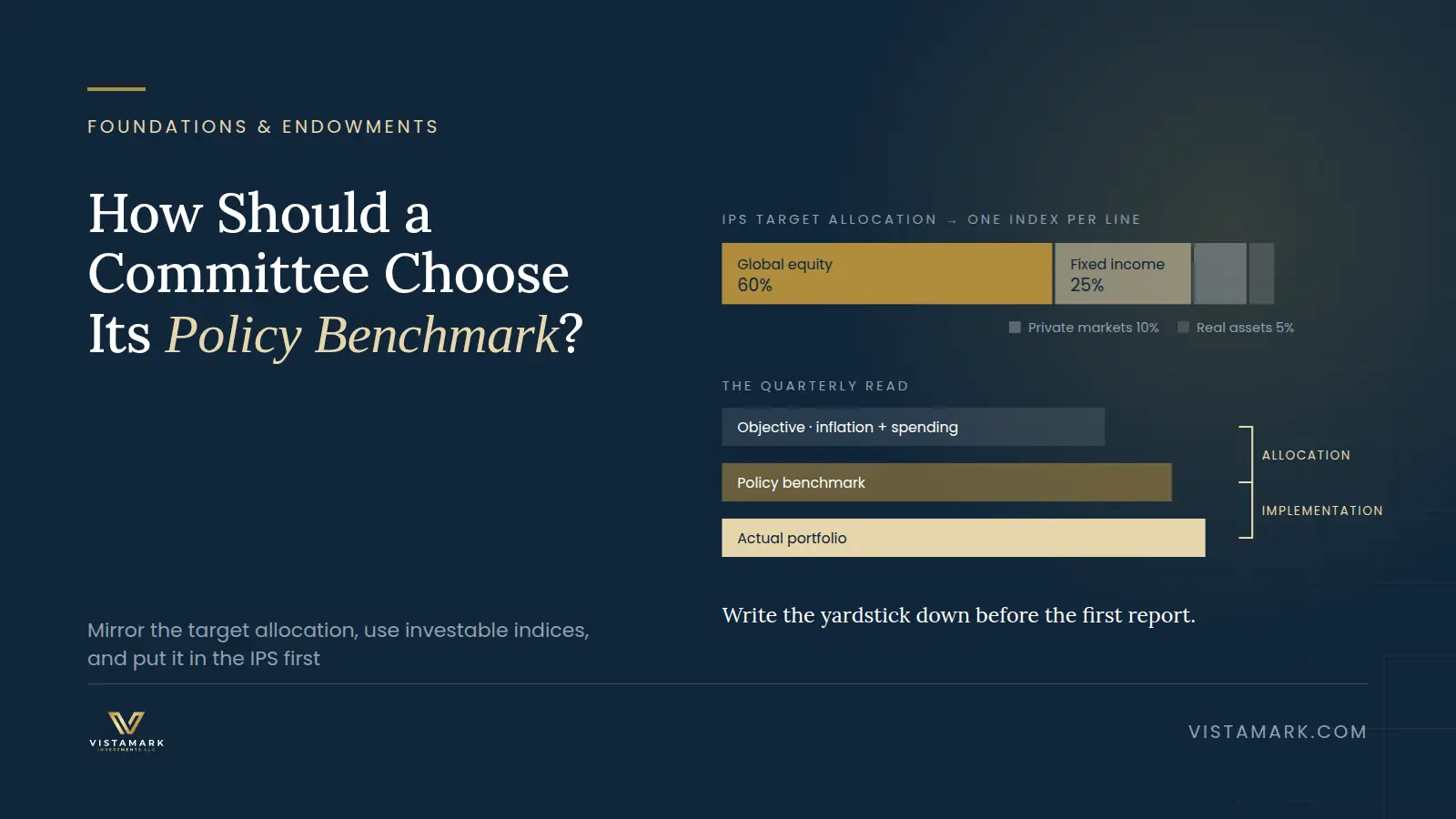
The benchmark and the peer group. Each investment manager needs a benchmark that matches its mandate (a small-cap manager should be measured against an appropriate small-cap index) and, where available, a peer universe of similar strategies.
The evaluation horizon. Most policies evaluate managers over rolling three- and five-year periods, and a full market cycle where one can be identified, so that a single bad quarter cannot restart the clock.
The watch-list criteria. These are the specific events that move a manager from routine monitoring to formal review, covered next.
What Events Should Put a Manager on the Watch List?
A watch list is the committee's formal record that a manager is under heightened review. Being placed on it is not a termination; it is a commitment to gather more information and revisit the manager by a stated date. Most policies name triggers in two groups.
Qualitative triggers relate to the people, the firm, and the process, and they matter more than the numbers because they change the odds that the past record will repeat. Common ones include the departure of a lead portfolio manager or a meaningful share of the team; a sale, merger, or ownership change; rapid asset growth that could crowd the strategy; a move into securities outside the stated mandate (often called style drift); regulatory action or litigation; and any breach of the investor's constraints or guidelines, including mission or faith-based screens.
Quantitative triggers relate to results. A typical policy flags a manager that trails its benchmark over a rolling three-year period, ranks in the bottom portion (typically the bottom half) of its peer group over three or five years, or shows risk characteristics (volatility, tracking error, risk-adjusted performance) that have deteriorated or are materially different from the committee's understanding at the outset. The thresholds should fit the manager's style; a concentrated, high-conviction strategy will swing wider than an index-like one.
A useful test for any quantitative trigger is whether the result would have surprised the committee at hiring. If a value manager trails during a growth-led market, that is the strategy working as described. If the same manager trails during a value-led market, the committee has learned something.
How Should the Committee Conduct a Formal Manager Review?
When a manager hits a watch-list trigger, the committee (or its advisor, on the committee's behalf) should conduct a structured review rather than an open-ended discussion. The review works through four questions in order.
Has anything changed at the firm? Confirm the people, ownership, assets under management, and process against what was documented at hiring. If the team that built the record has left, the record no longer belongs to the people managing the money, and the review shifts toward replacement regardless of recent numbers.
Is the manager doing what it was hired to do? Compare current holdings and risk characteristics against the mandate. A manager underperforming while doing exactly what it promised is a different case from one underperforming because it drifted.
Does the manager's own explanation match the evidence? Ask for a written explanation of the period. A credible answer names the specific decisions or exposures that hurt and ties them to the stated philosophy. An answer that blames the market in general, or quietly describes a new approach, is a warning.
Would the committee hire this manager today? This is the decisive question. If the committee, knowing everything it now knows, would not select this manager in a fresh search, the manager should not stay simply because it is already in the portfolio. If the committee would hire it, the underperformance is the price of the strategy, and the minutes should say so.
The output is a written recommendation: retain and remove from the watch list, extend the watch period to a stated date, or begin a replacement search and terminate, each recorded with its reasoning. The record matters because the next committee will face the same manager, and because a documented process is the strongest evidence a board can offer that it acted prudently.
When Is Underperformance Alone Enough to Terminate?
Occasionally there is no qualitative trigger, the manager is doing what it promised, and the results are still poor for a very long time. Persistent underperformance across a full market cycle, including the environment in which the strategy was supposed to shine, is a legitimate reason to terminate. The committee is concluding not that the manager got unlucky, but that the edge it believed in at hiring does not appear to exist.
Two cautions apply. The committee should be confident it is measuring against the right benchmark and period, since a mismatched benchmark can manufacture underperformance that is not really there. And a committee that repeatedly replaces active managers in large, efficient public markets may conclude that a low-cost index exposure was the better role definition in the first place. That is a policy conclusion, not a failure, and it belongs in the Investment Policy Statement.
Can an Investment Committee "Fire" a Private Fund Manager?
Not in the usual sense. A private equity, private credit, or real assets fund is a commitment for the life of the fund, typically ten years or more, and the institution cannot redeem. What the committee can decide is whether to commit to the manager's next fund, whether to sell the existing interest in the secondary market (usually at a discount), and how the experience should change future pacing and selection.
Because exit options are so limited, the monitoring standard for private managers has to be applied before commitment rather than after; team stability, ownership, and strategy consistency carry more weight in a private fund than in a public one. For the role these funds play in a perpetual portfolio, see Securing Tomorrow, Today: The Indispensable Role of Private Equity in Endowment and Foundation Portfolios.
What Should Happen After a Termination Decision?
Termination is the start of a process, not the end of one. Three steps follow.
Plan the transition. The interim destination for the money should be decided before the termination notice is sent. Often that is an index fund in the same asset class, which keeps the allocation intact while a replacement is selected and avoids leaving the proceeds in cash.
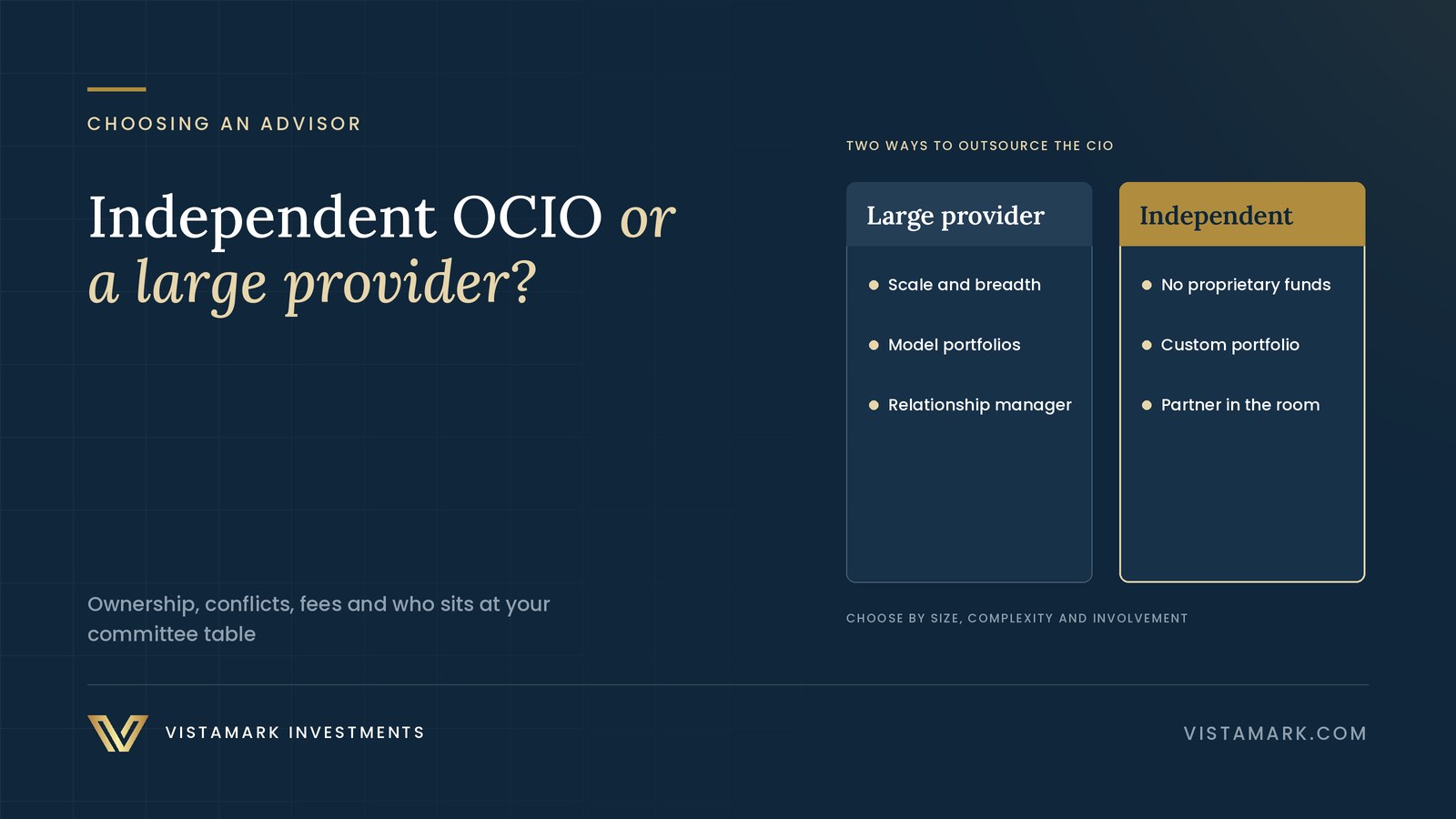
Run a proper replacement search. Apply the same selection criteria, due diligence, and documentation standard used for any new hire, and resist the pull toward whichever manager has the best trailing three-year number. The principles a committee uses to select an advisor apply to selecting a manager as well; Choosing the Right Investment Advisor for Your Foundation or Endowment covers the questions that matter most.
Review the policy itself. Did the watch list flag the problem early enough? Was the benchmark right? Would a different selection process have avoided the hire? A committee that updates its policy after each significant decision ends up with a document that reflects its experience rather than a template.
Where Should a Committee Start?
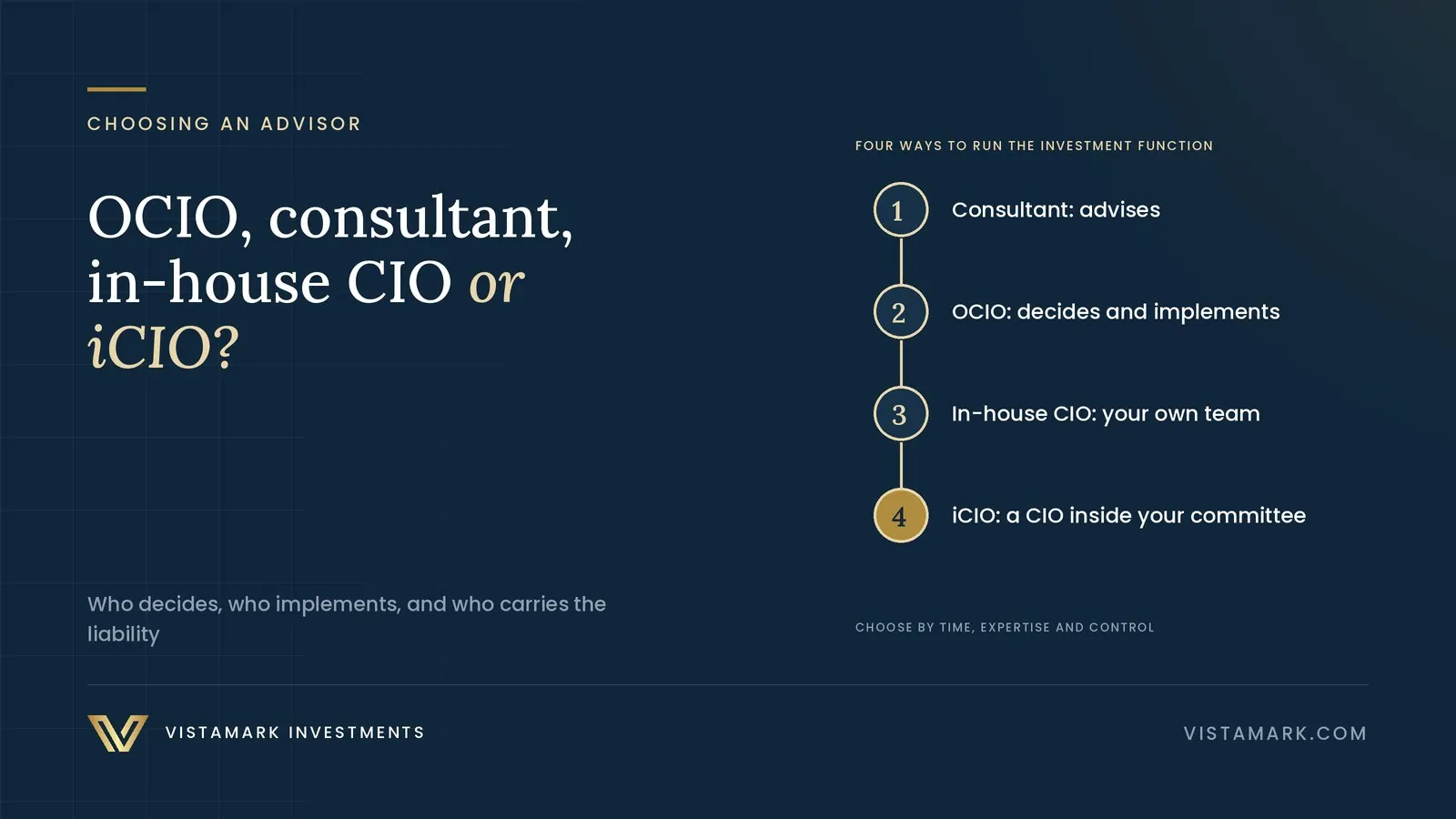
Committees that delegate manager selection to an outsourced chief investment officer (an OCIO, meaning a firm the committee has authorized to hire and fire managers within the policy's limits) still own the monitoring standard; they apply it one level up, by confirming the OCIO has a written process, follows it, and reports every manager change with its reasons.
For every other committee, if the investment policy does not contain a manager monitoring section, drafting one is a single-meeting project: permissible asset classes with selection criteria, a benchmark and horizon for each, and a short list of watch-list triggers. If the policy already has one, test it against the last manager change the committee made and ask whether it would have produced the same decision, sooner.
A committee that knows in advance what would cause it to act can afford to be patient when patience is warranted, and can act quickly when it is not. That combination, rather than any performance threshold, is what protects an E&F organization from the cycle of hiring recent winners and firing recent losers.
Sources and further reading
- Uniform Law Commission — Uniform Prudent Management of Institutional Funds Act (2006), final act
- Tibble v. Edison International, 575 U.S. 523 (2015) — the continuing duty to monitor investments
- ERISA §404(a), 29 U.S.C. §1104 — Fiduciary duties
For more information and personalized guidance, please feel free to reach out to Vistamark Investments. You can contact us at 312-895-3001, visit our website at vistamark.com, or send us an email to info@vistamark.com.
This article is part of our Foundation & Endowment Investment Guide, which collects our writing on the topic with answers to common questions.

Managing Partner and Founder; advises families, business owners and family offices through the VistaWealth Office™ and leads Vistamark’s private markets research. More about Sean →
This article is for informational and educational purposes only and does not constitute investment, legal, tax or accounting advice, or an offer or solicitation to buy or sell any security. Views are those of the author as of the publication date and are subject to change. Vistamark Investments is an SEC-registered investment adviser; see our disclosures.