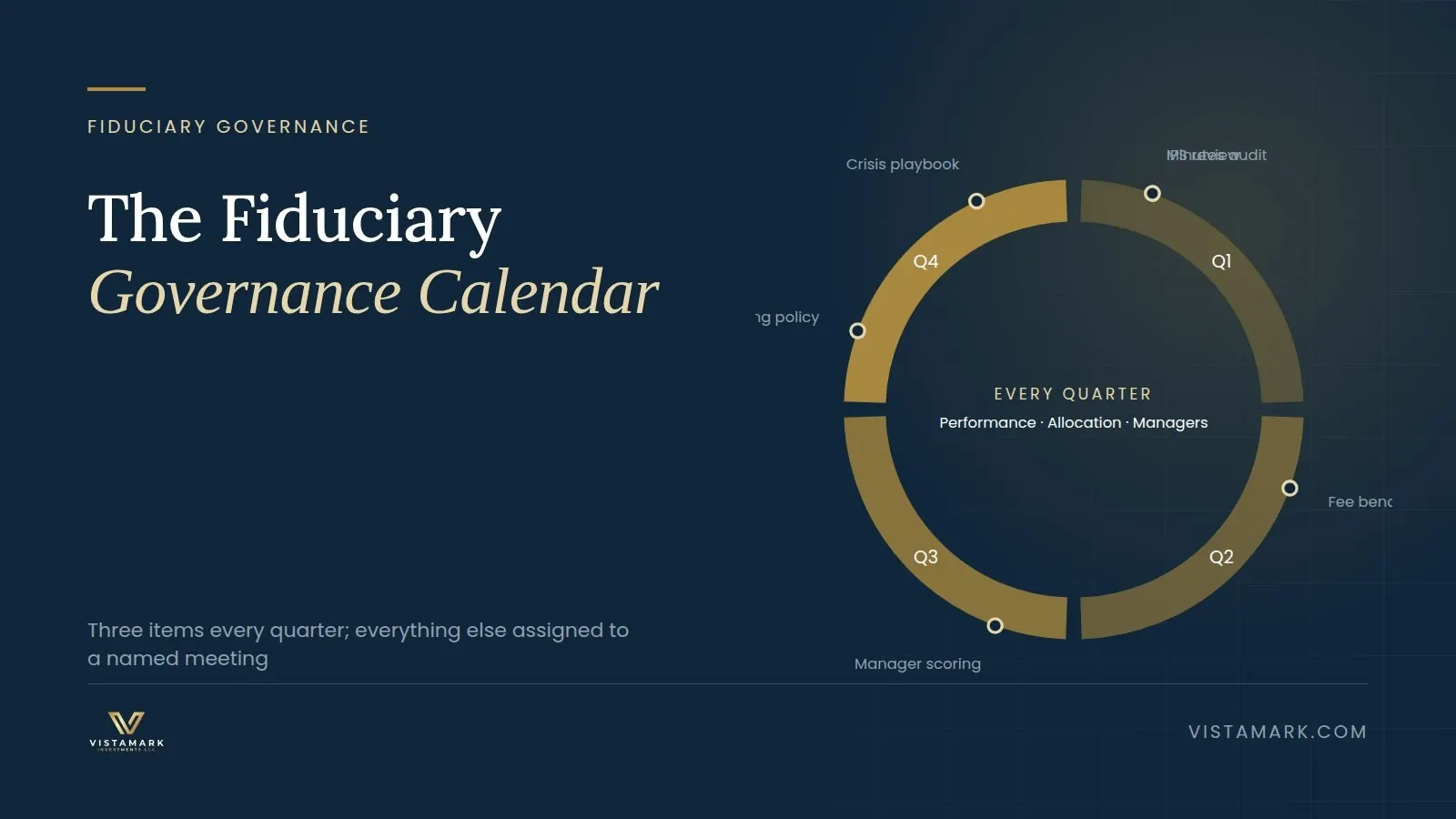
An investment committee should review three things every quarter: performance against policy benchmarks, the portfolio's position relative to its target allocation, and any change in the managers or vehicles it holds. Everything else belongs on a longer cycle. The most common governance failure at endowments and foundations is not neglect, it is repetition: committees re-litigate returns four times a year while the decisions that actually drive outcomes, spending policy, asset allocation, and advisor oversight, go years without a structured review.
A fiduciary governance calendar fixes that by assigning each responsibility to a specific meeting. This guide lays out what belongs on a quarterly agenda, what belongs on an annual one, and what belongs on a multi-year cycle, written for the board members and professional staff of institutional pools, typically in the $25MM to $250MM range, who have to run these meetings in ninety minutes.
What Is a Fiduciary Governance Calendar?
A fiduciary governance calendar is a written schedule that assigns every oversight duty of the investment committee to a particular meeting in the year. It is a simple document, often one page, and it usually lives as an appendix to the Investment Policy Statement.
Its purpose is evidentiary as well as practical. Under the prudent-investor standards that govern institutional funds in nearly every state, prudence is assessed by the process the fiduciary followed, not by the return the portfolio produced. A calendar is the cleanest available proof that a process exists. When a committee can point to minutes showing that fees were reviewed in the second quarter and the spending policy in the fourth, it has documented a system. When it can only point to four quarters of performance discussion, it has documented a habit.
The calendar also solves a staffing problem. Committee membership turns over, chairs rotate, and institutional memory is thin. A calendar tells a new member what the committee does and when, without requiring anyone to remember.
What Belongs on the Quarterly Agenda?
Four items, and they should take up most but not all of the meeting.
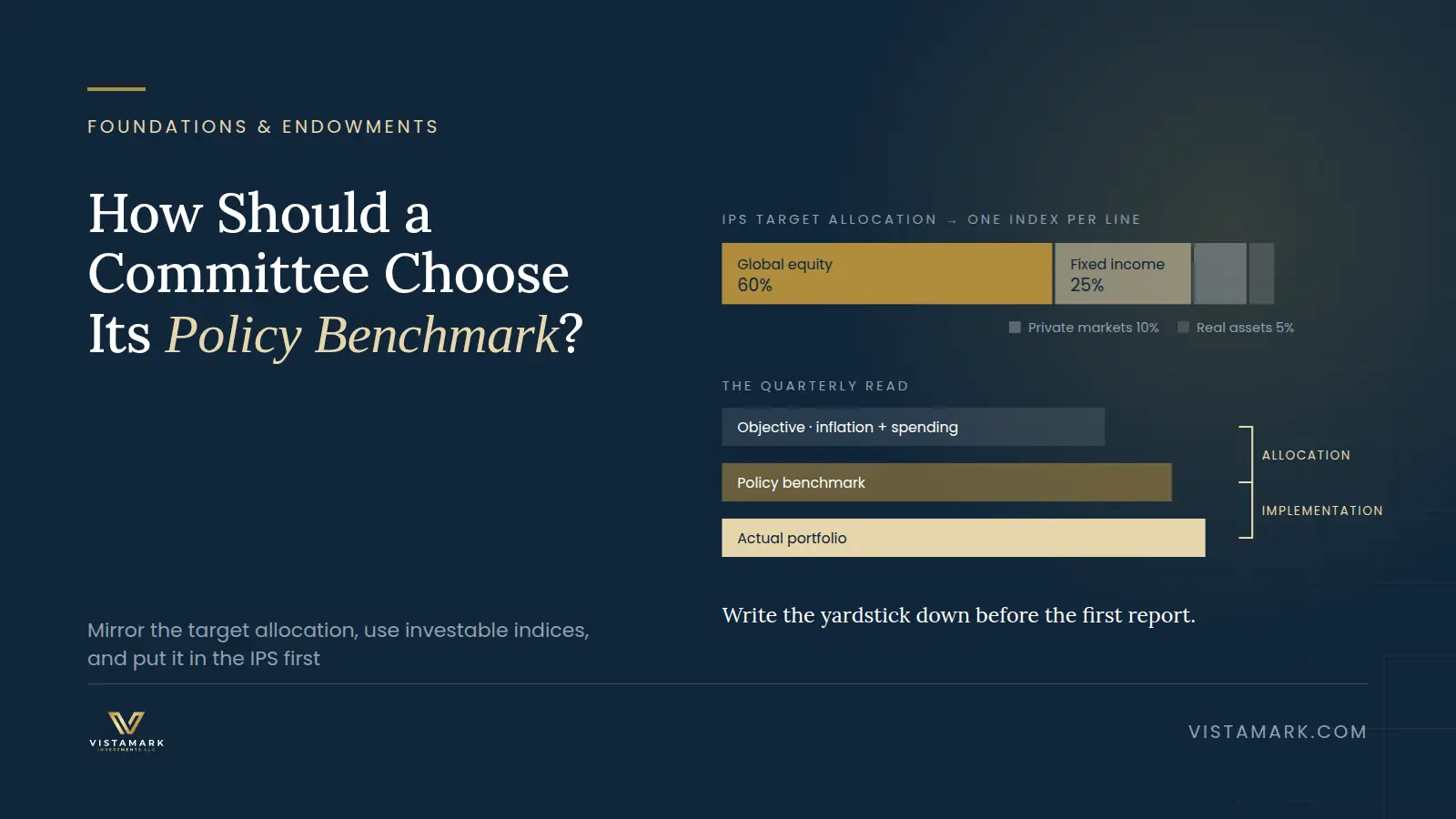
Performance against policy benchmarks. The relevant comparison is the portfolio versus its policy benchmark, meaning the blended index that reflects the target allocation in the Investment Policy Statement. That comparison answers the only question the committee can act on: is the portfolio doing what our own policy said it should do? Peer comparisons and headline index returns are context, not evidence. Review trailing periods long enough to be meaningful, with the emphasis on multi-year results rather than the most recent quarter.
Allocation versus targets and rebalancing. Every allocation has ranges around it. The quarterly question is whether any asset class has drifted outside its range and, if so, what was done or should be done about it. If the Investment Policy Statement grants rebalancing discretion to an advisor or OCIO, the committee reviews the trades that were made rather than authorizing each one. Recording that review is what turns delegated discretion into monitored discretion.
Manager and vehicle changes. Additions, terminations, and any material change at a manager: personnel departures, ownership changes, strategy drift, or a breach of guidelines. Committees often treat this as a footnote. It is closer to the heart of the oversight duty than performance is, because a manager problem is usually visible before it is expensive.
Liquidity and cash needs. What is the pool being asked to fund in the next twelve months, and can it fund that without selling anything at a bad time? For institutions with private-markets commitments, this is also where capital calls and distributions belong. Committees that hold illiquid assets should be able to state, in a sentence, how much of the portfolio could be converted to cash within a week and within a quarter.
What Should the Committee Review Once a Year?
Annual items are the ones with real leverage. Each should be assigned to a specific quarter so it cannot drift.
Spending policy. How much the institution appropriates from the pool, expressed as a rule rather than a negotiation, and what that rate implies for purchasing power over the long horizon. Statutory prudence factors in most states include the duration of the fund, inflation, expected total return, and the institution's other resources, which together read like the outline of a written spending policy.
Asset allocation review. Not a redesign every year, but a documented look at whether the target mix still fits the institution's spending rate, time horizon, and risk tolerance. Changes to the allocation should be rare. Confirming that no change is needed is itself a decision worth recording.
Fees and total cost. Advisory fees, manager expense ratios, custody, and any embedded costs, expressed in both basis points and dollars. Dollars are what force the conversation. Our guide on choosing the right investment advisor for your endowment and foundation covers what should sit alongside price in that evaluation.
Investment Policy Statement review. Read it, in full, once a year. The failure mode is not a bad policy, it is a stale one: benchmarks that no longer match the holdings, asset classes listed that the portfolio no longer owns, or ranges that were widened informally and never written down. Investment governance is the mechanism that connects a policy document to actual portfolio behavior, a theme we develop in how investment governance protects nonprofit missions.
Committee governance itself. Charter, membership terms, conflict-of-interest disclosures, and the annual audit or financial statement items that touch the investment pool.
What Belongs on a Multi-Year Cycle?
Three items, typically every three to five years.
A formal advisor or OCIO review. Distinct from the annual fee review, this is a structured evaluation of the relationship: service, reporting quality, responsiveness, the seniority of the people actually in the room, and whether the scope of delegation still matches what the committee needs. A review is not a search. Committees should be able to conduct one without implying dissatisfaction, and should be willing to run a full search when the review warrants it.
An asset-liability or spending-sustainability study. A modeling exercise that tests whether the current spending rate and allocation can coexist over the institution's horizon under a range of outcomes.
A private-markets pacing review, for institutions that allocate there. Commitment pacing determines whether a target allocation is actually reached and held, and it is a multi-year exercise by nature. The case for the allocation itself is covered in our piece on private equity in endowment and foundation portfolios.
What Should the Committee Stop Doing Every Quarter?
Three habits consume most of the time that annual items need.
Reacting to the last quarter's returns. A quarter is noise for a perpetual pool. The committee's job is to notice when results are inconsistent with the policy over multi-year periods, which is a different and less frequent alarm.
Re-deciding settled questions. If the allocation was reviewed and confirmed in the fourth quarter, revisiting it in the first quarter because markets moved is not diligence, it is drift.
Running the meeting as a manager-by-manager tour. Reviewing every holding every quarter guarantees that the portfolio-level questions arrive with ten minutes left. An exception-based format, where only managers on a watch list or in breach get discussion time, preserves the agenda for decisions.
How Do You Build the Calendar?
Start with the meetings you already hold. Most committees meet quarterly, which is the right cadence for institutions in the $25MM to $250MM band. Then assign the annual items across the four meetings so that no single meeting carries more than two: fees and Investment Policy Statement in one quarter, spending policy in another, asset allocation in a third, committee governance in the fourth. Add the multi-year items to the calendar in the year they come due, not as a general intention.
Then write it down, adopt it by motion, and attach it to the Investment Policy Statement. Ask the advisor or OCIO to build the meeting materials around it, so the pack that arrives before each meeting matches the agenda the committee actually set. A committee that can hand a successor a one-page calendar, a current policy statement, and minutes that show both were followed has met the standard, whatever the market did that year.
This article is general educational information and not legal advice. Requirements vary by state and by governing document, and counsel should confirm the specifics for your institution.
Sources and further reading
- Uniform Law Commission — Uniform Prudent Management of Institutional Funds Act (2006), final act
- Internal Revenue Service — Taxes on Failure to Distribute Income, Private Foundations (IRC §4942)
- U.S. Securities and Exchange Commission — Commission Interpretation Regarding Standard of Conduct for Investment Advisers, Release IA-5248 (2019)
For more information and personalized guidance, please feel free to reach out to Vistamark Investments. You can contact us at 312-895-3001, visit our website at vistamark.com, or send us an email to info@vistamark.com.
This article is part of our Foundation & Endowment Investment Guide, which collects our writing on the topic with answers to common questions.

Managing Partner and Founder; advises families, business owners and family offices through the VistaWealth Office™ and leads Vistamark’s private markets research. More about Sean →
This article is for informational and educational purposes only and does not constitute investment, legal, tax or accounting advice, or an offer or solicitation to buy or sell any security. Views are those of the author as of the publication date and are subject to change. Vistamark Investments is an SEC-registered investment adviser; see our disclosures.