The short answer. Thanksgiving dinner for 10 costs about 6% more than last year, according to the American Farm Bureau Federation. The turkey alone is up 10%. But one dinner is not the inflation rate: consumer prices rose 3.7% in the year to September, groceries rose only 1.8%, and the meal still costs 8.5% less than its 2022 peak. The bird is simply the most volatile holding on the table, and the main one that also puts you to sleep.
How much does Thanksgiving dinner cost in 2026?
$58.63 for 10, or $5.86 a person. Feeding the relatives is cheap. Listening to them for six hours is the expensive part. The meal is about 20% above 2019’s $48.91. The Farm Bureau prices the same menu every year, from turkey to pumpkin pie. A fixed basket is exactly how the government measures inflation, only with more pie and fewer footnotes.
Why is the turkey up 10% when the meal is up 6%?
Every basket has one item that refuses to behave, and this year it is the guest of honor. At $1.48 a pound, the turkey reflects a flock still recovering from two years of bird flu, plus tight inventories and strong demand (Farm Bureau). Higher diesel costs pushed up milk, rolls and cranberries, but the Farm Bureau says they likely spared the turkey, at least until next year. The turkey declined to comment, on advice of its veterinarian.
| Item | Change from 2025 | Analyst note |
|---|---|---|
| 16-lb turkey | +10.1% | The concentrated position everyone is talking about |
| Cranberries | +8.8% | Small cap, big year, still nobody’s favorite |
| Whole milk | +8.6% | The defensive asset that did not defend |
| Dinner rolls | +7.0% | Steady compounder, slightly overcooked |
| Frozen peas | -2.0% | Underowned and unloved, as usual |
| Frozen pie crusts | -2.7% | Biggest dollar decline on the table, at 9 cents |
| Veggie tray | -3.7% | The value stock: cheap, healthy, ignored |
| Whole meal for 10 | About +6% | The benchmark |
Figures are from the Farm Bureau’s 2026 survey. The analyst notes are not.
Does a pricier turkey mean inflation is running hot?
So is the bird a warning sign? Not on its own. In the 12 months to September, the CPI rose 3.7%, but core prices rose 2.6% and food at home just 1.8%. Energy, up 20.4%, did most of the damage (BLS). The pricier part of this year’s dinner may be running the oven and driving to the in-laws, and only one of those is optional.
Why can’t anyone tell you October’s inflation rate?
Reading inflation is harder when some of the evidence is missing, and this year some of it is. The October 2025 numbers were never collected: during last fall’s lapse in federal appropriations, the Bureau of Labor Statistics gathered no data, so its latest release shows dashes where October’s 12-month changes should be. It is the government’s version of “the dog ate my homework,” except the dog was Congress. Sometimes the honest answer is a blank cell. If an uncle announces October’s inflation rate with great confidence, ask for his source. Then ask him to pass the rolls, which are up 7%.
Is a 2026 turkey even the same turkey?
Even complete data has a problem: the thing being priced keeps changing. The government adjusts some prices for quality, a practice called hedonic adjustment: a television that costs the same but gets better counts as a price cut. The Farm Bureau makes no such adjustment, though the turkey has a case. The average bird has roughly doubled since 1960, from about 15 pounds to about 31. Grandma’s turkey fit in the oven. Today’s arrives with a forklift and a liability waiver. It is the only guest at the table whose weight gain counts as a productivity improvement.
Health care is the serious version. The country spent about $150 a person in 1960, roughly $1,500 in today’s dollars, and $15,474 in 2024 (CMS). But in 1960 a failing heart earned you bed rest, a sympathetic look and a doctor who smoked during the appointment. Today it gets a stent and a robot, plus a parking bill that costs more than the 1960 surgery did. Not every added dollar bought better medicine, but comparing those price tags without adjusting for quality is like pricing a 1960 television against a new one.
What does the turkey know that investors forget?
The modern turkey is bigger. It is not wiser. Every morning the farmer brings food, and every uneventful day is more evidence that the farmer is a friend. By the Wednesday before Thanksgiving, the turkey has never felt safer: its confidence peaks on the worst possible day.1
Bull markets do the same to investors. Each calm year feels like proof the next will be calm too, right up until the one that isn’t. A long quiet stretch tells you a great deal about the past and very little about the farmer. The turkey never studied market history. Judging by every market top, neither did a lot of investors.
What does the pardoned turkey teach about track records?
A lucky few escape. Every year the President pardons a turkey or two, and they retire to a farm, photographed and famous. Turkeys are not the only ones hearing the word this week: the President called a pardon “always an option” for a certain chip CEO who, like the turkey, has not been charged with anything. Judge the species by the pardoned birds and a turkey’s prospects look excellent. The other 198 million raised this year are unavailable for comment (USDA). Investors make the same mistake with track records: the funds still around to advertise their returns are the pardoned ones. The rest were quietly closed, and nobody held a ceremony.
What does the plate say about a portfolio?
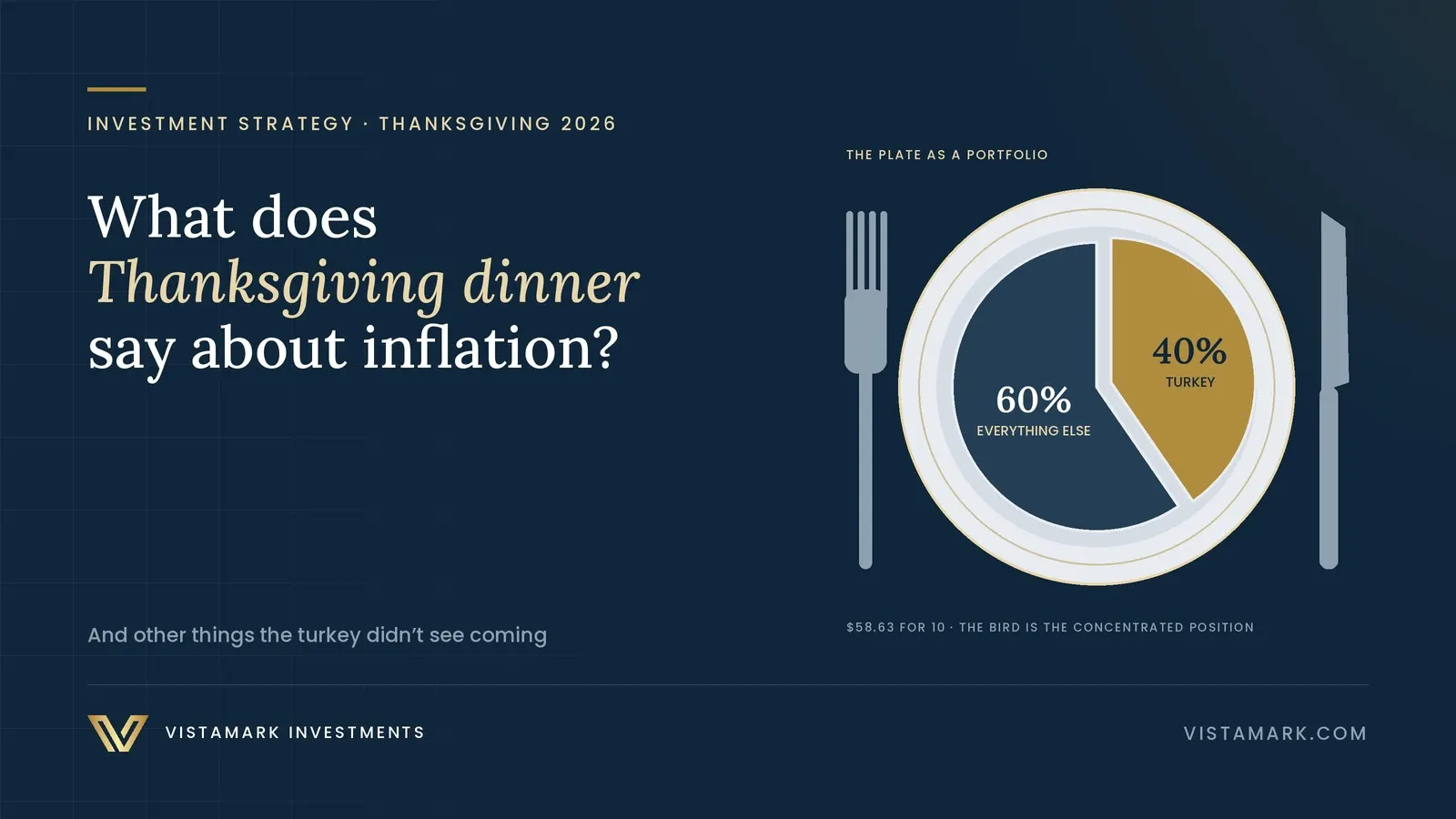
Survivors aside, the turkey’s real lesson is how much of the meal it is. The bird is about 40% of the cost, the kind of concentration an investment committee would flag before the appetizers. Its 10% rise pulled up the whole meal, while the cheaper veggies, peas and pie crust barely registered. Nobody serves a plate that is all turkey, and few families should own a portfolio that is mostly one stock, one sector or one property. Chasing last year’s favorite works about as well in markets as in kitchens: the dish everyone raved about gets doubled, and by Sunday it is a leftover nobody will make eye contact with.
What did the 1959 cranberry scare teach about panic?
Concentration is one way to get hurt. Panic is another, and the cranberry has the scars. Seventeen days before Thanksgiving 1959, a federal official warned that a small part of the crop was tainted with a weed killer. Most berries were fine, but sales collapsed nationwide. One alarming headline, and everyone sold the whole position. Investors will recognize the move. The cranberries recovered; this year they are up 8.8%, and the canned kind still holds its shape better than most portfolios in a selloff.
How does food inflation compound?
Whatever happens to any one dish, food inflation works the same way over time: quietly. From $48.91 in 2019 to $58.63 today is roughly 2.6% a year, a pace nobody notices until they look back. A hypothetical household spending $1,000 a month on groceries would pay about $1,486 in 20 years at 2% inflation and about $1,806 at 3%. That $320 gap is why long-term plans should assume rising prices. Your grandchildren will someday complain about the price of pie, and they will be right. Illustrative, not a forecast, and not a reason to buy canned yams in bulk.
For the latest on markets, rates and energy, see the weekly Market Compass.
What is the one money conversation worth having?
Which is why the most valuable thing at the table may not be on it. Several generations in one room is a natural moment for a short, low-pressure talk: where the important documents are, who would step in if help were needed, and what matters most to the family about its money. Ten minutes over pie is a fine start. No agenda, no account balances, no slides, and ideally no opening line that begins “So, about the will.” For the longer version, see How Should a Family Run a Meeting About Money?, ideally not while the turkey is resting or anyone is holding a carving knife.
Where does Vistamark fit?
Vistamark is an independent, employee- and partner-owned investment firm headquartered in Hinsdale, Illinois, in the Chicago area. Through the VistaWealth Office™, it helps families build diversified portfolios, set spending policies that account for inflation, and rebalance by rule, coordinated with each family’s tax and estate advisors. Matthew Rice, CFA, CAIA, is Vistamark’s Chief Investment Officer. He is metaphorically overweight the veggie tray, though you won’t find many vegetables on his actual plate on Thanksgiving. This article is general information, not investment advice.
A note of thanks
One last thing. To every client who placed their confidence in us in 2026: thank you. Trust is the one item in this article that cannot be priced, and all of us at Vistamark are grateful for yours, this week and every week. Consider this our most concentrated position of the year: gratitude, 100% allocated to you.
From our families to yours, we wish you a very happy and joyful Thanksgiving.
Matt
1 The turkey is borrowed from Nassim Nicholas Taleb, The Black Swan: The Impact of the Highly Improbable (2007), who in turn adapted it from Bertrand Russell’s chicken. ↩
Sources
- American Farm Bureau Federation: Cost of Thanksgiving Dinner Increases, Remains Below 2022 Record High (November 18, 2026)
- American Farm Bureau Federation Market Intel: Thanksgiving Dinner Cost Ticks Upward in 2026
- American Farm Bureau Federation Market Intel: Turkey Farmers Recovering From Two Years of Losses
- Associated Press: Americans Will Pay More for Thanksgiving Dinners This Year, Farm Bureau Says (November 19, 2026)
- U.S. Bureau of Labor Statistics: Consumer Price Index, September 2026 (released October 14, 2026)
- U.S. Bureau of Labor Statistics: Consumer Price Index, October 2026 (released November 10, 2026)
- CNBC: Thanksgiving Dinner Still Costs Less Than $50 on Average (2019 Farm Bureau survey, $48.91)
- Centers for Medicare & Medicaid Services: National Health Expenditure Data, 1960–2024
- USDA National Agricultural Statistics Service: Turkeys Raised (September 2026)
Market Compass · weekly
Get the Compass by email
One concise recap of the week’s market-moving events and what to watch next, written by our CIO at the end of each market week.

Founder and CIO of Vistamark; as CIO of Fiducient Advisors, oversaw investment strategy for more than $260 billion in client assets. More about Matthew →
This article is for informational and educational purposes only and does not constitute investment, legal, tax or accounting advice, or an offer or solicitation to buy or sell any security. Views are those of the author as of the publication date and are subject to change. Vistamark Investments is an SEC-registered investment adviser; see our disclosures.