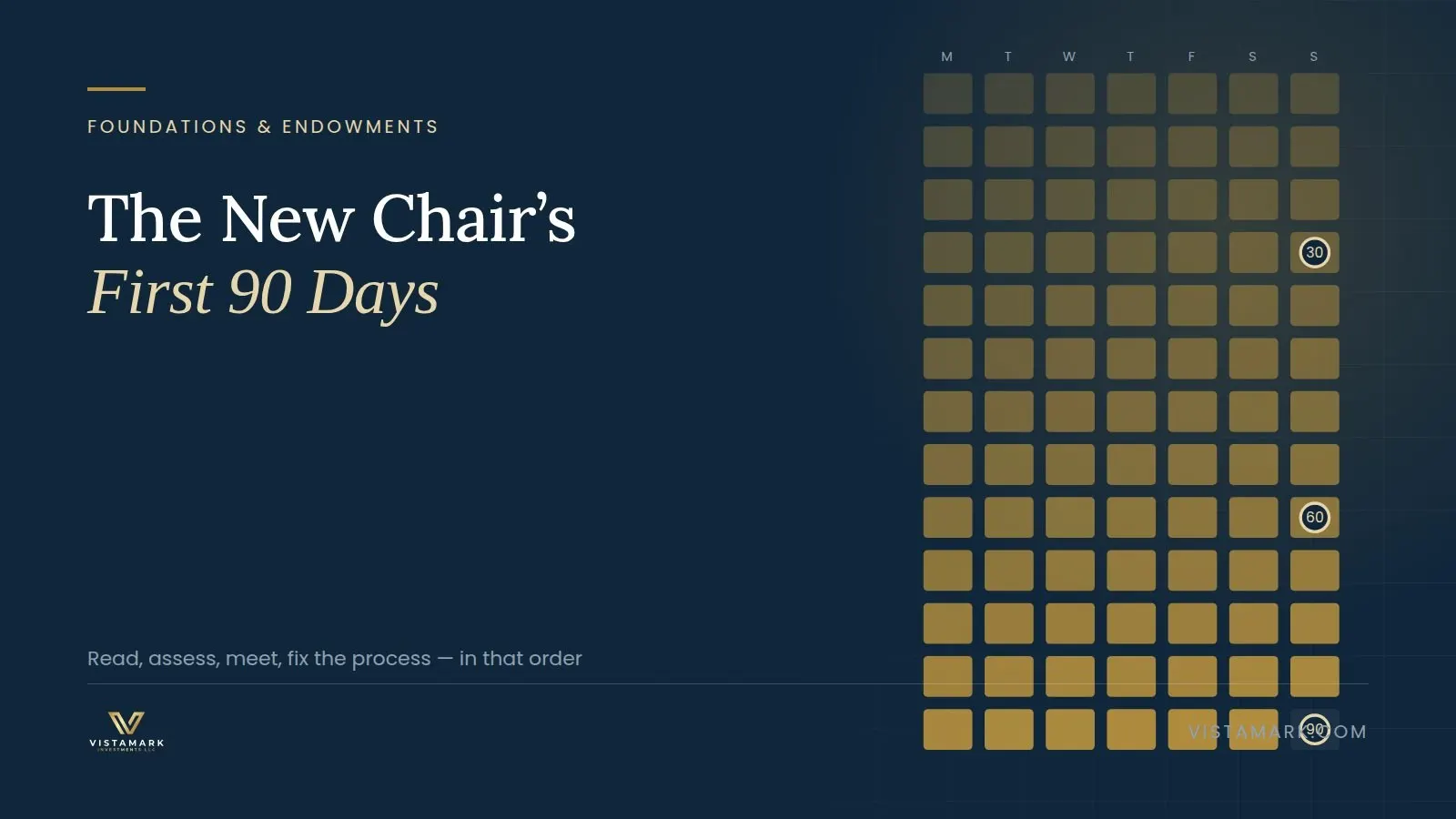
A new investment committee chair should spend the first 90 days understanding what the committee has already decided before changing any of it. That means reading the governing documents, learning how the portfolio is actually positioned against the policy, meeting the people who carry out the committee's decisions, and fixing the committee's own process where it is weak. The one thing a new chair should avoid in the first quarter is a change to the asset allocation or the advisor relationship made before the chair knows why the current arrangement exists.
This guide is written for the incoming chair of an investment committee at an endowment, foundation, or nonprofit pool, and for the board members and professional staff who support that person. It is aimed at institutions with roughly $25 million to $250 million in investable assets, where the chair is almost always a volunteer, the committee meets four to six times a year, and there is usually no internal investment staff standing between the chair and the portfolio. At that size the chair's habits become the committee's habits, which is why the first 90 days matter more than they look.
Why Do the First 90 Days Matter So Much?
A committee chair changes the way a committee works without ever taking a vote. The chair sets the agenda, decides how long each item gets, chooses what the advisor is asked to prepare, and determines whether a disagreement is resolved in the room or deferred for another quarter. Over two or three years those choices shape the portfolio as surely as any allocation decision.
The first 90 days matter because they set the pattern. A chair who arrives and immediately proposes a new allocation, a new advisor, or a new manager lineup teaches the committee that change is the chair's job. A chair who arrives and asks what the committee is trying to achieve and how well it is doing teaches the committee that its job is oversight. The second pattern is much harder to establish later once the first has taken hold.
There is a practical reason as well. The incoming chair inherits decisions made by people who may no longer be in the room. The reasons behind the current allocation, the spending rate, the choice of advisor, and the manager roster often live in old minutes or in the memory of a departed member. Changing any of them before those reasons are understood risks reversing a decision that was right for a reason the chair has not yet learned.
What Should the New Chair Read First?
The chair's reading list is short and should be finished in the first 30 days. Four documents carry nearly everything the chair needs.
The Investment Policy Statement (IPS). This is the committee's contract with itself: the return objective, the risk tolerance, the target allocation and ranges, the spending policy, the rebalancing rules, and the standards for evaluating managers and the advisor. If the chair reads nothing else, the chair should read this, and should ask when it was last reviewed. An IPS that has not been revisited in several years is the first item for the agenda.
The committee charter. This states what authority the board has delegated to the committee, what the committee may decide alone, and what must return to the full board. Chairs are regularly surprised to learn that the committee's authority is narrower, or broader, than the committee has been assuming.
The last eight quarters of minutes. Minutes show what the committee actually talks about, which is often different from what the IPS says it should. They also record the decisions the chair now owns and, if the minutes are good, the reasons behind them.
The advisor agreement. The chair should know what the advisor has been engaged to do, whether the arrangement is discretionary or non-discretionary, what it costs, and what the termination terms are. A chair does not need to have an opinion about the advisor in the first 90 days, but the chair does need to know the terms of the relationship.
Two more documents are worth the time if they exist: the most recent audited financial statements, which show how the investment pool relates to the organization's overall finances, and any donor restriction schedule, which tells the chair how much of the pool is actually free to be spent under the state's prudent-management statute. Board members who want the plain-English version of that statute can start with UPMIFA in Plain English.
How Should the Chair Assess Where the Portfolio Stands?
Reading the policy tells the chair what the committee intended. The second step, in the first 30 to 60 days, is finding out how far reality has drifted from it. The chair should ask the advisor or staff for a single page answering five questions.
Is the portfolio inside its policy ranges today? If any asset class is outside its range, the chair should ask how long that has been true and whether a rebalancing decision was made or simply deferred.
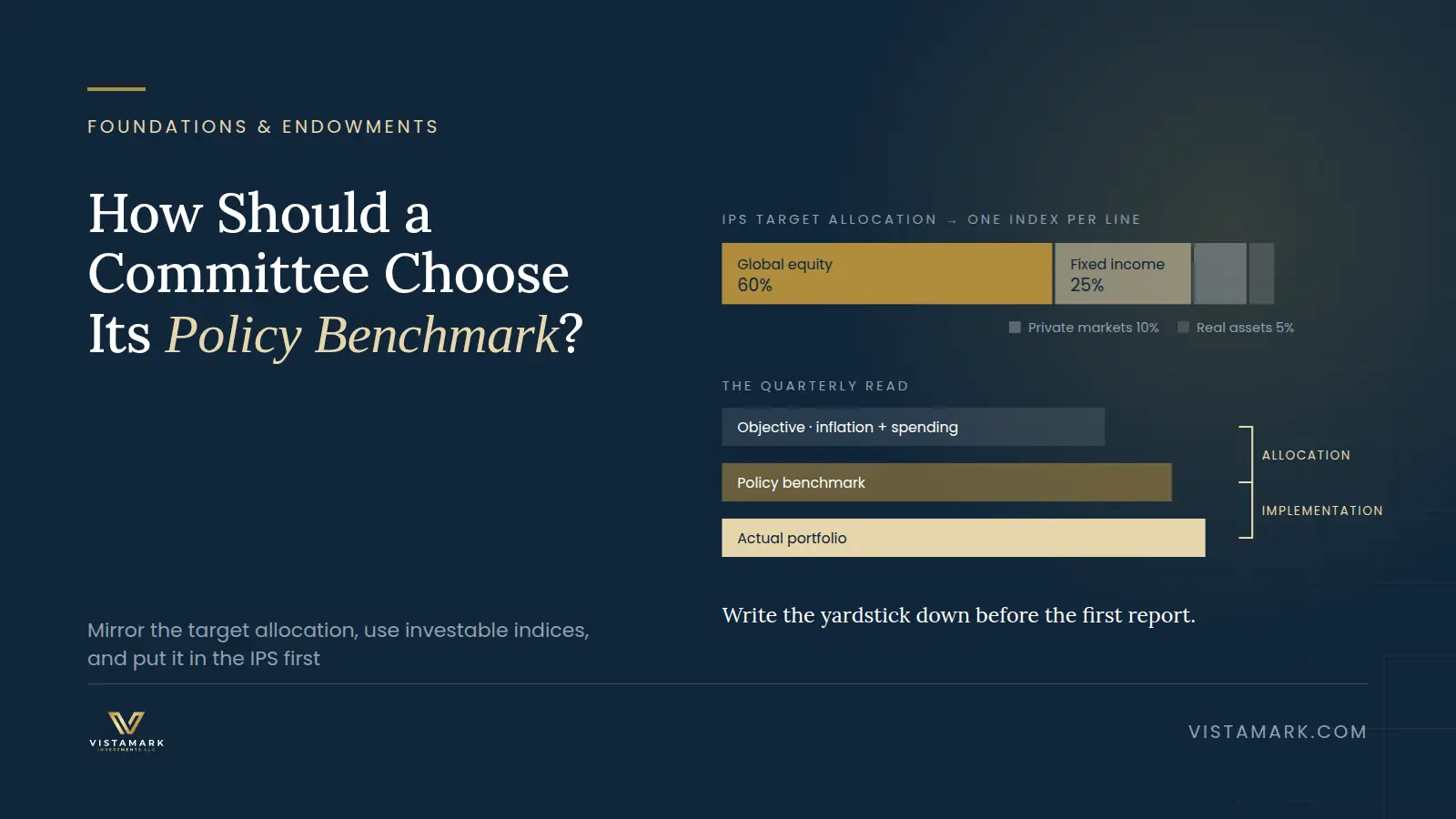
How has the portfolio performed against the policy benchmark over one, three, five, and ten years? The comparison that matters is against the benchmark the IPS defines, not against a peer group or the stock market. If the committee has never adopted a policy benchmark, that is a finding in itself.
What is the current spending rate, and what has the pool's real (inflation-adjusted) value done over the last decade? A pool that is spending more than it earns after inflation is shrinking in purchasing power, and the committee should know that before it is asked to approve next year's distribution.
What is committed and what is liquid? If the pool holds private funds, the chair should know how much capital is still unfunded and how many years of spending the liquid portion covers.
Is any manager currently on a watch list, and why? A manager under review is a decision the chair will be asked to make soon, and the chair should understand the case before the meeting where it comes up.
None of these questions requires the chair to be an investment professional. They require the chair to insist on a clear answer, and to notice when one is not available.
Who Should the Chair Meet, and What Should the Chair Ask?
Documents describe the committee; people run it. In the first 60 days the chair should hold short one-on-one conversations with four groups.
Each committee member. The chair should ask what each member thinks the committee does well, what it avoids, and what they would change. These conversations reveal the disagreements that never surface in a meeting, and they tell the chair which members have expertise the committee has not been using.
The outgoing chair, where possible. The most useful question is which decisions were close calls, and why the committee landed where it did.
The executive director and the chief financial officer. The chair should learn how the investment pool fits into the organization's budget, how much the organization depends on the annual distribution, and whether any large inflows or outflows are expected. A capital campaign, a planned building purchase, or a large bequest changes the liquidity picture and the committee should hear about it early.
The advisor. This is the meeting most new chairs handle worst, either by treating it as a performance review or by treating it as a sales presentation. It should be neither. The chair should ask the advisor to explain the current positioning in the advisor's own words, to name the decisions the advisor thinks the committee has been putting off, and to describe what the advisor needs from the committee to do the job well. The chair should also ask who, specifically, does the work on the account and how often the committee will see that person. Committees that later find themselves in an advisor search, as described in Choosing the Right Investment Advisor for Your Foundation or Endowment, often trace the decision back to an answer to that question.
What Should the Chair Fix About the Committee's Own Process?
By day 60 the chair usually has a clear view of where the committee's process is weak, and process is the one area where a new chair should act quickly. Four fixes are common.
Adopt an annual agenda. Most committees react to whatever the advisor brings. A better practice is a written calendar that assigns each recurring task, such as the IPS review, the spending decision, the advisor evaluation, and the manager reviews, to a specific meeting each year. That way nothing important depends on someone remembering to raise it. A quarter-by-quarter model is at The Fiduciary Governance Calendar.
Change the meeting structure. If most of each meeting is spent on a performance recap, the committee is spending its time on the part of its job that requires the least judgment. The chair can move the performance report to a consent item, circulated in advance, and spend the meeting on decisions.
Upgrade the minutes. Minutes should record not just what was decided but why, and what alternatives were considered. This is the committee's best protection under the prudence standard, and it is the document the next chair will need most.
Check the composition. If the committee is missing a skill it needs, or is carrying a member who no longer attends, the chair should raise it with the board chair now rather than in year two.
What Should the Chair Not Do in the First 90 Days?
The temptation for a new chair is to demonstrate value by changing something visible. Three changes should wait.
Do not change the asset allocation. Allocation is the largest decision the committee makes and the one that most depends on the return objective, the spending rate, and the risk tolerance written in the IPS. If the chair thinks the allocation is wrong, the right first step is a formal IPS review with the full committee, not a motion at the chair's second meeting.
Do not replace the advisor. An advisor change is a year-long project that consumes the committee's attention and carries real transition cost. If the chair has concerns, the first 90 days are for documenting them and for asking the advisor directly. A review can be scheduled for later in the year with criteria the committee agrees in advance.
Do not fire a manager on recent returns. A manager review that is already underway should follow whatever process the IPS defines. A new chair who overrides that process on arrival signals that the process does not matter.
The exception to all three is a real breach: a manager that has violated its guidelines, an advisor that has failed to disclose a conflict, or a portfolio that is far outside its ranges with no plan to correct it. Those require action, and the chair should act. Everything else can wait for the chair to understand it.
What Does a Good 90-Day Plan Look Like on Paper?
Written down, the plan fits on one page.
Days 1 to 30: read the IPS, the charter, the minutes, and the advisor agreement. Request the five-question portfolio summary. Meet the outgoing chair and the executive director.
Days 31 to 60: meet each committee member and the CFO. Meet the advisor and ask for the deferred-decisions list. Identify the gaps in the committee's process.
Days 61 to 90: propose the annual agenda calendar to the committee. Adjust the meeting format. Set a date for the next IPS review. Report to the board chair on what the committee is doing well and where the chair intends to focus.
At the end of the 90 days the chair should be able to explain, in a few sentences, what the pool is for, how it is positioned, how it is performing against its own policy, who is responsible for what, and which decisions the committee will need to make in the coming year. A chair who can do that has earned the right to change things. A chair who cannot should keep asking questions.
Where Does the Advisor Fit in the Transition?
A good advisor should make the chair's first 90 days easier, not harder. The chair should expect the advisor to provide the documents and the portfolio summary without being chased, to brief the chair before the first meeting the chair runs, and to be candid about the decisions that have been deferred. A chair who has to build that picture alone, or who receives a stack of quarterly reports in place of a summary, has learned something useful about the relationship. For endowment and foundation (E&F) organizations in the $25 million to $250 million range, where the advisor is often the only investment professional the committee regularly speaks with, that support in the transition is one of the more telling measures of the relationship's quality.
Sources and further reading
- Uniform Law Commission — Uniform Prudent Management of Institutional Funds Act (2006), final act
- U.S. Securities and Exchange Commission — Commission Interpretation Regarding Standard of Conduct for Investment Advisers, Release IA-5248 (2019)
- U.S. Securities and Exchange Commission — Investment Adviser Public Disclosure (look up any adviser’s Form ADV)
For more information and personalized guidance, please feel free to reach out to Vistamark Investments. You can contact us at 312-895-3001, visit our website at vistamark.com, or send us an email to info@vistamark.com.
This article is part of our Foundation & Endowment Investment Guide, which collects our writing on the topic with answers to common questions.

Managing Partner and Founder; advises families, business owners and family offices through the VistaWealth Office™ and leads Vistamark’s private markets research. More about Sean →
This article is for informational and educational purposes only and does not constitute investment, legal, tax or accounting advice, or an offer or solicitation to buy or sell any security. Views are those of the author as of the publication date and are subject to change. Vistamark Investments is an SEC-registered investment adviser; see our disclosures.